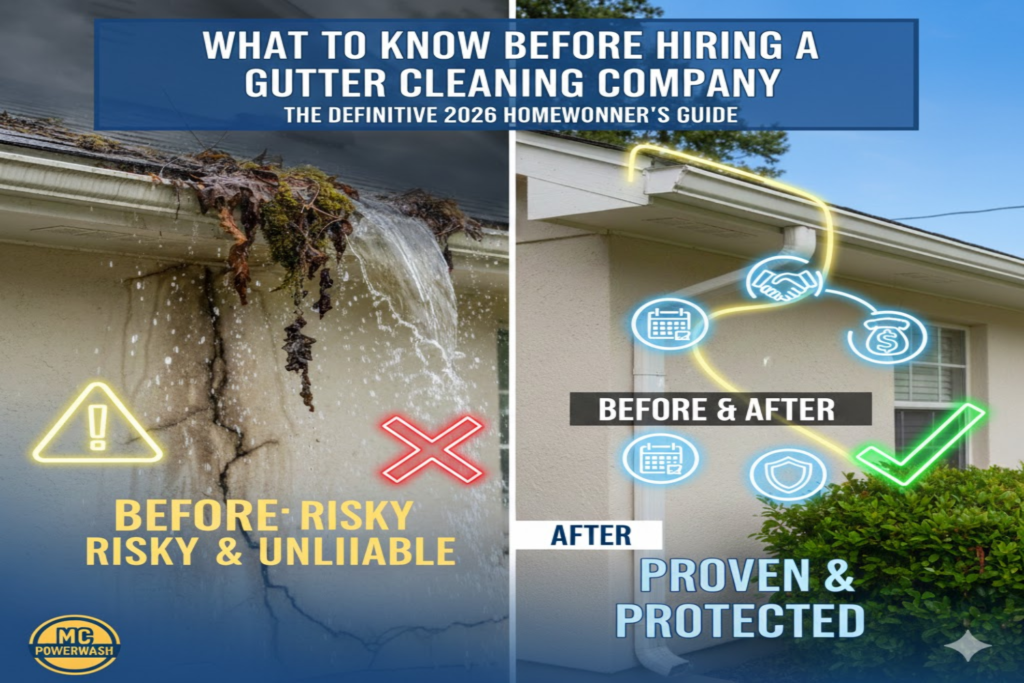
Hiring a professional to scale your roof is a decision that involves significant liability and structural stakes. Many homeowners view gutter cleaning as a simple “commodity” service, assuming that anyone with a ladder can perform the task safely. However, the reality of property maintenance is far more complex.
Clogged gutters are the primary cause of foundation failure, basement flooding, and roof rot. In a high-stakes real estate market like Los Angeles, failing to vet your contractor properly can lead to a financial catastrophe that far exceeds the cost of the cleaning itself. This guide serves as a masterclass in consumer protection, technical standards, and the legal nuances of hiring exterior service professionals.
1. The Legal Risks of the “Gig Economy” Gutter Cleaner
The first thing every homeowner must understand is the legal landscape of domestic service. When you hire an individual to work on your property, you are, in many jurisdictions, assuming a level of employer liability. If that individual is not properly insured, you—the homeowner—become the primary source of compensation in the event of an accident.
The Hidden Dangers of General Liability Insurance
Most homeowners ask, “Are you insured?” and accept a simple “Yes” as an answer. This is a mistake. General Liability insurance only covers damage to your property—it does not cover the person doing the work. If a worker falls from a ladder and breaks their leg, their General Liability policy will not pay for their medical bills. Without Workers’ Compensation, the injured worker’s attorney will look directly at your homeowners’ insurance or your personal assets to cover six-figure medical costs and long-term disability.
Why You Must Verify Workers’ Compensation
Before any ladder touches your house, you should request a Certificate of Insurance (COI) sent directly from the contractor’s insurance agent. This document must explicitly show “Workers’ Compensation” coverage. In the busy service hubs of Los Angeles, many small operators skip this expensive coverage to offer lower prices. By hiring them, you are essentially gambling your home’s equity to save $50 on a gutter cleaning.
2. Technical Standards: How a Professional Clean Actually Works
Not all gutter cleaning is created equal. To reach the highest standard of property protection, a company must follow a specific technical protocol. If they “scoop and go” without checking the secondary systems, your home is still at risk.
Manual Scooping vs. Mechanical Removal
While leaf blowers are fast, they are often messy and ineffective for “roof sludge”—the wet mixture of decomposed organic matter and heavy asphalt shingle granules. Manual hand-scooping into buckets is the most thorough method. It allows the technician to feel for loose brackets and ensures that no debris is accidentally blown into your attic vents or onto your clean siding.
The Downspout Integrity Test
The gutter is only half of the system. The downspout is where the real clogs happen, specifically at the “elbows” (the curved sections). A professional company will always perform a “high-flow flush” using a garden hose. This test confirms that water is not just leaving the gutter, but successfully exiting the downspout at the ground level. If water backs up during this test, it indicates an underground clog that requires specialized snaking tools.
3. Protecting Your Home’s Structural Integrity During Service
The act of cleaning gutters can ironically cause damage if the company doesn’t use the correct equipment. Aluminum and copper gutters are thin and easily deformed by the weight of a heavy extension ladder.
Ladder Stabilizers and Gutter Guards
A reputable company will never lean a ladder directly against your gutters. Instead, they use “Ladder Stabilizers” (also called standoffs). these wide-arm attachments rest on the roof or the siding, keeping the ladder’s weight off the metal gutters entirely. If you see a contractor showing up with a bare ladder and leaning it against your aluminum gutters, stop them immediately—they are likely bending your gutters out of their “pitch,” which will cause water to pool and breed mosquitoes.
The Role of the Fascia Board
The fascia is the wooden board that your gutters are mounted to. During a professional cleaning, the technician should be inspecting the fascia for “soft spots” or rot. In the dry, sun-drenched climate of Los Angeles, wood can dry out and crack, allowing water to seep behind the gutter and rot the rafter tails. A professional will notify you of these issues before they become a $10,000 structural repair.
4. Pricing Transparency and the “Low-Ball” Trap
Pricing for gutter cleaning is not standardized, which allows unscrupulous companies to use “bait and switch” tactics. Understanding how estimates are generated will help you spot a scam.
Factors That Influence Your Quote
A legitimate estimate is based on more than just the size of your house. Contractors look at:
- The Pitch of the Roof: Steeper roofs require “steep-slope” safety harnesses and take twice as long to clean.
- The “Drop” Frequency: If you have pine trees (which drop needles year-round) versus oak trees, the debris density changes the labor time.
- Underground Drains: If your gutters drain into underground PVC pipes, cleaning these is a specialized task that usually carries an extra fee.
Avoiding Hidden Surcharges
Always ask if the quote includes debris removal. Some companies will clean your gutters but leave piles of wet, stinking leaves in bags on your curb or, worse, scattered in your flower beds. Ensure your contract specifies that all debris will be hauled away or placed in your green-waste bin according to local Los Angeles sanitation ordinances.
5. The Professional Gutter Cleaning Checklist
Before you sign a contract, use this checklist to verify the company’s professionalism.
| Feature | Red Flag (Amateur) | Green Flag (Professional) |
| Estimate Type | “About $150” over the phone | Detailed written quote after viewing property |
| Photos | None provided | Before and after photos of every side |
| Equipment | Household ladder, no gloves | Stabilizers, buckets, safety harnesses |
| Payments | Cash only / Upfront | Invoice sent after work is completed |
| Warranty | “Call me if there’s a problem” | 30-day “No-Overflow” Guarantee |
6. Maintenance Myths and the “Gutter Guard” Deception
Many homeowners hire companies specifically to install “gutter guards” so they never have to clean again. This is one of the biggest myths in home maintenance.
Why “Maintenance-Free” Does Not Exist
No gutter guard is 100% effective. Small debris like shingle grit, pine needles, and pollen will eventually find their way through the mesh. Over time, this creates a “sludge” at the bottom of the gutter that can only be cleaned by removing the guards. A professional company will be honest with you: guards reduce the frequency of cleaning, but they do not eliminate the need for an annual inspection.
Seasonal Timing
When should you hire a company? If you wait until the first big rain, every company in the city will be booked out for weeks. Proactive homeowners schedule their cleanings in late spring (to clear seeds and blossoms) and late fall (to clear leaves). In Los Angeles, it is especially important to have a clean system before the winter “atmospheric river” storms, which can dump months of rain in a single afternoon.
7. The Science of Water Displacement: Why This Matters
To truly appreciate the value of a professional company, you have to understand the volume of water your roof handles. For every inch of rain that falls on a 1,000-square-foot roof, nearly 600 gallons of water are collected.
Hydrostatic Pressure and Foundations
If your gutters are clogged, those 600 gallons pour directly onto the soil next to your foundation. This causes “hydrostatic pressure,” where the weight of the water-logged soil pushes against your concrete foundation. This pressure leads to cracks, bowing walls, and eventually, catastrophic structural failure. A professional gutter cleaner isn’t just a “cleaner”—they are a foundation protection specialist.
8. Frequently Asked Questions (FAQs)
Q: Is it okay if the company uses a leaf blower to clean my gutters?
A: While blowers are fast, they are generally discouraged for high-quality residential work. Blowers often miss the heavy “sludge” at the bottom and can blow debris into your attic vents or under your shingles. Manual cleaning is always superior.
Q: Do I need to be home when the company arrives?
A: Most companies do not require you to be home as long as they have access to a water spigot. However, you should ensure that pets are inside and that the company provides digital “Before and After” photos as proof of completion.
Q: What should I do if the company finds a leak?
A: A professional company will document the leak with a photo and offer a repair estimate. Usually, this involves re-sealing a miter joint or replacing a “drop” outlet. If they suggest replacing the whole system for a small leak, get a second opinion.
Q: How do I know if a company’s reviews are real?
A: Look for “Verified Purchase” reviews and check for a mix of ratings. Be wary of companies that have 500 reviews that are all 5-stars with very little text. Real reviews often mention specific technicians and the challenges of the specific property.