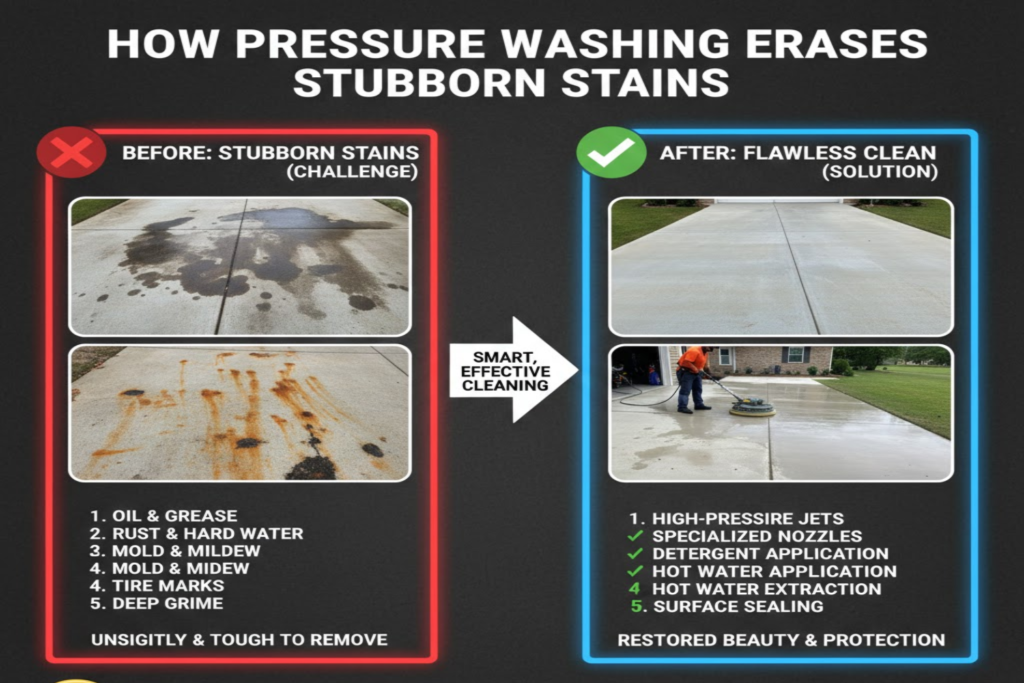
An oil stain on a driveway is more than just a cosmetic blemish; it is a structural and safety liability. For homeowners, particularly those in high-traffic urban environments like Los Angeles, these dark, slick patches are a constant battle. Oil is a “non-polar” hydrocarbon, meaning it does not naturally mix with water. To make matters worse, driveway materials like concrete and pavers are essentially “hard sponges.”
The “Sponge Effect”
At a microscopic level, concrete is filled with tiny interconnected pores and capillaries. When a vehicle leaks motor oil or transmission fluid, gravity and capillary action pull the oil deep into the substrate. Over time, these hydrocarbons begin to break down the binders in the concrete or asphalt, leading to “spalling” or crumbling. Furthermore, a fresh oil leak creates a significant slip hazard, especially during the rare but slick rainy days in Los Angeles.
This guide moves beyond surface-level cleaning. We are exploring a professional-grade roadmap that combines molecular chemistry with high-velocity kinetic energy to extract oil from the heart of your driveway.
2. The Molecular Battle: How Water and Oil Interact
To understand why pressure washing is necessary, we must first understand the chemistry of the enemy.
Non-Polar vs. Polar Molecules
Water is a polar molecule—it has a positive and negative charge, similar to a magnet. Oil, however, is non-polar. In the world of chemistry, “like dissolves like.” This is why a standard garden hose—no matter how long you spray—will simply see water beads bouncing off the oil’s surface. The water cannot “grip” the oil to lift it away.
+1
Breaking Surface Tension
Pressure washing introduces mechanical force. By hitting the oil at 3000 PSI, you are physically shattering the oil’s surface tension and forcing water into the pores where the oil hides. However, in a climate like Los Angeles, the sun plays a detrimental role. The intense California UV rays and heat “bake” the oil, causing it to oxidize and harden within the concrete pores. This makes the oil even more resistant to standard pressure, necessitating the use of specialized chemical “pre-treatments.”
3. The Role of Chemical Pre-Treatment: The Real Hero
If pressure is the “muscle,” then chemicals are the “brain” of the operation. Without a proper degreaser, you are likely just spreading the oil thinner across the driveway rather than removing it.
Degreasers vs. Detergents
- Detergents: Designed to lift surface dirt and organic matter (pollen, dust).
- Degreasers: Specifically formulated to break down the molecular bonds of heavy fats, oils, and greases.
The Magic of Emulsification
A high-quality degreaser contains surfactants. These molecules have a “hydrophilic” (water-loving) head and a “lipophilic” (oil-loving) tail. The tails attach themselves to the oil, while the heads stay in the water. This process, called emulsification, effectively turns the oil into a substance that can be dissolved in water.
For Los Angeles residents, choosing between Solvent-based (heavy-duty, usually containing orange citrus oils) and Water-based (eco-friendly) degreasers is key. Solvent-based cleaners are superior for old, “baked-in” stains, while water-based options are safer for the local environment and pets.
4. Hot Water vs. Cold Water Pressure Washing
One of the biggest secrets in the professional exterior cleaning industry is the use of thermal energy.
The Dishwashing Analogy
Think of washing a greasy frying pan in a sink. If you use cold water, the grease remains thick and clumpy. If you use hot water, the grease melts and flows away easily. The same principle applies to your driveway.
The Professional Edge
While most DIY electric pressure washers use cold water, professional rigs in Los Angeles often feature onboard burners that heat water to 100°C (212°F) or higher. Hot water:
- Reduces Viscosity: It thins the oil so it can escape the concrete pores.
- Increases Chemical Reaction: Degreasers work 2x to 3x faster when paired with heat.
- Sterilizes: It kills any deep-seated mold or algae feeding on the organic components of the oil.
5. Oil Stain Removal Strategy by Age
Not all oil stains are created equal. Use this technical table to determine your strategy based on the severity of the leak.
Technical Matrix for Driveway Oil Extraction
| Stain Age | Primary Challenge | Recommended Chemical | Recommended PSI | Dwell Time |
| Fresh (0-24 Hours) | Surface pooling | Absorbent (Kitty Litter) | 1500 – 2000 | 10 Minutes |
| Moderate (1-4 Weeks) | Capillary penetration | Alkaline Degreaser | 2500 – 3000 | 20 Minutes |
| Ancient (1+ Year) | Oxidation/Hardening | Solvent-based “Pour-N-Restore” | 3000+ (Hot Water) | 1-2 Hours |
| Shadow Stains | Deep pore residue | Biological (Enzymatic) Cleaner | Low Pressure Rinse | 24 Hours |
6. Step-by-Step: The “Extraction” Method
To achieve a “like-new” finish, follow this professional extraction sequence.
Step 1: The Absorption Phase
If the oil is still wet, do not spray it. This will blast the oil deep into the concrete. Instead, use an absorbent like kitty litter, cornstarch, or professional oil-dry. Pour it over the stain and grind it in with your boots. Let it sit for at least an hour to “pull” the liquid oil up and out. Sweep it away before proceeding.
Step 2: The Agitation Phase
Apply your chosen degreaser liberally. Do not just let it sit—you must agitate it. Use a stiff-bristled nylon brush to scrub the chemical into the concrete. This physical scrubbing ensures the degreaser reaches the bottom of the pores.
Step 3: The Dwell Phase
Allow the chemical to sit (dwell) for the time specified in the table above. In Los Angeles, where evaporation is a major factor, cover the stain with a piece of plastic or keep it misted with water so the degreaser doesn’t dry out. If the chemical dries, the oil will re-settle and bond even tighter to the concrete.
Step 4: The Pressure Pull
Finally, use your pressure washer with a 25-degree (Green) nozzle. Start about 12 inches away and move in toward the stain until you see the oil lifting. Work in a “pulling” motion, dragging the wand toward the edge of the driveway where the water can be collected or diverted safely.
7. Specialized Tools for Oil Removal: The Professional Arsenal
When dealing with deep hydrocarbon saturation, a standard wand and nozzle are often insufficient. To achieve a uniform, streak-free finish that looks like it was done by a Los Angeles premier exterior cleaning crew, you need specialized equipment.
- Surface Cleaners (The Game Changer): * A surface cleaner is a circular, “UFO-shaped” attachment with two or three rotating nozzles inside.
- Why they are better: Unlike a wand, which relies on the steady hand of the operator, a surface cleaner maintains a constant distance from the concrete. This ensures that every square inch of the driveway receives the exact same amount of pressure.
- For oil removal, surface cleaners prevent “zebra stripping” and help hover the hot water and detergent over the stain longer, providing better agitation than a single spray pattern.
- Stiff Nylon Brushes vs. Wire Brushes: * Many homeowners reach for a steel wire brush to scrub degreasers. This is a critical mistake.
- The Risk: Steel bristles can break off and become embedded in the porous concrete. Over time, the humidity in the air causes these tiny fragments to rust, leaving orange speckles all over your driveway.
- The Solution: Use heavy-duty nylon or polypropylene brushes. They provide the necessary friction to “unlock” the oil without damaging the concrete’s cream coat or leaving metallic residue.
- Oil-Eating Microbes (Bioremediation): * This is the new “Green” frontier in Los Angeles pressure washing. These are liquid suspensions of safe, naturally occurring bacteria that literally eat oil.
- Once you’ve pressure washed the bulk of the stain, you apply these microbes. They migrate deep into the capillaries where the water couldn’t reach, consuming the remaining hydrocarbons and turning them into harmless $CO_2$ and water.
8. Advanced Techniques: Dealing with “Ghost Stains”
Even after a perfect pressure washing session, you may notice a faint, dark “shadow” where the oil used to be. This is known in the industry as a Ghost Stain.
Why the Shadow Remains
A ghost stain occurs because the oil has altered the refractive index of the concrete or has penetrated so deep that surface-level pressure cannot reach it. In Los Angeles, where the sun is constant, these shadows become more visible during the “Golden Hour” when light hits the driveway at an angle.
The “Poultice” Method
For high-end properties where a shadow is unacceptable, professionals use the Poultice Method.
- The Mix: Create a paste using an absorbent material (like baking soda or cat litter) and a strong solvent (like acetone or a commercial degreaser).
- The Application: Spread the paste over the ghost stain.
- The Seal: Cover it with plastic wrap and tape down the edges.
- The Science: As the solvent evaporates, it “wicks” the remaining oil out of the concrete and into the absorbent paste. After 24 hours, you simply sweep it away and perform a final light rinse.
9. Environmental Considerations & Runoff Control
Operating a pressure washer in Los Angeles comes with a unique set of legal and ethical responsibilities. The city’s storm drain system leads directly to the Pacific Ocean, meaning whatever you wash off your driveway ends up in the sea.
EPA and Local Regulations
The Clean Water Act makes it illegal to discharge “pollutants” (which includes oil and cleaning chemicals) into the municipal storm sewer system. If a city inspector sees oil-slicked water flowing into the gutter, the homeowner or contractor can face thousands of dollars in fines.
Runoff Management
- Oil Booms: These are absorbent “snakes” that you place at the end of your driveway. They allow water to pass through while trapping the oil molecules.
- Vacuum Recovery: High-end professionals use a “Wash and Vac” system that sucks up the dirty water the moment it leaves the surface cleaner, filtering it before disposal.
- Eco-Friendly Degreasers: Always opt for “Readily Biodegradable” labels. These break down within 28 days and are far less toxic to the local flora and fauna.
10. Preventive Measures: Stopping the Next Stain
Once your driveway is restored, your goal should be to ensure you never have to do this level of deep cleaning again.
Selecting an Oil-Resistant Sealer
Washing concrete opens up its pores, making it even more vulnerable to the next leak. You must close those pores.
- Penetrating Sealers: These create a chemical bond inside the concrete. They are “Oleophobic,” meaning they repel oil. If your car leaks, the oil will sit on top of the sealer like water on a waxed car, allowing you to simply wipe it up with a rag.
- Frequency: In the harsh UV environment of Los Angeles, a high-quality sealer should be reapplied every 3 to 5 years.
Vehicle Maintenance
It sounds simple, but placing a “drip tray” or a piece of cardboard under an older vehicle while it’s parked in the garage or driveway can save you hours of labor later.
11. Conclusion: Restoring the Foundation
A clean driveway is the foundation of a beautiful home. It reflects the pride of ownership and the attention to detail that defines the best properties in Los Angeles. While oil stains are notoriously difficult to remove, the combination of dwell time, emulsifying chemistry, and high-pressure kinetic energy can work wonders.
DIY vs. Professional: The Final Verdict
If you have a small, fresh spill, the DIY methods outlined in this guide will save you money and yield great results. However, if you are dealing with years of “ghost stains,” large-scale saturation, or strict local environmental runoff laws, calling a Los Angeles professional with a hot-water recovery system is the safest and most effective route.
A stain-free entrance is not just about cleanliness—it’s about preserving the “face” of your home for years to come. With the right tools and the science of extraction on your side, your driveway can look as good as the day the concrete was poured.
11. Frequently Asked Questions
Q1: Can I use Coca-Cola or WD-40 to remove stubborn oil stains?
A: This is a common DIY myth that often does more harm than good. While Coca-Cola contains phosphoric acid and WD-40 is a solvent, neither is formulated to extract hydrocarbons from deep within concrete pores. Coca-Cola can leave a sugary residue that attracts pests and mold, while WD-40 can leave its own oily film. For professional-grade results, always use a high-alkaline degreaser specifically designed for masonry.
Q2: Why does a “clean spot” appear after I wash an oil stain?
A: When you deep-clean an oil-saturated area, you are essentially restoring that small section to its original color. Because the rest of the driveway is covered in a thin layer of atmospheric soot and traffic film, the treated spot looks “too clean.” To fix this, you should perform a full-surface pressure wash after treating the individual stains to ensure a uniform, bright appearance across the entire entrance.
Q3: How many treatments are required for a 5-year-old “baked-in” stain?
A: In the intense Los Angeles heat, oil oxidizes and bonds with the concrete over time. For stains that have been neglected for years, a single wash is rarely enough. Expect to perform 2 to 3 extraction cycles. Each cycle draws a little more oil from the deeper capillaries to the surface through a process called “wicking.”
Q4: Are there specific laws in Los Angeles about washing oil into the street?
A: Yes. Under the Clean Water Act and local Los Angeles municipal codes, it is illegal to discharge pollutants—including motor oil and chemical detergents—into the storm drain system. These drains lead directly to the ocean without being treated. Homeowners should use absorbent materials to soak up the bulk of the oil and divert rinse water to landscaped areas that can act as a natural filter.
Q5: Is it safe to use a wire brush for scrubbing degreasers into concrete?
A:No. You should avoid wire brushes at all costs. Metal bristles are abrasive and can scratch the finished “cream coat” of the concrete. Furthermore, tiny fragments of the wire can break off and become lodged in the pores. Once these fragments are exposed to moisture, they will rust, leaving permanent orange speckles that are harder to remove than the original oil stain. Always use a stiff-bristled nylon brush.
Q6: Why is hot water considered superior to cold water for oil removal?
A: It comes down to thermodynamics. Hot water reduces the viscosity of the oil, turning it from a thick, sludge-like state into a thin liquid. This makes it significantly easier for the pressure stream to “flush” the oil out of the concrete’s microscopic pores. Professionals in Los Angeles almost exclusively use hot water rigs for oil restoration because it increases chemical efficiency by nearly 300%.