A concrete driveway is much more than a utilitarian slab for vehicle storage; it is the visual foundation of your property’s exterior. In the competitive real estate markets of Los Angeles, where aesthetic standards are exceptionally high, a dull, stained driveway can significantly detract from a home’s overall appeal. While many see concrete as an indestructible, solid mass, professionals understand it as a complex, limestone-based “hard sponge.” Because concrete is naturally porous, it acts as a reservoir for environmental pollutants, automotive fluids, and organic growth, all of which migrate deep into the substrate over time.
To truly restore a driveway, one must move beyond the concept of “washing” and embrace the science of “restoration.” In the unique climate of Southern California, factors such as intense UV radiation, coastal salt air, and urban smog soot create a stubborn layer of oxidation that a standard garden hose cannot touch. This guide is designed to provide you with the professional-grade techniques—honed in the demanding neighborhoods of Los Angeles—to extract deep-seated grime, eliminate biological hazards, and restore the bright, clean finish that defines a well-maintained estate.
2. The Science of the “Clean”: Why Technique Trumps Power
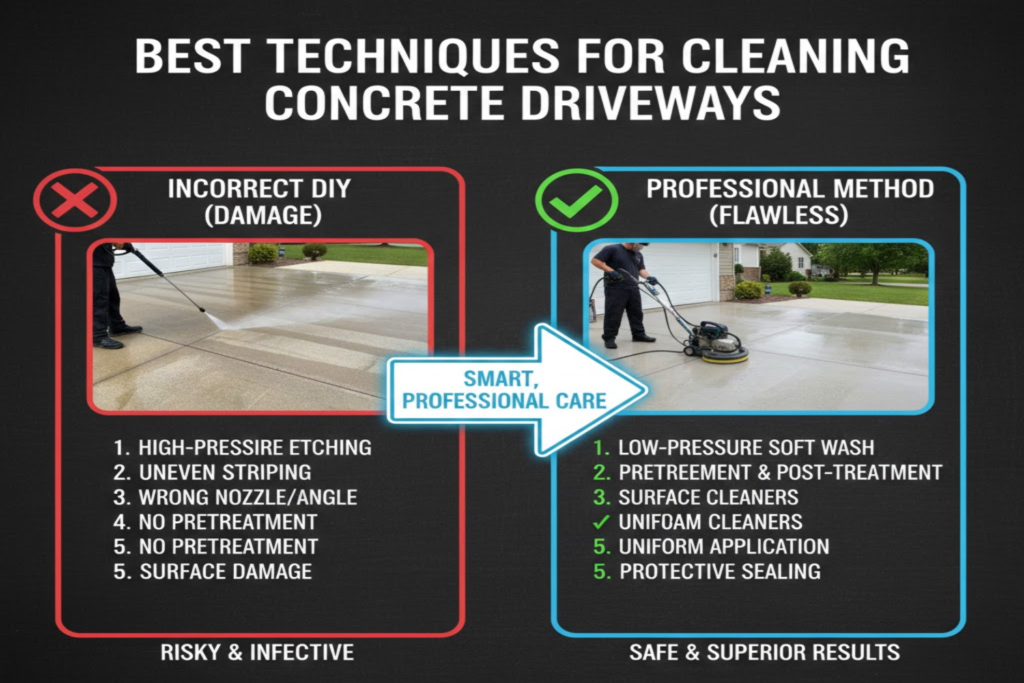
The most prevalent misconception in exterior cleaning is that sheer force—measured in PSI—is the solution to every stain. In reality, relying solely on high pressure is a novice mistake that often leads to permanent property damage.
The Myth of “Higher PSI”
Many homeowners rent a 4000 PSI machine and use a narrow nozzle at point-blank range, thinking it will “blast” the dirt away. However, this level of force can easily strip the “Surface Cream”—the smooth, protective top layer of the concrete. Once this cream is etched, the underlying aggregate (the stones and sand) is exposed, leaving the driveway with a rough, sandy texture and a patchy appearance that is impossible to reverse without expensive resurfacing.
Deep-Pore Extraction via Capillary Action
The best technique for a professional clean is a balance of Chemistry, Heat, and Flow Rate (GPM). By using a surfactant or an alkaline degreaser, you break the surface tension of the contaminants. This allows the cleaning solution to penetrate the microscopic capillaries of the concrete, surrounding the dirt molecules and lifting them to the surface. When you combine this chemical action with a high GPM (Gallons Per Minute) flow, you are essentially “flushing” the pores rather than just scouring the surface.
3. Professional Toolset: The “Pro-Sumer” Setup
To achieve the “uniform” look seen on luxury Los Angeles estates, you must utilize tools that ensure consistency.
- The Surface Cleaner: This is the industry-standard tool for driveways. It consists of a circular housing with a rotating spray bar inside. Because the nozzles are kept at a fixed distance from the ground, it eliminates the “human error” of moving a wand back and forth, preventing the dreaded “tiger stripes.”
- Turbo Nozzles (Rotary Nozzles): This tool combines the power of a 0-degree jet with the coverage of a 25-degree fan by spinning the water in a rapid circular motion. It is the best technique for removing caked-on mud or cleaning the “cold joints” (expansion gaps) where dirt tends to settle.
- Telescoping Wands: For the steep, winding driveways found in the Hollywood Hills, a telescoping wand allows you to maintain a safe footing on flat ground while cleaning slopes or high retaining walls that would otherwise require dangerous ladder work.
4. Pre-Treatment Techniques: The “Soft Wash” Approach
Professionals never start with the “big guns.” The best technique always begins with a chemical pre-treatment to loosen the biological and chemical bonds of the dirt.
Downstreaming vs. X-Jetting
- Downstreaming: This is the process of injecting soap into the water line after it leaves the pump but before it reaches the hose. It allows for a low-pressure application of soap, which is safer for the concrete and the surrounding Los Angeles landscaping.
- X-Jetting: For driveways with heavy black mold or green algae, an X-Jet nozzle is used to apply a higher concentration of sodium hypochlorite (bleach) and surfactant. This kills the organic growth at the root before the high-pressure rinse even begins.
5. Cleaning Technique Matrix
Choosing the right approach is vital for efficiency and safety. The following matrix outlines the best techniques based on specific cleaning goals.
Professional Concrete Cleaning Techniques Compared
| Technique | Primary Goal | Speed | Safety Rating | Best For |
| Surface Cleaning | Uniformity & Speed | Fast | High | Large Flat Driveways |
| Soft Washing | Killing Algae/Mold | Fast | Very High | Delicate/Aged Concrete |
| Turbo Nozzle | Heavy Debris Removal | Moderate | Medium | Edges and Expansion Joints |
| Hot Water Wash | Oil & Grease Removal | Fast | High | Commercial/Mechanic Driveways |
| Wand Fan Spray | Detailed Rinsing | Slow | Medium | Small Patios/Detail Work |
6. Step-by-Step Execution: The “Overlapping Fan” Method
Consistency is the hallmark of a professional. If you want your driveway to look like it was done by a Los Angeles specialist, follow this grid-based execution plan.
Step 1: The Perimeter Cut-In
Begin by cleaning a 6-to-10-inch border around the entire perimeter of the driveway. Use a 25-degree nozzle for this. This “cuts in” the edges, ensuring that when you use your surface cleaner later, you don’t have to get dangerously close to the delicate grass or flower beds.
Step 2: The Systematic Grid (The 50% Overlap Rule)
When operating the surface cleaner or a wand, move in a steady, walking-pace motion. Each pass should overlap the previous pass by exactly 50%. This technique ensures that no thin slivers of dirt are left behind, which usually only become visible once the concrete dries.
Step 3: Strike Angle and Distance Management
If you are using a wand, maintain a 45-degree strike angle. This “shears” the dirt off the surface rather than pushing it deeper into the pores. Keep the tip exactly 12 inches from the surface. In the dry Los Angeles air, working in sections of 10×10 feet prevents the dirty slurry from drying before you can rinse it away.
Step 4: The Final High-Volume Flush
Once the entire surface has been agitated, switch to a high-volume rinse nozzle. Start at the highest elevation of the driveway and “push” the dirty water toward the street or the drain. This prevents “re-soiling,” where the loosened dirt settles back into the pores as the water evaporates.
7. Advanced Techniques for Difficult Scenarios
Concrete is a resilient material, but it is susceptible to specific chemical reactions that require more than just water pressure to fix.
- Removing Efflorescence (The “White Powder” Technique): Efflorescence is that stubborn, white, powdery salt residue that migrates to the surface of concrete after heavy rain. Because it is a mineral deposit, high pressure alone won’t dissolve it. The best technique involves using a mild acid wash (like diluted phosphoric or citric acid). Apply the solution, scrub gently with a nylon brush, and rinse. This neutralizes the salts and restores the concrete’s original gray tone.
- Acorn and Leaf Stain Removal (Tannin Extraction): In leafier neighborhoods like Pasadena or the Hollywood Hills, organic tannins from fallen leaves and acorns can leave dark brown or yellowish “ghost” stains. These are organic dyes. The best technique is a sodium percarbonate (oxygen bleach) application. Unlike chlorine bleach, oxygen bleach breaks the organic bond of the tannin without damaging the concrete’s pH balance.
- Cold Joint and Expansion Gap Management: The gaps between concrete slabs (expansion joints) are magnets for dirt, weeds, and debris. Professionals use a Turbo Nozzle at a 45-degree angle to “sweep” the gaps. Warning: Never spray directly down into a joint, as this can wash out the sand base or gravel underneath, leading to a sunken slab over time.
8. The “Hot Water” Advantage: When Pressure Isn’t Enough
While cold water is sufficient for dust and dirt, it fails against the “unholy trinity” of driveway stains: Gum, Grease, and Baked-on Carbon.
The Physics of Heat
Motor oil and chewing gum are “thermoplastic” substances—they harden when cold and soften when heated. In the high-traffic environment of Los Angeles, automotive exhaust soot (carbon) acts as a binding agent for these stains. Using water heated to 200°F melts the molecular bond of the grease, allowing it to be flushed away with 50% less pressure than cold water would require. This is safer for the concrete and significantly faster.
Rental vs. Professional Service
Most DIY rental units are cold-water only. If your driveway has significant oil saturation or decades of gum buildup, the “best technique” is to hire a professional Los Angeles service that utilizes truck-mounted boilers. The cost of the professional service is often offset by the time saved and the superior deep-pore extraction that cold water simply cannot achieve.
9. Environmental Best Practices: The “Reclaim” Technique
Southern California has some of the strictest water runoff regulations in the United States. Being a responsible homeowner means ensuring your cleaning process doesn’t harm the local ecosystem.
- Runoff Management: Use “Sandbagging” or weighted “Snake Booms” at the end of your driveway to divert water away from the municipal storm drains. These drains lead directly to the Pacific Ocean, and carrying oil and bleach into them can result in heavy fines.
- The Neutralization Step: If you have used a high-strength alkaline degreaser or sodium hypochlorite, your runoff is chemically “hot.” Before it reaches your lawn or garden, spray a neutralizing agent (like a weak citric acid solution) to balance the pH, ensuring your grass stays green and healthy.
- Water Conservation: Utilize a Surface Cleaner instead of a wand. Surface cleaners use up to 40% less water because they cover more square footage in a single pass, making them the most eco-friendly technique for drought-prone areas like Los Angeles.
10. Post-Cleaning Precision: The Art of the Finish
The job isn’t done just because the machine is turned off. The final 10% of the process determines the longevity of the clean.
The Neutralization Rinse
After using detergents, a invisible film can remain on the concrete. If you plan to apply a sealer later, this film will prevent the sealer from bonding. Perform a final, high-volume rinse with fresh water. The concrete should “sheet” water evenly; if you see beads or dry spots, there is still chemical residue present.
Inspecting for “Tiger Stripes”
While the concrete is still damp, walk the length of the driveway. “Tiger stripes” (uneven cleaning lines) are most visible during the drying phase. If you catch them while the concrete is wet, you can quickly go over the area with a wand to blend the finish. Once it dries, fixing these stripes requires a complete re-wash of the entire slab.
11. Conclusion: A Professional Result Every Time
Mastering the best techniques for cleaning concrete driveways is a blend of mechanical skill and chemical knowledge. It is a rewarding process that does more than just “wash away dirt”—it restores the architectural integrity of your home’s entrance and protects your most significant investment.
By moving away from the “high pressure only” mindset and adopting the professional formula of Pre-treatment + Surface Cleaning + Systematic Rinsing, you can achieve a finish that rivals any professional crew in Los Angeles. Your driveway is the red carpet to your home; treat it with the technical precision it deserves.
12. FAQs: Expert Concrete Cleaning Techniques
Q: Is it okay to use a circular motion with the wand?
A: No. A circular motion creates uneven pressure points and often leads to “swirl marks” on the concrete. The best technique is a linear, sweeping motion—similar to a pendulum—maintaining a consistent distance from the ground.
Q: How do I stop my driveway from looking “patchy” after it dries?
A: Patchiness is usually caused by uneven detergent application or inconsistent wand height. To ensure a uniform look, use a Surface Cleaner for the main areas and always overlap your passes by at least 50%.
Q: What is the best technique for cleaning sloped driveways?
A: Always start at the top and work your way down. This allows gravity to assist in moving the dirty slurry away from the clean area. If you start at the bottom, the dirty water from the top will re-soil the sections you just cleaned. In Los Angeles hillside homes, ensure you have a “spotter” to help manage your high-pressure hose so it doesn’t trip you on the incline.