For homeowners in Los Angeles, the patio is more than just an outdoor space; it is an extension of the living room. Thanks to the year-round Mediterranean climate, Southern California residents utilize their patios for everything from high-end alfresco dining to quiet morning retreats. However, this frequent use combined with the region’s unique environmental factors—such as Santa Ana winds carrying desert dust, urban smog, and the occasional coastal dampness—can quickly turn a beautiful stone or concrete patio into a stained, slippery eyesore.
When it comes to restoration, homeowners generally find themselves caught between two major schools of thought: Pressure Washing vs. Chemical Cleaners. On one side, you have the raw, mechanical force of high-pressure water. On the other, the scientific precision of chemical reactions designed to melt away grime. While both methods promise a “like-new” finish, the reality is that the wrong choice can lead to permanent property damage. This guide will provide a deep-dive comparison to help you determine the best approach for your specific patio material, ensuring your Los Angeles outdoor oasis remains a source of pride rather than a maintenance nightmare.
2. Contender #1: Pressure Washing (The Mechanical Force)
Pressure washing, often referred to as “power washing” when heat is involved, relies on the physics of kinetic energy. By forcing water through a tiny nozzle at high velocity, you create a liquid “scrubbing” action that physically displaces dirt.
How it Works
A pressure washer takes standard water pressure (usually around 60 PSI) and ramps it up to anywhere between 1500 and 4000 PSI. This concentrated stream acts like a microscopic chisel, hitting the surface and prying loose the bond between the debris and the patio material.
The Benefits
- Immediate Gratification: You see the results instantly. As the wand passes over the stone, the transformation is visible to the naked eye.
- Eco-Friendly (In Water-Only Mode): If you aren’t dealing with heavy grease, pressure washing can be done with water alone, making it a “green” choice for those wary of runoff.
- Versatility: With the right nozzles, a pressure washer can remove everything from caked-on mud after a rainstorm to old, peeling paint.
The Risks
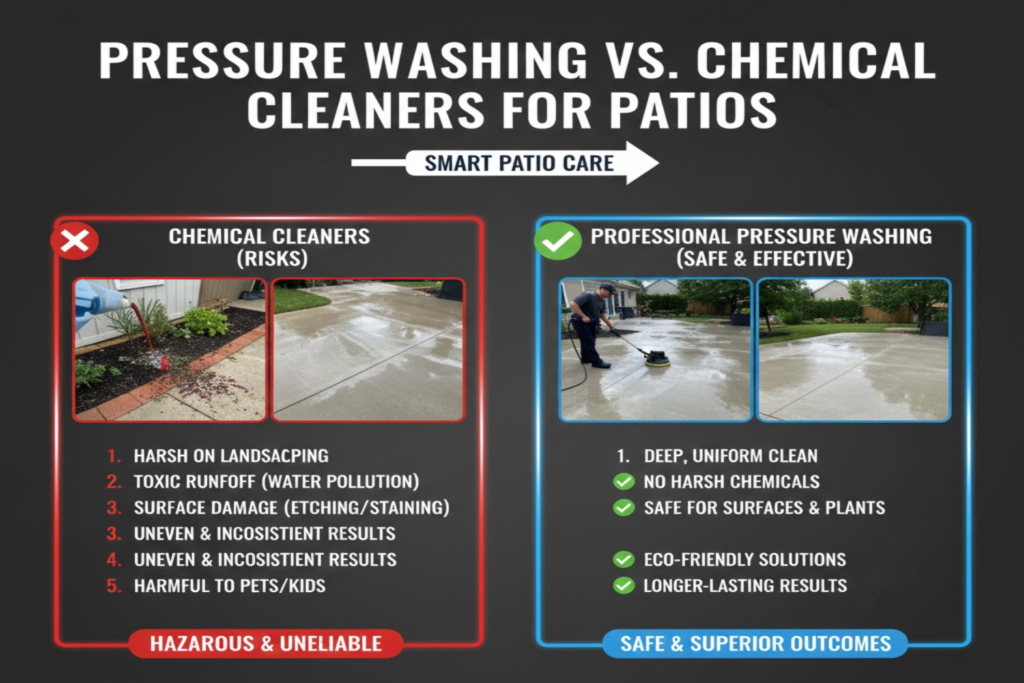
Mechanical force is indiscriminate. If you use too much pressure on aged concrete or soft stone, you can cause surface etching—permanent “scars” where the water has eaten into the material. Furthermore, for patios with sand-filled joints (like pavers), high pressure can blast away the stabilizing sand, leading to loose stones and weed growth. Finally, the “Tiger Stripe” effect occurs when a homeowner moves the wand unevenly, leaving unsightly zig-zag lines across the patio.
3. Contender #2: Chemical Cleaners (The Scientific Approach)
Chemical cleaning is a “Soft Wash” technique that prioritizes molecular chemistry over physical impact. Rather than blasting the dirt away, you use solutions to dissolve it.
Types of Cleaners
- Sodium Hypochlorite (SH): The gold standard for killing organic matter like mold, mildew, and black algae (the dark streaks common on Los Angeles patios).
- Sodium Percarbonate: An oxygen-based bleach that is much safer for plants and wood. It’s excellent for lifting gray oxidation from composite decks or light soot from stone.
- Surfactants: These are “soaps” that break the surface tension, allowing the water to penetrate deep into the pores of the patio.
The Benefits
- Deep-Pore Sterilization: While pressure washing only cleans the surface, chemicals kill the spores deep inside the stone, preventing mold from returning for much longer.
- Safety for Delicate Surfaces: There is zero risk of etching or “pitting” the stone because the water pressure used is no stronger than a garden hose.
- Less Physical Labor: You simply apply the solution, let it “dwell,” and rinse.
The Risks
Chemicals require caution. In the heat of Los Angeles, chemicals can evaporate quickly, potentially leaving a white film if not kept wet. There is also the risk of phytotoxicity—where bleach-based runoff can yellow your lawn or kill sensitive landscape plants if not properly neutralized.
4. Material Matters: What is Your Patio Made Of?
The “winner” of the Pressure Washing vs. Chemical Cleaners debate is usually determined by the substrate you are cleaning.
Natural Stone (Flagstone, Slate, Travertine)
Natural stone is often layered (foliated). High pressure can cause these layers to “delaminate” or flake off. For natural stone, Chemical Cleaning is the superior choice. A mild surfactant and a low-pressure rinse will preserve the stone’s texture while removing the grime.
Pavers and Bricks
Pavers are held in place by friction and polymeric sand. High-pressure washing is the #1 cause of paver failure because it removes this sand. Professionals in Los Angeles recommend a Hybrid Approach: use chemicals to loosen the dirt, and a low-pressure Surface Cleaner (under 1500 PSI) to rinse.
Poured Concrete
Standard concrete is the most durable surface. It can generally handle high-pressure washing (up to 3000 PSI) quite well. However, if the concrete is less than two years old, chemicals are safer to prevent damage to the curing “cream” layer.
Wood and Composite Decks
Never high-pressure wash a deck. It “furs” the wood fibers and can leave permanent gouges in composite material. Chemical cleaners (Oxygen-based) are the only safe way to restore a deck without destroying the finish.
5. Side-by-Side Comparison
| Feature | Pressure Washing | Chemical Cleaning | The Hybrid Method |
| Best For | Caked Mud / Hard Concrete | Mold / Algae / Soft Stone | Professional Restoration |
| Risk of Damage | High (Etching/Pitting) | Low (Chemical Burn) | Very Low |
| Longevity | 3-6 Months | 9-12 Months | 12+ Months |
| Water Usage | High | Low | Moderate |
| DIY Friendliness | Moderate (Careful!) | High (Follow Label) | Moderate |
6. The Professional Secret: The “Hybrid Method”
Why choose one when you can use both? Professionals in Los Angeles almost never rely on a single method. They use the “Hybrid Method” to get the best of both worlds.
Step 1: The Chemical Pre-Treat
Before turning on the pressure washer, apply a specialized patio cleaner (surfactant + algaecide). This is the “brain” of the operation. Let it dwell for 15 minutes. During this time, the chemicals are “eating” the organic bonds that hold the dirt to the stone.
Step 2: The Low-Pressure Rinse
Now, use the pressure washer—but with a wide Green (25-degree) nozzle or a Surface Cleaner attachment set to low pressure. Because the chemicals have already loosened the dirt, you don’t need 4000 PSI to move it. 1500 PSI will now do the work of 4000 PSI, effectively flushing the pores without any risk of damaging the surface.
Step 3: The Post-Treatment
After the patio is clean and rinsed, many Los Angeles pros apply a very light “mist” of a mold inhibitor. This stays in the stone’s pores and acts as a shield, ensuring that even in a damp coastal fog, algae cannot take root.
7. When to Choose One Over the Other: Specific Scenarios
While the hybrid method is preferred by professionals, certain residential situations call for a singular approach. Recognizing these scenarios will save you both time and the potential cost of repairing a damaged surface.
Scenarios for Pressure Washing Only
- Post-Construction Cleanup: If you have recently remodeled your home and your patio is covered in dried mortar, drywall dust, or caked-on mud from heavy machinery, mechanical force is your best friend. Chemicals cannot “dissolve” a layer of mud; only high-velocity water can displace it.
- Restoring Unsealed, Hard Concrete: For a standard, non-decorative concrete slab that hasn’t been cleaned in a decade, a high-PSI pressure wash is often sufficient to strip away the “gray” oxidation and reveal the bright surface beneath without the need for surfactants.
- Stripping Old Paint or Stain: If your goal is to completely remove an old, peeling solid stain from a wood or concrete patio to prep for a new coat, the abrasive power of a pressure washer is the most efficient tool for the job.
Scenarios for Chemical Cleaning Only
- Delicate Tiles and Porous Natural Stone: If your Los Angeles patio features Mexican Saltillo tile, Travertine, or honed Marble, keep the pressure washer in the garage. These stones are soft and highly susceptible to “spalling.” A chemical soft-wash is the only way to clean them without destroying the finish.
- Heavy Black Algae (Infestation): If your patio has turned entirely black, you aren’t just looking at dirt—you are looking at a living organism. High pressure will only remove the “heads” of the algae, leaving the “roots” inside the pores. You must use chemicals to kill the biological growth at its source.
- Roof-Adjacent Patios: If your patio sits directly under a roofline, you must be careful with high pressure, as the backsplash can force water under your siding or roof shingles. A gentle chemical application is far safer for the home’s structural envelope.
8. Environmental and Safety Impact
In Los Angeles, being a responsible homeowner means balancing a clean home with environmental stewardship.
- Drought-Conscious Cleaning: Southern California’s water restrictions are a reality. Pressure washing can use between 2 to 5 gallons per minute (GPM). To conserve water, always use a Surface Cleaner attachment. It covers more area in less time, reducing your total water footprint by up to 40% compared to a standard wand.
- Pet and Child Safety: If you use Sodium Hypochlorite (Bleach) or other surfactants, safety is paramount. The general rule of thumb is the “Dry Touch” rule. Once the patio has been thoroughly rinsed and is completely dry to the touch, it is safe for pets and children to return. Typically, in the Los Angeles sun, this takes about 2 to 4 hours.
- Eco-Friendly Alternatives: For those wary of bleach, Sodium Percarbonate (Oxygen Bleach) is an excellent alternative. It breaks down into oxygen, water, and soda ash, making it completely safe for your lawn and local wildlife while still being effective at lifting organic stains.
9. Equipment Requirements for Both Methods
To achieve a professional-grade finish, your equipment must match your ambition.
Pressure Washing Gear
- Gas vs. Electric: Electric washers are great for small balconies, but for a full Los Angeles patio, a Gas-Powered unit (at least 2800 PSI) is recommended to handle the volume of water needed for rinsing.
- Nozzles: Never use the Red (0-degree) nozzle. Stick to the Green (25-degree) for washing and the White (40-degree) for delicate rinsing.
Chemical Cleaning Gear
- Pump Sprayers: A 2-gallon “HDPE” plastic pump sprayer is the best way to apply chemicals evenly.
- Personal Protective Equipment (PPE): This is non-negotiable. When handling professional-grade chemicals, you must wear chemical-resistant gloves, safety goggles, and closed-toe rubber boots. Even a small splash of degreaser in the eye can cause permanent damage.
10. Cost-Benefit Analysis: DIY vs. Professional
Many homeowners choose the DIY route to save money, but the math doesn’t always work out in their favor.
- The Hidden Costs of DIY: Renting a gas pressure washer in Los Angeles typically costs $80–$120 per day. Add in $40 for professional-grade chemicals and a full Saturday of labor, and your “free” job is costing you nearly $200.
- The Risk Factor: One accidental “etch” in a high-end Flagstone patio can cost thousands of dollars to repair. Professionals carry Liability Insurance and have the experience to know exactly how much pressure a specific stone can handle. For delicate or high-value patios, the $300–$500 spent on a professional service is essentially an insurance policy for your home’s curb appeal.
11. Conclusion: Making the Right Choice for Your Home
The “showdown” between pressure washing and chemical cleaners doesn’t have a single winner—instead, it has a “smart” winner. The most effective way to maintain a Los Angeles patio is to embrace the “Safe-First” approach. Start with the gentlest method possible (Chemical Soft-Washing) and only introduce mechanical pressure when the chemicals alone aren’t enough to finish the job.
By understanding the unique needs of your patio’s material and respecting the power of both physics and chemistry, you can transform a weathered, gray slab into a vibrant outdoor sanctuary. Your patio is the “Outdoor Heart” of your home; treat it with professional care, and it will reward you with years of beautiful sunsets and memorable gatherings.
Additional FAQs: Mastering the Patio Clean
Q: Why does my patio look patchy or cloudy after using a chemical cleaner?A: This usually happens for two reasons: poor rinsing or “flash drying.” In the dry Los Angeles climate, if the chemical dries on the surface before you rinse it, it leaves a surfactant film or a white salt residue. To fix this, always work in small sections and perform a “flood rinse” with high volumes of water to ensure every trace of the chemical is flushed from the stone’s pores.
Q: Can I use a pressure washer on a second-story balcony or patio?A: You must exercise extreme caution. High pressure can force water under the threshold of sliding glass doors or through the waterproof membrane of the balcony. For upper-level patios, the Chemical Soft-Wash method is significantly safer. It prevents water intrusion into the rooms below and avoids the risk of high-pressure spray splashing onto neighbors’ properties or pedestrians.
Q: How do I know if my patio stone is too soft for pressure washing?A: Perform the “Scratch Test.” Take a small, inconspicuous corner of the stone and try to scratch it with a penny. If the stone flakes or scratches easily, it is likely a soft limestone or sandstone. For these materials, mechanical pressure above 800 PSI will cause surface erosion. Stick to chemical cleaners and a soft-bristle scrub brush for these delicate surfaces.
Q: Does pressure washing remove weeds between patio pavers?A: While a pressure washer will blast away the visible green part of the weed, it rarely kills the root. In fact, by removing the stabilizing sand, you often create a better environment for more weeds to grow. The best technique is to treat the weeds with a herbicide or boiling water first, then pressure wash, and finally, sweep in new polymeric sand to “lock” the joints and prevent future growth.
Q: Is it safe to use “Pool Chlorine” instead of store-bought patio cleaner?A: While pool chlorine (Liquid Shock) is chemically similar to professional surfactants (both contain Sodium Hypochlorite), pool chlorine is often much more concentrated (usually 10-12%). Using it “straight” can bleach your stone unevenly and is highly corrosive to your pressure washer’s internal seals. If you use it, you must dilute it significantly and add a surfactant to help it “stick” to the surface.
Q: How long will my patio stay clean after a professional hybrid wash?A: In a typical Los Angeles environment, a hybrid wash (Chemical + Pressure) usually keeps a patio looking pristine for 9 to 14 months. Because the chemicals kill the algae spores deep in the pores, regrowth is much slower than with water-only pressure washing. To extend this life, consider applying a breathable sealer once the stone is completely dry.
Q: Can I clean my patio furniture with the same chemicals I use for the stone?A: Not necessarily. While oxygen-based cleaners (Sodium Percarbonate) are generally safe for outdoor fabrics and wood, bleach-based patio cleaners can ruin the finish on powder-coated metal or “burn” wicker furniture. Always move your furniture off the patio or cover it with a tarp before applying heavy-duty stone chemicals.