There is a unique, almost therapeutic satisfaction that comes from watching a jet of high-pressure water peel back years of grime from a gray driveway, revealing the pristine white concrete underneath. This visual “instant gratification” is the primary driver behind the “Saturday Morning Warrior” syndrome. Many homeowners in Southern California view driveway cleaning as the ultimate low-stakes DIY project—a way to save a few hundred dollars while getting some sun and a sense of accomplishment.
However, beneath that satisfying spray lies a hidden layer of complexity. Modern hardscaping—incorporating pavers, stamped patterns, and specialized sealers—is far more delicate than the industrial-grade slabs of the past. What begins as a simple cleaning task can quickly escalate into a structural repair project if the wrong equipment or technique is applied. In this guide, we evaluate whether the DIY route truly offers the value it promises, or if the “Professional Edge” is an investment that pays for itself in time and property protection.
2. The DIY Approach: Taking Control of Your Curb Appeal
For many, the DIY path starts at the local home improvement store. Whether you are renting a unit for the day or purchasing a consumer-grade machine, the barrier to entry is lower than ever.
The Cost Factor: Rental vs. Ownership
Renting a gas-powered pressure washer in Los Angeles typically costs between $70 and $150 per day, depending on the power of the unit. Purchasing a mid-range electric unit can cost between $200 and $400. On the surface, this looks like a bargain compared to professional quotes. If you have a small, standard concrete driveway and the time to spare, the math seems to favor the DIYer.
The Flexibility of the Learning Curve
DIY allows you to work on your own schedule. You can spend four hours obsessing over a single oil spot near the garage door without an hourly labor charge ticking away. It also provides an opportunity to learn the mechanics of your home’s maintenance. However, that learning curve often involves “trial by error,” and with water pressure, those errors can be permanent.
The Limitations of Consumer Equipment
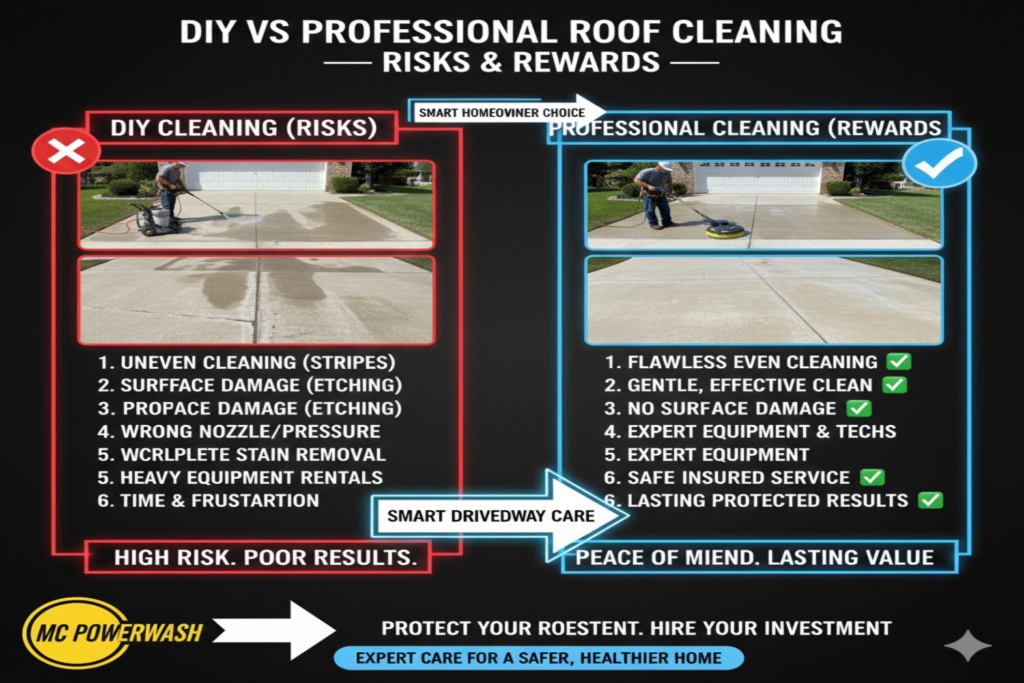
The biggest hurdle for DIYers isn’t just pressure (PSI); it’s flow (GPM). Most consumer-grade electric washers produce about 1.2 to 2.0 Gallons Per Minute (GPM). While they may boast high PSI numbers like 3,000, they lack the volume of water needed to “flush” the dirt away efficiently. This leads to the “Zebra Striping” effect, where you are forced to hold the wand so close to the ground to see results that you end up etching thin, permanent lines into the concrete.
3. The Professional Edge: Beyond Just “High Pressure”
Professional exterior cleaners don’t just bring a “bigger version” of what you can rent; they bring an entirely different class of technology designed for speed, safety, and deep-pore restoration.
Industrial Flow Rates: The GPM Secret
While a DIYer focuses on PSI, a professional focuses on GPM. Professional truck-mounted units typically output 5.0 to 10.0 Gallons Per Minute. This high volume allows for the use of a “Surface Cleaner”—a circular hovering disk with spinning nozzles. A surface cleaner ensures a perfectly uniform clean without the risk of wand marks, and it allows a professional to clean a 3-car driveway in 30 minutes that would take a DIYer 4 to 6 hours with a standard wand.
The “Hot Water” Advantage
Most DIY machines use cold water. However, automotive fluids like oil, transmission fluid, and brake dust are chemically designed to resist water. Professional units often include on-board boilers that heat the water to 180°F – 200°F. This heat acts as a “force multiplier,” melting the molecular bonds of grease and oil. Cleaning a driveway with hot water is the difference between washing a greasy frying pan with cold water versus hot soapy water; the results are fundamentally different.
Commercial Chemistry and Precision
Professionals have access to high-concentration surfactants and “clinging” foams that are not available to the general public due to licensing and safety regulations. These chemicals do the heavy lifting, allowing the professional to use lower pressure than a DIYer would, which protects the concrete from the “sandy” erosion caused by excessive cold-water blasting.
4. [Table Section] Side-by-Side Comparison Matrix
| Feature | DIY (Homeowner Grade) | Professional (Industrial) |
| Typical PSI / GPM | 2,000 PSI / 1.5 GPM | 3,500 PSI / 8.0 GPM |
| Water Temperature | Cold Only | Heated (Up to 200°F) |
| Estimated Time (2-Car) | 4 – 6 Hours | 45 – 60 Minutes |
| Risk of Surface Etching | High (Wand use) | Low (Surface Cleaner use) |
| Oil Stain Removal | Surface lightened only | Deep-pore emulsification |
| Average Cost (SoCal) | $70 – $150 (Rental) | $180 – $450 (Service) |
5. The Risk Assessment: What Could Go Wrong?
The “Savings” of a DIY job disappear the moment a mistake is made. In the world of pressure washing, these mistakes are often structural and irreversible.
The DIY Hazard: Permanent Etching
“Zebra striping” or wand marks occur when the operator holds a high-pressure nozzle too close to the concrete or moves too slowly. This doesn’t just “clean” the dirt; it actually carves away the “cream coat” (the smooth top layer) of the concrete, exposing the rough sand and aggregate underneath. Once etched, these lines are permanent and can only be hidden by expensive resurfacing or opaque staining.
Professional Accountability and Insurance
When you hire a licensed professional in California, you are paying for their General Liability Insurance and Workman’s Comp. If a professional accidentally shatters a window with backspray or etches a stamped concrete pattern, their insurance covers the repair. If a DIYer makes the same mistake, the cost comes directly out of their pocket.
Personal Safety and Injection Injuries
Pressure washers are not garden hoses; they are dangerous tools. A 3,000 PSI stream can cause a “High-Pressure Injection Injury,” where water and bacteria are driven deep under the skin into the bloodstream. These injuries often look minor on the surface but can lead to amputation if not treated by a specialist immediately. Professionals are trained in “Trigger Discipline” and safety protocols to mitigate these risks.
6. Time and Opportunity Cost
In the fast-paced economy of Southern California, your time is your most valuable asset.
The “Whole Weekend” Reality
A DIY driveway project is rarely just about the washing. It involves:
- Driving to the rental yard and waiting in line.
- Loading a 150lb machine into your vehicle.
- Setting up hoses and clearing the driveway.
- Spending hours hunched over a wand.
- Managing runoff to ensure it doesn’t flood the neighbor’s yard.
- Cleaning the machine and returning it before the “Late Fee” kicks in.
What was supposed to be a “quick wash” often consumes a full Saturday and Sunday.
Efficiency and Results
A professional crew arrives with 100+ feet of hose, meaning the heavy machine stays on the truck. They move with an efficiency born of doing thousands of driveways. For a homeowner, the question is simple: Is saving $200 worth 10 hours of grueling labor? For many, the answer is a resounding “No.”
7. When DIY Makes Perfect Sense
Despite the advantages of professional services, there are specific scenarios where the DIY route is not only feasible but arguably the better choice for a budget-conscious homeowner.
Routine Maintenance of Clean Surfaces
If your driveway is relatively new, well-sealed, and free of deep oil saturations, a DIY wash is a great way to maintain its curb appeal. Using a standard electric pressure washer to remove light dust, pollen, or recent bird droppings every few months prevents these contaminants from becoming “baked” into the surface. In this case, you aren’t performing a “restoration,” but rather a “rinse,” which low-power consumer machines handle perfectly well.
Small Footprints and Walkways
For homeowners with a single-car “apron” or a small 20-foot walkway, the minimum call-out fee for a professional (often $150–$250 in Los Angeles) might feel excessive. If the total square footage is under 400 sq. ft., a DIYer can finish the job in a couple of hours without the physical exhaustion that comes from tackling a massive 4-car driveway.
The Mechanical Hobbyist
If you already own a high-quality gas-powered machine and understand the nuances of nozzle degrees and chemical dilution, the DIY approach can be quite effective. For those who enjoy the process of home maintenance, the $200 saved can be redirected into high-quality sealers or other landscaping upgrades.
8. When to Call the Pros: The “Red Flags”
Certain conditions make DIY a high-risk gamble. If you encounter any of the following, the “Professional Edge” becomes a necessity to protect your property value.
- Deep Petroleum Saturation: If you have dark, “wet-looking” oil spots that have been there for months, a cold-water DIY machine will only lighten the surface. Professionals use 200°F hot water to liquify the oil and industrial emulsifiers to pull it out of the concrete’s pores.
- Acreage and Scale: If your driveway exceeds 2,000 sq. ft., attempting it with a DIY wand will take an entire weekend and likely result in “zebra stripes.” A professional with an 8 GPM machine and a 24-inch surface cleaner can do it in a fraction of the time with perfectly uniform results.
- Prep for Sale: When a home is heading to the market, “clean” isn’t enough; it needs to look “new.” Professionals provide a uniform, bright finish that adds immediate perceived value to a listing, often returning the cost of the service 10x over in the final sale price.
9. The Environmental and Regulatory Gap
In California, the “Clean Water Act” isn’t just a suggestion—it’s strictly enforced. This is perhaps the biggest hidden difference between DIY and professional work.
Runoff Reclaim and Compliance
In many Southern California municipalities, allowing soapy, oily runoff to enter a storm drain can result in fines starting at $500 per day. Storm drains lead directly to the ocean, and only rainwater is permitted. Professional crews often use Reclaim Systems—vacuum booms that capture the wastewater as they wash, filtering it or hauling it away for legal disposal. A DIYer with a garden hose and a rental machine often inadvertently violates these local ordinances.
Chemical Responsibility
Managing the runoff from industrial degreasers is a significant responsibility. Professionals are trained to “berm” the work area, ensuring chemicals are neutralized or captured before they can reach your lawn or the municipal water system. When you hire a pro, you are also hiring their compliance with California’s rigorous environmental standards.
10. The Value of the “Complete Package”
A professional service doesn’t end when the water stops flowing. It’s the “Post-Treatment” that truly separates the results.
The “Brightening” Post-Treatment
After the pressure washing is complete, professionals often apply a light “post-treatment” of Sodium Hypochlorite. This serves two purposes: it kills any remaining microscopic mold spores deep in the pores (preventing green algae from returning for 6–9 months) and it “whitens” the concrete as it dries. A DIY wash often looks “damp” and gray; a professional wash looks “sun-bleached” and brilliant.
Integrated Sealing Services
Most professionals offer a 2-for-1 service where they wash on day one and return on day two to apply a high-quality silane-siloxane sealer. This protects your freshly cleaned surface from future oil spills and salt damage. Coordinating this as a DIYer requires renting equipment twice and managing the “dry-out” window yourself, which is a logistical headache.
11. Conclusion: Aligning Your Goals with Your Method
Choosing between DIY and professional pressure washing comes down to a simple calculation of Risk vs. Reward. If you have a standard driveway, plenty of time, and a desire to “do it yourself,” the DIY route can be a rewarding way to save a few hundred dollars.
However, if you are dealing with expensive decorative stone, heavy oil stains, or a massive surface area, the professional route is the only way to ensure a uniform, damage-free result. In the high-value real estate markets of Southern California, the “Professional Edge” isn’t just a luxury—it’s an investment in the longevity and aesthetic of your home’s most visible asset.
12. FAQs: Making the Final Choice
Can a DIY machine really damage concrete?
Yes. Even a small 2,500 PSI machine can “etch” concrete if you use a narrow nozzle ($0^\circ$ or $15^\circ$) or hold it too close. This creates permanent “scars” that can only be fixed by resurfacing the entire driveway.
How much does a professional driveway wash cost in Los Angeles in 2026?
The typical range for a standard 2-car driveway is $190 to $350. Factors such as heavy oil stains, the need for hot water, or wastewater reclaim requirements can push the price toward the higher end.
Do I need to be home for a professional service?
Usually, no. As long as the contractor has access to an exterior water spigot and the driveway is cleared of vehicles, most pros can complete the work while you are at the office.