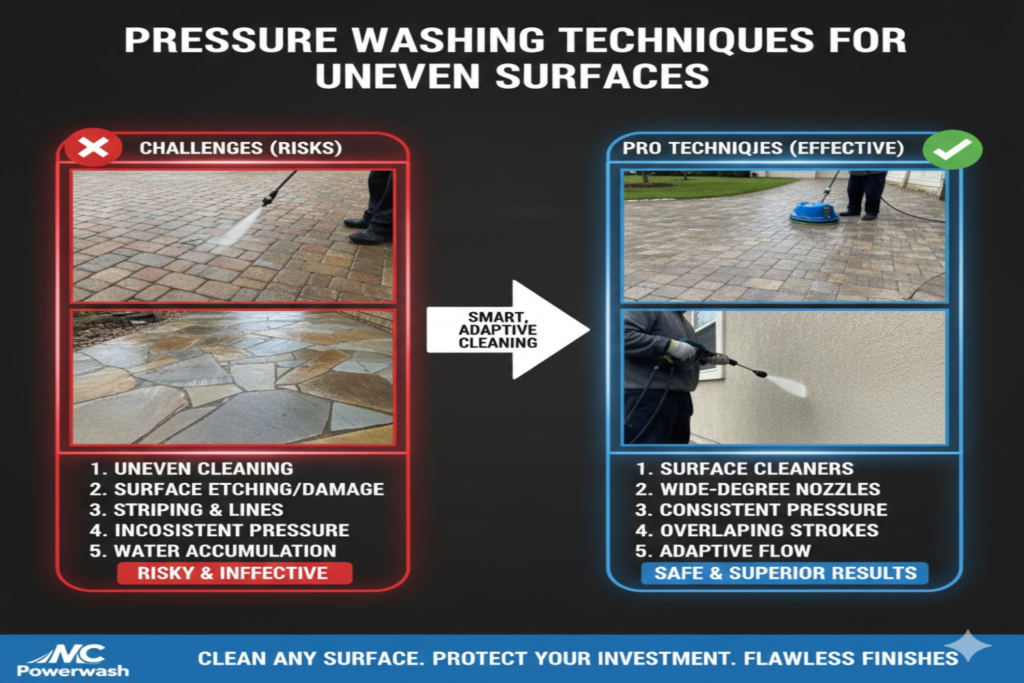
In the world of professional exterior cleaning, the “flat, gray slab” is the exception, not the rule. Homeowners in Southern California often invest heavily in “textured” hardscaping—rustic cobblestones, hand-laid flagstone, and decorative exposed aggregate—to create a natural, high-end aesthetic. While these surfaces are beautiful, they present a significant mechanical challenge when it comes time to clean them.
The primary issue is that standard pressure washing equipment and techniques are designed for a two-dimensional plane. When you introduce a third dimension—the “peaks and valleys” of uneven stone—the physics of cleaning changes. Water doesn’t just hit and rinse; it deflects at unpredictable angles, “pools” in low spots, and skips over the “shadowed” areas of deep textures. To achieve a uniform clean on a non-flat surface, one must move beyond brute force and master the art of wand geometry, equipment selection, and water management.
2. Understanding the Surface Types and Their Risks
Before pulling the trigger, you must identify the specific “terrain” you are cleaning. Each type of uneven surface has a “failure point” where high pressure can turn a cleaning job into a costly repair.
Natural Flagstone and Slate: The Shaling Risk
Flagstone and slate are “foliated” rocks, meaning they are formed in layers. On an uneven patio, these layers are often exposed at the edges of the stones. If you hit these edges with a high-pressure stream at a shallow angle, you can cause “shaling”—where thin sheets of the stone literally peel or flake off. This not only ruins the look of the patio but creates new, sharp edges that are prone to further damage.
Cobblestones and Belgian Block: Deep Joint Navigation
Cobblestones are mounded in the center, creating deep “valleys” at the joints. Standard flat-surface cleaners will “bottom out” on the mounds and fail to reach the grime living in the recessed grout or sand lines. Furthermore, the irregular height of the stones means the distance between your nozzle and the surface is constantly changing, which can lead to “splotchy” cleaning results if you don’t adjust your wand height in real-time.
Exposed Aggregate: Preventing Pebble “Pop-Out”
Exposed aggregate consists of small pebbles embedded in a concrete matrix. On uneven sections, the “bond” between the pebble and the concrete is often weaker at the high points. Excessive pressure or using a nozzle that is too narrow will “chisel” the pebbles out of their sockets, leaving your driveway looking pitted and moth-eaten.
Cracked or Heaved Concrete: Navigating the “Lip”
Tree roots or soil shifting often create a “lip” where one slab of concrete is higher than the other. If you sweep your wand across this lip from the “high” side to the “low” side, the water can get under the edge of the lower slab, potentially eroding the sub-base or “chipping” the concrete edge.
3. Wand Geometry: The “Oscillating Sweep” Technique
Cleaning an uneven surface requires a more active, “hand-crafted” approach than cleaning a flat driveway. You cannot simply walk in a straight line; you must dance with the stone.
The 45-Degree Rule Revisited
On a flat surface, a 45-degree angle is a suggestion; on an uneven surface, it is a survival tactic. Because textured stone has “shadows”—recessed areas that the water can’t hit directly—you must constantly change the angle of your wand. If you only spray from one direction, you will leave “grime ghosts” on the back-side of every ridge. Use a “Cross-Hatch” pattern: clean once from North to South, and then again from East to West.
Distance Management as a “Gimbal”
Think of your arm as a camera gimbal. As the ground rises toward your nozzle, you must lift your arm; as the ground falls into a depression, you must lower it. The goal is to maintain a constant “Impact Force.” If you keep your hand at a fixed height, you will be blasting the “peaks” with 3,000 PSI while only “misting” the “valleys” with 1,000 PSI.
The “Contour Follow” Method
For heavily mounded stones like cobblestones, you should follow the contour of the individual stone. Use a “wrist-flick” motion to wrap the water around the curve of the stone. This ensures that the water is always striking the surface at the optimal angle for debris removal rather than glancing off and creating a “back-splash.”
4. Equipment Selection for Difficult Terrain
The right tools can compensate for the irregularities of the ground.
The Turbo Nozzle (The “Secret Weapon”)
If a surface cleaner is a lawnmower, a Turbo Nozzle is a weed-whacker. This nozzle creates a rotating pencil jet that hits the surface from multiple angles hundreds of times per second. Because the jet is constantly moving in a circle, it is much better at “digging” grime out of the uneven pits of flagstone or the deep joints of Belgian blocks. It provides the “punch” needed for deep textures without the risk of a static $0^\circ$ nozzle “gouging” a hole in the stone.
Adjustable Dual-Lance Wands
Professional-grade “Dual-Lances” allow you to adjust the pressure at the handle. This is vital for uneven terrain where you might transition from a durable granite mound to a soft, crumbly grout line in the span of six inches. Being able to “dial down” the pressure instantly prevents you from blowing out the joint filler while still having the power to clean the stone face.
5.The Uneven Surface Risk Matrix
| Surface Type | Primary Risk | Best Tool | Recommended PSI | Technique |
| Flagstone / Slate | Shaling (Delamination) | 40° Fan or Turbo | 1,200 – 1,500 | “Lead with the angle” |
| Cobblestones | Deep joint erosion | Turbo Nozzle | 2,000 – 2,500 | “Wrist-flick” sweep |
| Exposed Aggregate | Pebble Pop-out | 40° Fan Tip | 1,000 – 1,200 | High volume (GPM) |
| Heaved Concrete | Edge Chipping | Surface Cleaner (High) | 2,000 | Lift over the “Lip” |
| River Rock | Dislodging stones | Soft Wash (Chemical) | 500 (Rinse) | No-pressure kill |
6. Managing the “Pooling” and “Backsplash” Problem
Uneven surfaces are notorious for “pooling”—where the water collects in low spots, creating a “mud puddle” that hides the dirt you are trying to clean.
The “Top-Down” Workflow
Always identify the highest point of the uneven terrain and work your way down. This sounds simple, but on a textured patio, the “drainage” isn’t always obvious. If you start at the bottom, the “dirty runoff” from the top will constantly re-contaminate the areas you’ve already cleaned, requiring double the water and double the time.
Dealing with “Blowback”
When water hits an angled stone, it doesn’t just spread out; it can reflect straight back at the operator. When cleaning uneven surfaces, Full-Face Protection is mandatory. You are not just dealing with water; you are dealing with “shrapnel”—tiny bits of stone, moss, and grit that are being reflected off the “peaks” of the texture.
The Squeegee and Vacuum Combo
On heavily recessed patios, rinsing alone won’t work. The water will just sit in the “valleys” and the dirt will settle back down as it dries. Use a heavy-duty floor squeegee or a “Wet-Vac” to physically remove the dirty water from the depressions. This ensures that when the stone dries, it is actually clean, rather than covered in a fine layer of “puddle-dust.”
7. Critical Mistakes to Avoid on Textured Stone
Working on uneven terrain is a game of inches. A lapse in focus for even a few seconds can lead to damage that is far more expensive to repair than the cost of the cleaning service itself.
The “Chisel Effect” of Narrow Nozzles
The most common mistake is using a nozzle with too narrow a spray pattern (like the $0^\circ$ red tip or even the $15^\circ$ yellow tip) to “dig out” stubborn moss from the valleys of a stone. On uneven slate or flagstone, these high-pressure jets act like a pneumatic chisel. If the jet catches a “peak” or a loose edge of a stone layer, it can shear off the top $1/8$-inch of the material instantly. Always favor a wider fan tip and let the chemistry do the loosening, rather than trying to “carve” the dirt out.
Washing Out the Sub-Base
When cleaning cracked concrete or “heaved” slabs, homeowners often drive the water directly into the crack to get it “perfectly clean.” However, on uneven ground, these cracks often lead directly to the sand or soil sub-base that supports the slab. By forcing high-pressure water into these gaps, you are essentially performing “hydro-excavation.” This erodes the support material underneath, leading to “voids” that will cause the slab to sink or crack further under the weight of a vehicle.
Ignoring the “Grout Gap”
On cobblestone or Belgian block, the “valleys” between the stones are often filled with a specialized mortar or polymeric sand. Because these areas are recessed, they collect the most moisture and, consequently, the most algae. Many people try to clean these gaps with pure pressure, but because of the “angle of incidence,” the water often just bounces off the top of the gap. Without chemical pre-treatment, you will end up with clean “mounds” and dirty, green “valleys,” creating a striped, unprofessional appearance.
8. The Role of Chemistry on Uneven Ground
Because mechanical force is so difficult to apply evenly on textured surfaces, Chemistry must do the heavy lifting. This is where the “Soft Wash” methodology becomes a vital partner to the pressure washer.
Soft Washing as a Primer
Think of your detergent as a “liquid scraper.” On a flagstone patio, you should apply a surfactant-rich biocide (like Sodium Hypochlorite mixed with a foaming agent) 15 minutes before you even touch your pressure wand. The chemical will seep into the “shadowed” areas and the microscopic pores of the uneven texture that your water stream might miss. By the time you start rinsing, the biological bond of the algae and moss is already broken, allowing you to use 50% less pressure to achieve the same result.
Foaming Agents for Slanted Stone Faces
Uneven terrain often includes slanted “transition” stones or vertical retaining walls. Standard liquid cleaners will simply run off these slants before they have time to work. By using a Foaming Agent, you create a “clinging” chemical layer that stays on the slanted faces of the uneven stone, ensuring the “dwell time” is consistent across the entire project, regardless of the angle of the ground.
9. Joint Maintenance: Post-Wash Stabilization
A deep clean on uneven surfaces almost always results in some loss of joint material. Leaving these joints empty is a recipe for disaster, as it invites rapid weed regrowth and destabilizes the stones.
Replacing Displaced Sand
Once the uneven surface is bone-dry (usually 24–48 hours after washing), you must inspect the joints. For cobblestones or pavers, sweep in new kiln-dried sand. On uneven ground, use a soft-bristle brush to ensure the sand is distributed into the low spots. Avoid overfilling; the sand should sit about $1/8$-inch below the “shoulder” of the stone to prevent it from washing out in the next rain.
Polymeric Sand for Irregular Gaps
For flagstone patios with irregular, wide gaps, Polymeric Sand is the gold standard. This sand contains additives that turn into a flexible “glue” when activated by a water mist. On uneven surfaces, this flexibility is crucial because it allows the joints to “move” slightly as the ground shifts without cracking like traditional rigid mortar would.
10. Environmental and Safety Considerations
Navigating uneven terrain while managing a pressurized hose and a high-flow wand requires specific safety protocols to prevent injury and environmental damage.
Tripping Hazards and Hose Management
Standard pressure washer hoses are stiff and prone to “coiling.” On an uneven stone patio, these coils act like snares. Always work with a partner who can “feed” you the hose, or use a high-flex, non-marring hose that lays flat against the contours of the stone. Always walk backward toward the high point of the terrain to ensure you are looking at the “unevenness” of the ground you are stepping onto.
Runoff Control in “Low Spots”
Because uneven surfaces have “depressions,” your wash water will naturally gravitate toward these areas. If these low spots are near the foundation of your house or a basement window, you risk flooding. Use “Snake Booms” or sandbags to redirect the pooling water away from the structure and toward a proper drainage point or a grassy area that can absorb the runoff.
11. Conclusion: The Art of the Uniform Clean
Cleaning an uneven surface is less about “power” and more about perspective. It requires an operator who is willing to slow down, adjust their angles, and treat every stone as an individual project. By combining the “downward sweep” of the wand with the “clinging power” of modern chemistry, you can strip away years of grime without damaging the rustic character of the stone.
The final result of a well-executed “Uneven Wash” is a surface that looks balanced, sterile, and vibrant. It transforms a “rugged” liability into a “refined” asset, proving that with the right technique, even the most difficult terrain can be restored to its original glory.
12. FAQs: Expert Answers for Complex Landscapes
Q: Can I use a spinning surface cleaner on flagstone?
A: Only if the stones are relatively level. If the height difference between stones is more than $1/4$-inch, the spray bar inside the surface cleaner will hit the edge of the stone, potentially damaging the machine or “chipping” the stone. For very uneven flagstone, a Turbo Nozzle is safer.
Q: How do I clean a driveway buckled by tree roots?
A: Treat the “buckle” like a mini-mountain. Clean the “approach” side first, then the “peak,” and finally the “slope.” Never spray directly under the lifted edge of the concrete, as this will wash away the soil and cause the slab to collapse or crack under its own weight.
Q: What is the safest way to clean “Exposed Aggregate”?A: Use high GPM (volume) and low PSI (pressure). The goal is to “flush” the dirt out from between the pebbles rather than “blasting” it. If you see even one pebble pop out, stop immediately and increase your distance.