1. Introduction: The “Invisible” Asset
Windows are the most paradoxical part of a home’s architecture. When they are clean, they are functionally invisible, serving as a seamless lens to the outside world. However, the moment they are neglected, they become the most prominent blemish on a property. For many homeowners, windows are also the most expensive single surface in the house; a standard set of high-quality, double-pane windows can cost tens of thousands of dollars. Despite this high value, the “hand-me-down” advice many of us use to maintain them is decades out of date.
The problem lies in the rapid advancement of glass technology. In the mid-20th century, a window was simply a single sheet of silica. Today, a window is a complex system involving argon gas, desiccant spacers, and microscopic metallic coatings. Following traditional “hacks” that worked for our grandparents can now lead to permanent structural damage and the voiding of manufacturer warranties. The thesis of this guide is clear: modern window maintenance is no longer a household chore—it is a science of surfactants, mineral management, and substrate protection. By debunking these common misunderstandings about window cleaning, we can preserve the beauty and the financial value of our homes.
2. Misunderstanding #1: “Rain Water Makes Windows Dirty”
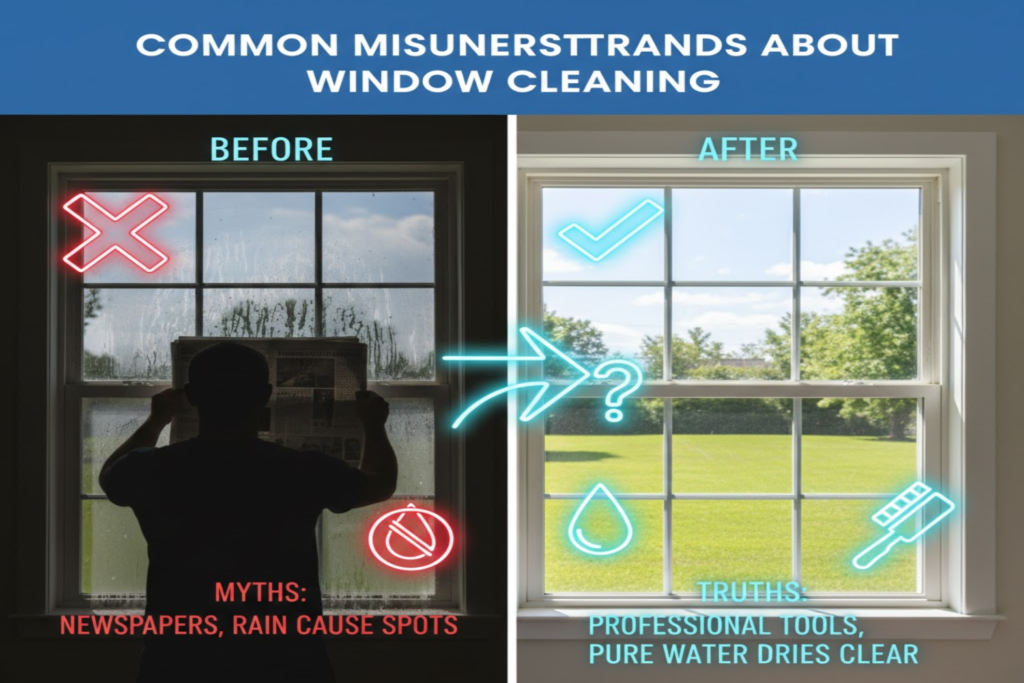
This is perhaps the most pervasive myth in the industry. How many times have you looked at a forecast and said, “I’m not cleaning the windows today because it’s going to rain tomorrow”? This logic is fundamentally flawed because it misunderstands the physics of precipitation.
The Truth About Precipitation and Pollution
In its natural state, rainwater is remarkably pure—essentially a form of distilled water. Because it has been evaporated and then condensed, it contains no minerals or solids. If you were to spray pure rainwater onto a perfectly clean window, it would dry without leaving a single spot. The “dirt” people see after a storm isn’t from the sky; it is already sitting on your glass. Over weeks and months, windows accumulate a fine, invisible layer of dust, pollen, and urban pollutants. When rain hits this layer, it acts as a solvent, turning that dry dust into liquid mud. As the water evaporates, it leaves that mud behind in the form of “dirt spots.”
The “Mud Spot” Phenomenon and Screens
Another major contributor to “rain spots” is the window screen. Screens act as a high-density filter for the air entering your home, trapping millions of micro-particles. When a rainstorm hits, the water passes through the dirty screen and carries those particles directly onto the glass. This is why windows with screens often look significantly “dirtier” after a storm than windows without them. It isn’t the rain that failed; it was the neglected screen that contaminated the water.
The Los Angeles Factor: Smog and Dust
In an environment like Los Angeles, this misunderstanding is particularly problematic. The city’s unique combination of high traffic, coastal salt air, and long dry spells creates a specific type of “urban soot.” This soot is often oily and sticks to the glass with a static charge. When the first light drizzle of the season arrives, it doesn’t wash the windows; it simply agitates the smog and turns it into a visible gray film. Routine professional cleaning removes this “static dirt,” meaning that when it does finally rain, the water simply beads off the glass, leaving it just as clear as before.
3. Misunderstanding #2: “All Glass is the Same”
To the untrained eye, glass is just a transparent solid. However, to a professional, every pane of glass has a “personality” and a set of chemical tolerances. Treating all glass with the same cleaning method is one of the quickest ways to cause thousands of dollars in damage.
The Low-E Coating Trap
Modern energy-efficient homes, especially in the sun-drenched neighborhoods of Los Angeles, almost exclusively use “Low-E” (Low-Emissivity) glass. This glass is treated with a microscopic layer of metal, usually silver or tin, designed to reflect heat while letting in light. In many cases, this coating is located on the interior surface of the glass. Using abrasive cleaners, ammonia-based sprays, or even a rough paper towel on these coatings can cause permanent “scuffing” or even strip the coating away entirely. Once a Low-E coating is scratched, it cannot be repaired; the entire window unit must be replaced.
Tempered Glass and “Fabrication Debris”
Tempered glass is heat-treated for safety and is required in bathrooms, doors, and large windows near the floor. A common misunderstanding is that all glass can be safely “scraped” with a razor blade to remove paint or stickers. However, during the manufacturing of some tempered glass, tiny microscopic “fines” (bits of glass dust) can become fused to the surface. This is known as “fabrication debris.” If an amateur runs a razor blade over this type of glass, they will drag those tiny shards across the pane, creating permanent, deep scratches. Professionals know how to identify these “soft” tempered surfaces and avoid mechanical scraping.
The Myth of “Self-Cleaning” Glass
Products like “Bioclean” or “SunClean” are marketed as self-cleaning. The misunderstanding is that these windows require zero maintenance. In reality, self-cleaning glass is “hydrophilic,” meaning it uses UV rays to break down organic dirt and causes water to sheet off. However, it cannot handle inorganic dirt like bird droppings or cement dust. Furthermore, if you use standard window cleaning soap on self-cleaning glass, you will destroy the chemical coating that makes it work. These high-tech windows require a very specific, surfactant-free maintenance schedule to stay functional.
4. Misunderstanding #3: “Newspaper and Vinegar is the Secret”
If you search for “DIY window cleaning,” you will invariably find the advice to use white vinegar and old newspaper. While this was a viable solution in the 1960s, it is a recipe for a mess in 2026.
The Soy-Ink Residue Problem
The myth of the newspaper persists because, historically, newsprint contained lead and petroleum-based inks that acted as a polishing agent. However, modern newspapers have switched to soy-based inks. These inks do not polish; they smear. If you use a modern newspaper on your windows today, you will notice a gray, oily residue left behind. Even worse, if you accidentally touch your white window frames with the wet newspaper, the ink will leach into the vinyl or paint, causing permanent staining that is nearly impossible to remove.
The Acidity of Vinegar and Seal Degradation
Vinegar is often praised for being “natural,” but “natural” does not mean “safe for all materials.” Vinegar is highly acidic (acetic acid). While it is effective at cutting through grease, it is incredibly hard on the rubber gaskets and silicone seals that hold your double-pane windows together. Repeated exposure to vinegar can cause these seals to dry out and crack. Once the seal fails, the insulating argon gas escapes and moisture gets in, leading to “blown seals” and permanently foggy windows. In the high-UV environment of Los Angeles, these rubber seals are already under stress; adding acid to the mix only accelerates their failure.
Microfiber vs. Wood Fiber
Finally, we must consider the tool itself. Paper towels and newspapers are made of wood fibers. Under a microscope, these fibers are sharp and jagged. Over years of cleaning, they can create “micro-scratches” on the glass. Professional-grade microfiber, however, is made of polyester and nylon fibers that are split 1/100th the thickness of a human hair. These fibers have a wedge-shaped structure that actually lifts dirt away from the glass and traps it, rather than just pushing it around like wood-fiber products. Using the right tool is the difference between “clearing the glass” and “polishing the glass.”
5. Misunderstanding #4: “Window Cleaning is Just a Luxury”
One of the most detrimental misconceptions in home maintenance is the idea that window cleaning is purely an aesthetic indulgence—a “luxury” service for those who want a better view. This perspective fails to account for the physical reality of glass and the chemistry of environmental decay.
The Hidden Economics of Glass Longevity
Contrary to popular belief, glass is not a perfectly smooth, solid barrier. At a microscopic level, glass is a porous, “liquid-like” solid. Its surface is filled with tiny valleys and ridges that are invisible to the naked eye. When you leave windows uncleaned, these microscopic pores act as “traps” for corrosive materials. Over time, these materials don’t just sit on the glass; they become part of it.
Mineral Etching and the “Hard Water” Crisis
In regions with high mineral content in the water supply, such as Los Angeles, the biggest threat to your windows is “mineral etching.” When hard water from garden sprinklers or “acid rain” evaporates on the glass, it leaves behind deposits of calcium and magnesium. If these minerals are heated by the sun, they undergo a chemical reaction with the silica in the glass.
This is not a stain that can be “washed” away; it is a permanent structural change to the glass called etching. Once etching occurs, the glass becomes cloudy and rough. To fix this, you cannot simply clean the window—you must hire a specialist to mechanically polish the glass with cerium oxide, a process that can cost thousands of dollars. Routine cleaning is the only way to remove these minerals before they “scar” your glass permanently.
Health, Hygiene, and the Hidden Mold
Window maintenance isn’t just about the glass; it’s about the “window system.” Homeowners often overlook the window tracks and sills. These areas are notorious for collecting condensation, which, when mixed with household dust and outdoor pollen, becomes a prime breeding ground for black mold and mildew. This biological growth can aggravate respiratory issues and allergies inside the home. A professional cleaning includes the sanitation of these tracks, ensuring that the air passing through your windows is as clean as the view itself.
6. Comparison Table: Misunderstanding vs. Professional Fact
| The Misunderstanding | The Scientific Reality |
| “Dish soap is the best cleaner.” | Dish soaps contain fats/lotions that leave a sticky film, attracting dust 2x faster than a surfactant-free clean. |
| “Sunlight helps windows dry.” | Direct sun causes “flash-drying,” which evaporates the water before the dirt is lifted, creating permanent streaks. |
| “Window cleaning is a DIY job.” | Modern pros use 4-stage DI water filtration and OSHA-grade safety harnesses for a medical-grade level of clean. |
| “Screens don’t need cleaning.” | Dirty screens act as a “pollution filter,” contaminating every breeze and splashing mud onto the glass during rain. |
| “Windex is safe for everything.” | Ammonia-based cleaners are chemically aggressive; they can delaminate window tints and degrade Low-E coatings. |
7. Misunderstanding #5: “The Squeegee is the Only Professional Tool”
While the squeegee has been the symbol of the industry for a century, the technology has evolved. A common misunderstanding is that if a pro isn’t using a squeegee, they aren’t “doing it right.” In reality, the most significant advancement in the last 20 years is the Water-Fed Pole (WFP) system.
The Rise of Water-Fed Pole Technology
- Deionized Water (DI) and the “Hungry Water” Concept: Water-fed poles use multi-stage filtration (Carbon, Sediment, RO, and DI) to bring the Total Dissolved Solids (TDS) of the water to zero. This “pure” water is chemically unstable; it wants to bond with minerals and dirt. It is often called “hungry water” because it aggressively pulls dirt off the glass without the need for traditional soaps.
- Safety Over Speed: Ladders are statistically the most dangerous tool in the home service industry. Modern professionals in Los Angeles use carbon-fiber water-fed poles to clean up to five stories from the safety of the ground. This eliminates the risk of ladder falls and prevents damage to your landscaping and siding.
- The “Scrub and Rinse” Superiority: A squeegee merely wipes the surface. A water-fed pole brush “agitates” the dirt out of the microscopic pores of the glass. Because the glass is then rinsed with pure, mineral-free water, it dries naturally to a “spotless” finish that stays clean longer because there is no soap residue to attract new dust.
9. Conclusion: The Path to Clarity
Understanding the science behind window maintenance is the first step toward protecting your home’s most valuable visual asset. By moving past these common misunderstandings, we see that window cleaning is an essential act of preservation, not just a cosmetic upgrade. Whether it’s protecting your Low-E coatings from abrasive DIY hacks or preventing $1,000+ mineral etching bills, the “truth” about window cleaning always leads back to professional standards and technical knowledge.
Knowledge is the best tool for a streak-free life. Your windows are your lens to the world; treat them with the scientific care they deserve, and they will provide you with a crystal-clear view for decades to come.
8. Frequently Asked Questions (FAQs)
Will cleaning my windows in the winter damage them? No. In fact, winter is a critical time for window cleaning. Road salt and winter pollutants are highly corrosive. As long as the temperature is above freezing (or if the pro uses an anti-freeze additive like rubbing alcohol), cleaning in the winter protects the glass from salt-etching.
Can I use a pressure washer on my windows?Never. Pressure washers are designed for hard surfaces like concrete. The force of a pressure washer can easily shatter a double-pane window, blow out the delicate rubber seals, and force water into your wall cavities, leading to hidden mold growth.
Why do my windows look “cloudy” even after I clean them? If they look cloudy from the inside, it is likely a “blown seal.” This means the insulating gas between the two panes has escaped and moisture has taken its place. This cannot be cleaned; the glass unit must be replaced. If they are cloudy on the outside, it is likely the mineral etching we discussed earlier.
Is “No-Streak” glass cleaner real? Most store-bought “no-streak” cleaners actually contain wax or silicone to hide streaks. This creates a buildup that makes the glass look hazy over time. The only true “no-streak” finish is achieved through pure water or professional surfactants that leave zero residue behind.