Many homeowners view pressure washing as a purely mechanical task—a contest between the force of the water and the stubbornness of the stain. However, relying solely on high-pressure water is not only inefficient but can also be destructive. The secret to a professional-grade finish lies not in the “blast,” but in the Chemistry of Clean. To understand why detergents are essential, one must look at the microscopic battle happening on the surface of your driveway or patio.
The Science of Surfactants
The primary role of a high-quality detergent is to act as a “surfactant” (Surface Active Agent). Water has a high surface tension, which causes it to bead up. Detergents break this tension, allowing the water to penetrate deep into the microscopic pores of concrete or stone. Once inside, the chemical molecules attach themselves to the grime, lifting it from the substrate so it can be rinsed away with minimal pressure.
Protecting the Substrate through Chemistry
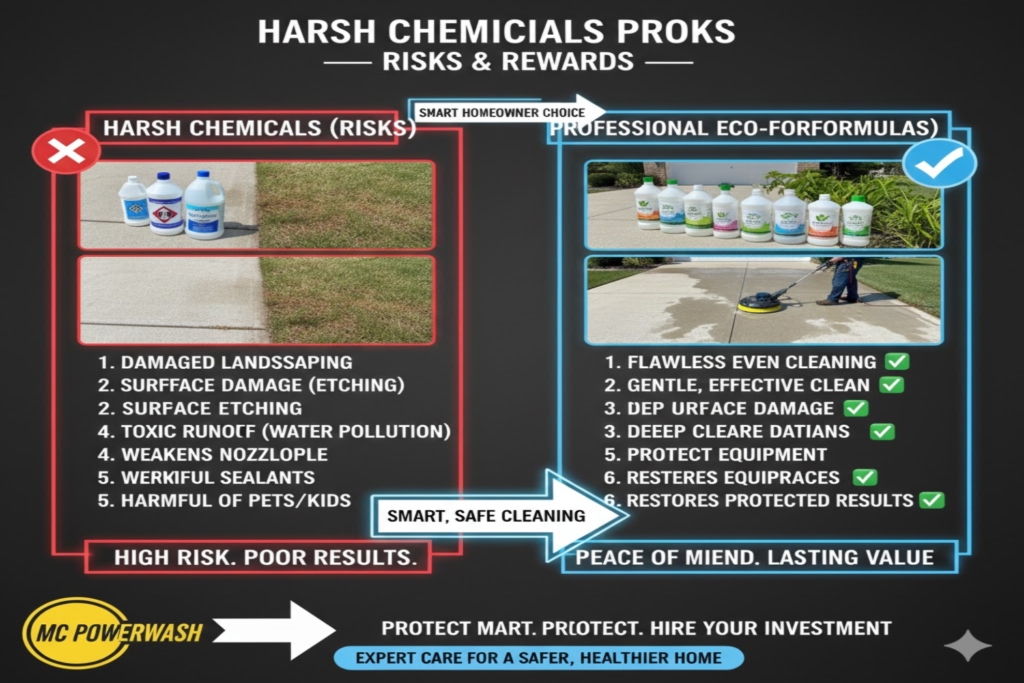
Using the right detergent allows you to use significantly less water pressure. Instead of using 4,000 PSI to “chisel” oil out of concrete, a specialized degreaser dissolves the oil at a molecular level, allowing it to be rinsed away at 1,500 PSI. This “Chemical-First” approach preserves the structural integrity of your stone, prevents surface etching, and ensures that the cleaning is uniform rather than splotchy.
2. Understanding the “Big Three” Active Ingredients
Not all soaps are created equal. In the professional exterior cleaning industry, three core chemical groups handle 95% of all contaminants. Understanding these “Active Ingredients” is the first step in moving from a DIY amateur to a surface specialist.
Sodium Hypochlorite: The Organic Assassin
Commonly known as the active ingredient in bleach, Sodium Hypochlorite is the gold standard for removing “Organic Growth.” This includes mold, algae, mildew, and moss. On many Southern California patios, the black spots you see aren’t dirt; they are living organisms. Sodium Hypochlorite works by oxidizing the cell walls of these organisms, killing them instantly and bleaching the remaining debris so the stone looks bright and new.
Sodium Metasilicate: The Heavy-Duty Degreaser
When dealing with “Inorganic” stains—primarily petroleum-based oil, grease, and carbon soot—bleach is useless. You need an alkaline powerhouse like Sodium Metasilicate. This ingredient is highly effective at “saponification,” a process where the chemical turns fats and oils into a soap-like substance that is water-soluble. It is the primary engine behind most high-end driveway degreasers.
Oxalic and Citric Acids: The Mineral Specialists
If your patio has orange streaks from irrigation water (rust) or white powdery deposits (efflorescence), you are dealing with mineral buildup. Alkaline cleaners won’t touch these. You need an acid. Oxalic acid is specifically formulated to “chelate” or grab onto iron molecules, lifting rust stains without the extreme aggression of hydrochloric acid. Citric acid is a milder alternative often used for “brightening” wood decks or neutralizing pH after a heavy alkaline wash.
3. Detergents for Concrete Driveways: Attacking Oil and Grease
Driveways are the workhorses of the property, and in car-centric Los Angeles, they bear the brunt of automotive fluid leaks. Cleaning these requires a specific class of detergents known as emulsifiers.
The Role of Emulsifiers in Oil Removal
Oil and water famously do not mix. An emulsifier is a molecule with two ends: a “hydrophilic” end that loves water and a “hydrophobic” end that loves oil. When you apply a professional degreaser to an oil spot, the hydrophobic ends “grab” the oil molecules, while the hydrophilic ends stay attached to the water. This allows the oil to be suspended in the water, creating a milky emulsion that can be safely rinsed into a reclaim system or grassy area.
Industrial-Grade vs. Consumer Options
While big-box stores sell “All-Purpose” cleaners, professionals look for concentrated formulas. Products like Purple Power or Simple Green (Pro version) are excellent for light maintenance. However, for deep-set “shadow” stains from a leaking crankcase, professionals often use Sodium Hydroxide based cleaners. These are much more aggressive and require careful handling, but they are the only chemicals capable of drawing oil out of concrete that has been “baked” by the sun for months.
The “Hot Water” Force Multiplier
It is important to note that many high-end driveway detergents are “thermo-activated.” While they work with cold water, their cleaning power increases exponentially when used with a hot-water pressure washer ($140^\circ\text{F}$ to $180^\circ\text{F}$). The heat thins the oil, allowing the Sodium Metasilicate to penetrate deeper and work faster, reducing your total cleaning time by half.
4. Patio Professionals: Cleaning Pavers and Natural Stone
Backyard patios require a much more nuanced chemical approach than a standard concrete driveway. Many decorative stones used in SoCal landscapes, such as Travertine, Limestone, and Sandstone, are chemically sensitive.
The pH-Neutral Requirement
Natural stones are often “calcareous,” meaning they are composed largely of calcium carbonate. If you use a strong acidic or highly alkaline cleaner on these stones, you can cause “etching”—a chemical burn that dulls the surface and leaves it feeling rough. For luxury patios, a pH-neutral detergent is mandatory. These soaps rely on high concentrations of surfactants rather than “acidic bite” to move dirt, ensuring the stone’s finish remains factory-fresh.
Oxygen Bleach: The Eco-Friendly Alternative
If your patio is surrounded by expensive succulents or near a swimming pool, you may want to avoid traditional Sodium Hypochlorite. Sodium Percarbonate (Oxygen Bleach) is a powdered alternative that, when mixed with water, releases a concentrated burst of oxygen. This oxygen “blasts” organic stains apart. The byproduct is simply soda ash and water, making it significantly safer for the environment and poolside applications.
Removing Tannins and “Tea Stains”
Many patios suffer from “Tannin” stains—dark, reddish-brown marks caused by fallen leaves or “bleeding” from nearby redwood or cedar fences. These stains are essentially a natural dye. To remove them, you need a detergent containing Oxalic Acid. This acid neutralizes the tannins and “brightens” the stone or wood, removing the yellow/brown dinginess that standard soaps leave behind.
5. [Table Section] The Detergent Selection Matrix
| Stain Type | Best Active Ingredient | Recommended Detergent Class | Dwell Time |
| Mold & Algae | Sodium Hypochlorite | Soft Wash Mix | 10 – 15 Mins |
| Oil & Grease | Sodium Metasilicate | Heavy-Duty Degreaser | 15 – 20 Mins |
| Rust & Tannins | Oxalic Acid | Restoration Acid | 5 – 10 Mins |
| Efflorescence | Phosphoric/Glycolic Acid | Efflorescence Remover | 2 – 5 Mins |
| General Grime | Surfactant Blend | pH-Neutral Soap | 10 Mins |
6. The “Soft Wash” Revolution
In recent years, the industry has shifted away from high pressure toward a method called “Soft Washing.” This technique relies almost entirely on chemical volume and “clinging power” rather than water velocity.
What is a Soft Wash Detergent?
A Soft Wash detergent is typically a “cocktail” of Sodium Hypochlorite and a specialized Foaming Agent. Unlike standard soaps that run off the surface immediately, a foaming agent creates a thick, shaving-cream-like consistency. This allows the chemicals to “dwell” on vertical surfaces or porous stone without drying out, giving the active ingredients more time to eat through the grime.
Why “Clinging Power” Wins
On a porous stone patio, dirt doesn’t just sit on top; it lives in the crevices. A high-pressure spray often hits the surface and bounces off. A foaming Soft Wash detergent, however, slowly collapses into those crevices, bringing the cleaning agents into direct contact with the root of the stain. This is the preferred method for high-end Los Angeles estates where “Do No Harm” is the primary goal of the cleaning crew.
7. Mixing and Dilution Masterclass
Understanding the chemistry is only half the battle; knowing how to deliver that chemistry to the surface is what separates the professionals from the amateurs. In the pressure washing industry, we rarely use chemicals at full strength. Instead, we use specific delivery systems to achieve a “Final Dilution Ratio” (FDR) that is effective yet safe.
Downstream Injection vs. X-Jet
The most common way to apply detergent is through Downstream Injection. This device sits at the pump’s outlet and uses a vacuum effect to pull chemicals into the water stream after it leaves the pump. This protects your expensive machine from internal corrosion. However, the dilution is usually fixed at around 10:1. If you need a “hotter” mix for a heavy oil stain on a San Fernando Valley driveway, you might use an X-Jet. This nozzle sits at the end of your wand and allows for much higher chemical concentrations (up to 1:1), though it requires carrying a bucket of chemicals as you move.
Calculating the Final Dilution Ratio
A common point of confusion is the difference between what is in your tank and what hits the stone. If you have a 12.5% Sodium Hypochlorite solution in your tank and your downstream injector has a 10:1 ratio, the water hitting your patio is actually around 1.25%. This is the “Sweet Spot” for most organic cleaning. Understanding this math is vital to prevent “burning” your plants or over-applying caustic degreasers that could damage the concrete’s cream coat.
The “No-Mix” Safety Protocols
Before you begin mixing, you must respect the laws of chemistry. The most dangerous mistake is mixing Sodium Hypochlorite (Bleach) with any Acid (like Rust Remover) or Ammonia-based soap. This creates a cloud of lethal Chlorine Gas. Even in an open outdoor patio in Santa Monica, a small whiff of this gas can cause immediate respiratory distress or permanent lung damage. Always rinse the surface thoroughly between applying an alkaline degreaser and an acidic rust remover.
8. Specialty Stains: Rust, Efflorescence, and Battery Acid
Standard detergents often fail when confronted with mineral-based stains. These require specialized “Restoration Chemicals” that use targeted acidity to break bonds without destroying the masonry.
F9 BARC and the Irrigation Rust Problem
In many Southern California neighborhoods, irrigation water is high in iron. Over time, this creates an orange “rust haze” across driveways. Standard soaps won’t touch this. Professionals use products like F9 BARC, which is a specialized acid blend that chemically converts the rust into a colorless, water-soluble form. Unlike raw muriatic acid, these blends are “buffered” to prevent the concrete from turning bright white or becoming porous and “sandy.”
Dissolving Efflorescence (The White Ghost)
Efflorescence—those white, salty streaks on pavers—occurs when moisture carries natural salts to the surface. To remove this, you need a “salted-acid” cleaner or a glycolic acid blend. These chemicals dissolve the salt crystals on contact. However, because efflorescence is a moisture issue, you must apply a high-quality breathable sealer after cleaning, or the “White Ghost” will return as soon as the next rain hits.
Lifting Tire Marks and Rubber Transfer
High-end garage floors and driveways often suffer from “Hot Tire Pickup” or black rubber streaks. These aren’t just dirt; they are plasticizers and rubber from the tires that have “melted” into the sealer. To remove these, you need a Solvent-Based Detergent. These chemicals soften the rubber without attacking the concrete, allowing you to gently scrub the marks away with a nylon brush.
9. Environmental Compliance: The SoCal “Green” Standard
Operating in Los Angeles, Orange County, or San Diego means adhering to some of the strictest environmental regulations in the world. Your choice of detergent must reflect this.
Biodegradability and the Pacific Ocean
Every gallon of water that runs off your driveway eventually hits a storm drain that leads directly to the ocean. You must ensure your detergents are “Readily Biodegradable.” This means the surfactants break down into non-toxic components within 28 days. Avoid any detergents containing NPEs (Nonylphenol Ethoxylates), as these are endocrine disruptors that are highly toxic to California’s marine life.
Navigating VOC Regulations
California’s SCAQMD (South Coast Air Quality Management District) regulates Volatile Organic Compounds (VOCs) in cleaning products. Many “old school” industrial degreasers sold in other states are illegal in California because they release smog-forming gases as they evaporate. Always check the label for “VOC Compliant in California” to ensure you aren’t using a prohibited substance that could result in heavy fines.
Neutralization for Pet and Plant Safety
Even biodegradable soaps can be “hot” when they hit your grass. A professional tip is to use a Neutralizing Agent. After using an alkaline degreaser or a bleach-heavy soft wash, rinse the area with a very light citric acid solution. This brings the pH of the soil back to a neutral 7.0, ensuring your expensive Beverly Hills landscaping remains lush and green.
10. The Dwell Time Factor: Managing the California Sun
The most powerful detergent in the world will fail—or worse, cause damage—if you don’t manage its “Dwell Time” correctly, especially in the dry heat of the Southwest.
The “Wet is Best” Principle
Detergents only work while they are liquid. Once a chemical dries on the surface of your stone, it stops cleaning and begins “scarring.” In SoCal, where surface temperatures on a driveway can hit $140^\circ\text{F}$, a chemical can flash-dry in 60 seconds. You must keep the surface “Active” by misting it with a very light spray of water to keep the chemicals from drying out during their 10-20 minute dwell cycle.
Pre-Hydrating the Pores
Before applying your detergent to a hot patio, you must Pre-Hydrate the stone. By soaking the stone with fresh water first, you “fill” the pores. This ensures that the detergent stays on the surface where the dirt is, rather than being sucked deep into the stone where it can’t be rinsed out. This simple step prevents “chemical shadowing” and ensures a much more uniform clean.
11. Conclusion: Precision Chemistry for Professional Results
The era of “Blasting and Praying” is over. To maintain a high-value property in today’s environment, you must work smarter, not harder. By matching the specific active ingredient—whether it’s Sodium Hypochlorite for mold, Sodium Metasilicate for oil, or Oxalic Acid for rust—to the specific contaminant, you achieve a level of clean that water alone can never reach.
Prioritizing chemistry over pressure is the ultimate form of property protection. It preserves your stone, protects your landscape, and complies with our vital environmental standards. Next time you face a stubborn stain on your driveway or patio, put down the high-pressure nozzle and pick up the right detergent. Precision chemistry is the true secret to a “Red Carpet” ready exterior.
12. FAQs: Expert Answers on Detergents
Q: Can I just use Dawn dish soap in my pressure washer?
A: While Dawn is an excellent surfactant for grease, it creates too much “suds” for a pressure washer pump. Excessive foam can cause the pump to cavitate (suck air), which leads to internal damage. Stick to low-foaming “Pressure Washer Rated” soaps for the machine, and save the Dawn for manual scrubbing.
Q: Will these chemicals kill my artificial turf?
A: Most detergents are safe for the “blades” of artificial turf, but the bleach can fade the green color over time, and the heat from hot-water washing can melt the plastic fibers. Always rinse turf thoroughly with cold, fresh water immediately after any detergent application.
Q: How long should I let the detergent sit?
A: For organic stains (mold/algae), 10 minutes is usually enough. For heavy oil, you may need 20 minutes with occasional agitation from a brush. If the chemical starts to dry, you’ve waited too long—rinse it and re-apply.