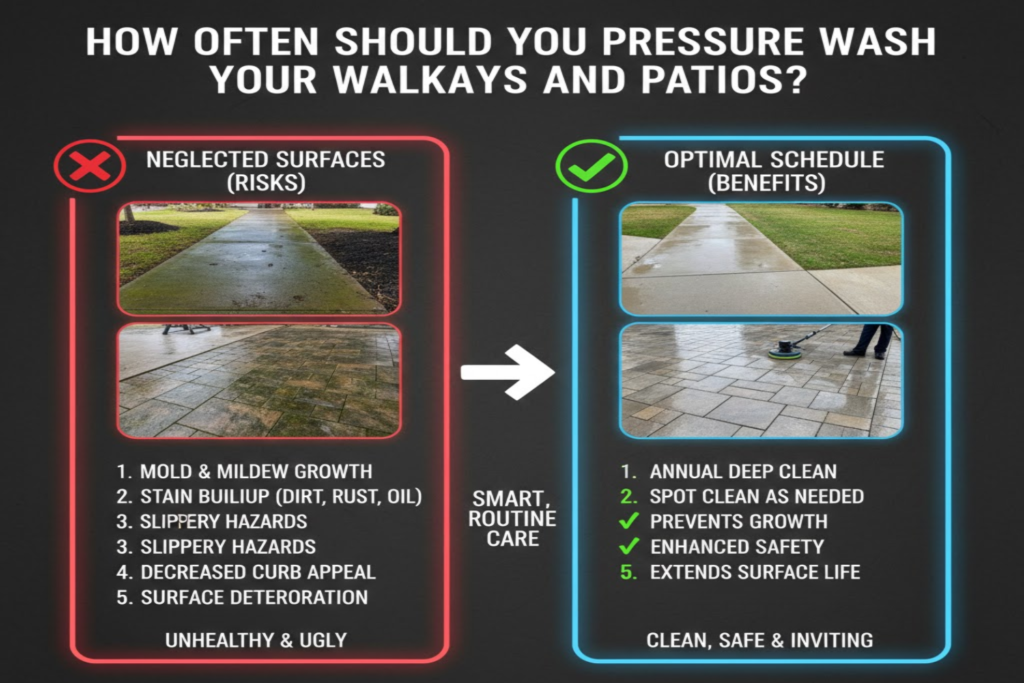
For many homeowners, the decision to clean a walkway or patio is purely reactive. We wait until the concrete looks gray, the stone is slippery, or a guest makes a comment about the “rustic” look of our entrance. However, the “set it and forget it” myth is one of the most dangerous approaches to property management. Waiting for visible dirt is often waiting too long; by the time you see the grime, it has likely already begun a microscopic assault on the structural integrity of your surfaces.
Maintaining a patio or walkway is a delicate balancing act. On one hand, regular cleaning preserves aesthetics and prevents the buildup of corrosive agents. On the other hand, aggressive over-maintenance—specifically the frequent use of high-pressure water—can prematurely age a surface by stripping away protective finishes. In Los Angeles, where the environmental conditions range from the salt-heavy air of the Pacific Palisades to the heat-stressed concrete of the San Fernando Valley, a “one size fits all” schedule simply does not exist. This masterclass will help you navigate the nuances of timing to ensure your outdoor spaces remain pristine without suffering from “cleaning fatigue.”
2. The General Rule of Thumb: The “Annual Baseline”
While every property is unique, the industry standard for most residential homes is once per year. This annual baseline is designed to address the natural accumulation of dust, pollen, and light organic growth that occurs through the changing seasons.
The “Spring Cleaning” Tradition
In Los Angeles, the best time for this annual wash is typically in the early spring (late March or April), right after the winter rains have subsided. During the winter, moisture often sits in the pores of the concrete, allowing microscopic algae spores to take root. By performing a deep clean in the spring, you are “disinfecting” your patio and walkway, preparing them for a summer of high-usage—barbecues, outdoor parties, and family gatherings.
Preventing the “Compounding Effect”
An annual wash serves a critical preventative function. When dirt and oil are left for multiple years, they undergo a process called carbonation, where pollutants bond chemically with the limestone in the concrete. An annual schedule prevents this “compounding effect,” ensuring that the cleaning process remains a simple “maintenance wash” rather than an expensive, multi-stage “restoration” project.
3. Environmental Variables: Factors That Speed Up the Clock
In Los Angeles, geography dictates your maintenance schedule. Your neighbor three miles away might need a totally different frequency than you do based on the local microclimate.
- Tree Canopy and Shade: If your property in Los Feliz or Encino is shaded by massive Oak or Pine trees, you may need to wash your walkways every 6 months. Trees drop more than just leaves; they release tannins (natural dyes), sap, and pollen. When combined with shade, these areas become breeding grounds for “black mold” and green algae, which can make walkways dangerously slippery within months.
- Coastal Salt Air: For properties in Santa Monica or Malibu, the air itself is a cleaning variable. Salt crystals from the ocean spray act as an abrasive and a desiccant, pulling moisture out of sealers and causing them to crack. Coastal homeowners often find that a light “soft wash” every 4 to 6 months is necessary to prevent salt-induced corrosion on stone patios.
- Urban Pollution and Smog: In high-traffic areas near the 405 or 101 freeways, urban soot (carbon) creates a greasy, gray film on concrete. This film isn’t just ugly; it’s acidic. Bi-annual attention is required here to prevent the smog soot from permanently darkening the concrete.
- The “North-Facing” Microclimate: Walkways on the north side of a home rarely see the sun. Because they stay damp longer after a rain or irrigation cycle, they develop algae twice as fast as south-facing surfaces. You might find yourself cleaning your north-facing walkway twice a year while the rest of your patio stays clean for twelve months.
4. Material-Specific Schedules: Not All Surfaces Are Equal
The “durability” of your material determines how often it can handle the stress of pressure.
- Poured Concrete (The Tank): Standard concrete is incredibly durable. It can typically withstand annual high-pressure washing for 20+ years. However, if it is stamped or colored concrete, you should aim for a gentler wash every 18 months to protect the decorative sealer.
- Natural Stone (Flagstone/Travertine): These materials are softer and more prone to “spalling” (flaking). For high-end Los Angeles stone patios, a “less is more” approach is vital. Professional cleaning should be done every 12 to 24 months, focusing more on chemical “soft washing” than raw pressure.
- Brick and Pavers: The frequency here is dictated by the joint sand. Frequent high-pressure washing will blast out the stabilizing sand, leading to loose bricks. Aim for every 18 months, followed immediately by a sand “top-off” to maintain structural stability.
- Wood and Composite Decks: These materials are highly sensitive to UV rays and moisture. A seasonal maintenance schedule (every 6 months) using low-pressure chemicals is the only way to prevent the fibers from “furring” or the composite from fading.
5. Frequency Comparison Chart
The following table serves as a quick-reference guide for Los Angeles residents to determine their optimal cleaning window.
Optimal Pressure Washing Frequency Matrix
| Household & Environment Type | Traffic Level | Primary Concern | Recommended Frequency |
| Active Family (Coastal) | High | Salt / Sand / Spills | Every 6 Months |
| Active Family (Inland) | High | Mud / Food Stains | Every 12 Months |
| Single Occupant (Shaded) | Low | Mold / Algae | Every 6-9 Months |
| Urban/Freeway Adjacent | Moderate | Smog Soot / Carbon | Every 6 Months |
| Desert/Dry (Inland Empire) | Moderate | Dust / UV Oxidation | Every 18 Months |
6. Signs You’re Waiting Too Long (The Red Flags)
If you aren’t following a strict calendar, you must learn to read the physical “red flags” your property is waving at you.
- The “Slip Test”: This is the ultimate safety indicator. If your patio or walkway feels even slightly “slimy” or slippery when wet, you have an active algae colony. This is no longer an aesthetic issue; it is a liability.
- Visual Oxidation (The Graying Effect): New concrete has a creamy, bright white or light gray finish. When it begins to look “mottled” or dark gray, the pores are full of carbon and soot.
- Hidden Cracks and Spalling: Dirt buildup acts as camouflage for structural damage. If you can’t see the texture of your concrete because of the grime, you might miss early warning signs of spalling (where the top layer peels) or hairline cracks that could be easily sealed before they become major repair bills.
7. The Risks of Over-Washing: When “Clean” Becomes “Damaged”
Pressure washing is a destructive process by nature. It uses high-velocity kinetic energy to displace matter. If used too frequently or with too much aggression, it begins to displace the very material you are trying to clean.
- Surface Etching (Destroying the Cream Coat): Every concrete slab has a “cream coat”—the smooth, top-most layer of fine cement. Over-washing at high PSI (above 3000) eventually wears this layer away. Once the cream coat is gone, the rough, porous aggregate underneath is exposed. Not only does this look patchy, but it also makes the concrete even more absorbent, meaning it will stain twice as fast in the future.
- Mortar and Joint Erosion: For brick walkways or paver patios, the bond is held together by mortar or sand. Frequent high-pressure washing acts like a liquid chisel, slowly carving out the mortar joints. This leads to loose bricks, “wobbling” pavers, and a significant trip hazard for your family and guests.
- Sealer Stripping: If you have invested in a high-quality sealer, you must understand that pressure washing is its natural enemy. Frequent washing “scratches” the sealer at a microscopic level, eventually stripping it away. This leaves your patio more vulnerable to oil, salt, and UV damage than it was before you started cleaning.
8. The “Maintenance Wash” vs. The “Deep Restoration”
One of the best techniques used by Los Angeles professionals to avoid the risks of over-washing is the shift toward “Maintenance Washes.”
The 6-Month Soft Wash
Instead of waiting two years for a heavy, high-pressure “Deep Restoration,” consider a “Soft Wash” every six months. This involves using low-pressure (under 500 PSI) to apply a biological detergent that kills algae and mold before they can take root. Because the pressure is so low, there is zero risk of etching the concrete or damaging mortar joints. It keeps the property looking “constantly clean” rather than “occasionally restored.”
The Power of Spot Cleaning
The secret to a long-lasting clean is immediate action. When a bird drops a mess or a car leaks a small amount of oil, don’t wait for your annual pressure wash. Use a stiff nylon brush and a pH-neutral cleaner to spot-clean the area immediately. This prevents the stain from “setting” and allows you to push back your full-scale pressure washing schedule by months.
9. Local Los Angeles Factors: Droughts and Regulations
Cleaning a home in Southern California requires a level of civic responsibility that isn’t necessary elsewhere.
- Water Restrictions: During periods of severe drought, the City of Los Angeles often restricts “non-commercial” pressure washing. Adapting your schedule to clean right after the rainy season—when water tables are higher and regulations are often relaxed—is a strategic move.
- Runoff Control: Municipal codes in LA are strict about what enters the storm drains. When you wash frequently, the accumulation of detergents can be harmful. The “Best Technique” for frequent maintenance is using Eco-Friendly, biodegradable surfactants. These break down before they reach the Pacific, ensuring your property remains beautiful without contributing to ocean pollution.
10. Seasonality: The Best (and Worst) Times to Wash
Timing your cleaning with the Los Angeles weather cycle is essential for both the safety of your concrete and the effectiveness of your chemicals.
- The Post-Rainy Season (February/March): This is the “Golden Window.” The winter rains have already loosened the surface dirt, and the cooler temperatures prevent your cleaning soaps from drying too quickly. This is the best time to tackle the green moss that grows in the shade.
- The Pre-Holiday Season (October/November): With the holidays approaching and many guests arriving, a light maintenance wash in the fall boosts curb appeal and removes the summer’s accumulation of dust and “smog film.”
- The Summer Heat “Danger Zone”: Avoid deep cleaning in the middle of a July or August heatwave. When concrete reaches temperatures of over $120^\circ F$, the water and chemicals you apply will evaporate almost instantly. This can cause “chemical burning,” where the concentrated detergent leaves permanent white marks on the hot stone.
11. Conclusion: Creating Your Personalized Maintenance Calendar
The key to a beautiful property is not having the most powerful pressure washer; it is having the most disciplined schedule. You must “listen” to your property. If you live in a shaded area of Encino, your calendar will look different than someone in the sun-drenched streets of Santa Monica.
Summary of the Mastery Formula:
- Spring: Perform your annual Deep Restoration or a thorough Maintenance Wash.
- Fall: Conduct a light rinse and spot-treat any summer stains.
- Monthly: Sweep away organic debris to prevent tannin staining.
- Immediately: Clean oil spills or pet messes before they soak in.
By following this personalized calendar, you ensure that your walkways and patios remain a “red carpet” entrance for your home year-round. Consistent, low-impact maintenance is the ultimate secret to longevity, safety, and a home that always looks its best.
12. FAQs: Timing and Frequency
Q: Can I wash my patio every month?
A: With a garden hose? Yes. With a pressure washer? Absolutely not. Monthly pressure washing will destroy the surface of your stone or concrete within two years. Stick to a monthly sweep and a hose-down, and save the pressure for an annual or bi-annual event.
Q: Does sealing my driveway mean I can wash it less often?
A: Yes! A high-quality sealer creates a non-porous barrier. This means dirt and oil sit on top of the sealer rather than soaking into the concrete. Most sealed driveways only need a light rinse every 12 months, whereas unsealed driveways require deep agitation.
Q: How does pet traffic affect the cleaning schedule?
A: If you have large dogs that spend a lot of time on the patio, you will likely need to wash every 3 to 4 months. Pet dander, oils from their fur, and “accidents” create an organic film that can become smelly and slippery in the Los Angeles sun.