1. Introduction: The High Stakes of Rapid Removal
Graffiti is rarely just about a single wall; it is a signal to the community about the state of its security and care. To understand why reporting and removal are so urgent, one must look at the “Broken Windows Theory.” This sociological theory suggests that visible signs of disorder and neglect—like broken windows or uncleansed graffiti—create an environment that encourages further, more serious crime. When a tag is allowed to remain on a building for weeks, it signals to vandals that the property is unmonitored. Conversely, removing graffiti within 24 to 48 hours is the single most effective deterrent against future vandalism.
It is also vital to distinguish between “Graffiti” and “Street Art.” While street art consists of commissioned, permitted murals that often enhance property value, graffiti is unauthorized tagging that constitutes a crime of vandalism. The financial burden of this crime is staggering, costing taxpayers and private owners billions of dollars annually. This guide serves as a comprehensive resource for navigating the aftermath of a “tagging” incident. Reporting and removing graffiti is a critical act of civic pride and property protection that requires a coordinated approach between citizens, municipal authorities, and professional restoration specialists.
2. Step-by-Step Guide: How to Report Graffiti
Navigating the bureaucracy of a large city can be daunting, but reporting is the first “paper trail” required for insurance and municipal assistance.
Navigating the Bureaucracy of Urban Restoration
The most common entry point for reporting is the 3-1-1 system. Most major metropolitan areas have centralized this service to handle non-emergency municipal requests. When you call 3-1-1, you are logged into a system that alerts public works. However, in 2026, digital reporting has become the gold standard. Using a municipal app allows you to geotag the exact location of the vandalism, which is essential for city crews trying to find a specific utility box or alleyway.
Documentation and Evidence-Grade Photos
Before any cleaning begins, you must document the damage. This is not just for your personal records; it is for legal and insurance purposes. You should take three types of photos:
- The Wide Shot: To show the context of the graffiti on the building.
- The Medium Shot: To show the scale of the damage.
- The Macro Shot: A close-up of the “tag” itself. Vandals often use unique signatures or “crews.” By providing high-resolution photos to the police, you assist gang units and vandalism task forces in linking multiple crimes to a single individual, which is often the only way to secure a conviction.
Specific Reporting Channels in Los Angeles
In a massive urban sprawl like Los Angeles, the city provides specific resources to help residents combat blight. The Los Angeles Office of Community Beautification (OCB) manages a massive graffiti abatement program. Residents are encouraged to use the “MyLA311” app, which streamlines the process of requesting free removal services for public-facing walls. Because of the sheer volume of incidents in the city, providing a clear photo through the app can move your request to the top of the queue.
Reporting on Public vs. Private Property
Responsibility is often the most confusing part of the process. If the graffiti is on a “City” asset—such as a street sign, a public park bench, or a sidewalk—the municipality is responsible for removal. However, if the graffiti is on a private fence, garage, or storefront, the burden of removal falls on the property owner. In some cases, cities like Los Angeles offer a “Right of Entry” (ROE) permit, where a homeowner can sign a waiver allowing city crews to paint over graffiti on their private property for free, though they are usually limited to a few standard “buffing” colors.
3. The Legal and Liability Landscape
Understanding your rights and your city’s ordinances is crucial to avoid being “victimized twice”—once by the vandal and once by municipal fines.
Rights and Responsibilities of the Property Owner
Many homeowners are surprised to find that they can be fined for being a victim of a crime. To prevent “urban blight,” many cities have passed strict ordinances requiring graffiti to be removed within 48 to 72 hours. If a property owner fails to act, the city may send a “Notice to Abate.” If ignored, the city will send its own crews to remove the graffiti and then send the homeowner a bill for the labor and materials, often accompanied by an administrative fine.
Insurance Coverage and the Deductible Dilemma
Graffiti is classified as “Vandalism and Malicious Mischief” in most homeowners’ insurance policies. While you can file a claim, it is often not financially viable. If the cost of professional removal is $600 and your deductible is $1,000, you will be paying out of pocket. However, if the vandalism is extensive—such as an entire brick facade being covered—it is worth contacting your agent to see if the restoration costs (which could reach $5,000+) are covered under your specific policy terms.
The Legal Risk of DIY Removal and Runoff
One of the most overlooked risks in graffiti removal is environmental liability. In the eco-conscious legal climate of Los Angeles, “Clean Water Act” violations are taken very seriously. If you use harsh chemicals to scrub your driveway and those chemicals, along with the dissolved paint, wash into the storm drain, you can be fined thousands of dollars. The storm drains in Los Angeles lead directly to the ocean without being filtered. Professionals use “reclamation” systems to vacuum up the wastewater, a step that most DIYers ignore at their own legal peril.
4. Technical Methods of Graffiti Removal
Choosing the wrong removal method can cause more damage to the building than the graffiti itself. The goal is to remove the “pigment” without “scarring” the substrate.
The Chemistry of Clean: Choosing the Right Method
- Pressure Washing and Power Washing: This is the most common method for masonry. High-heat “Power Washing” (water heated to 180°C) is particularly effective at melting the binders in spray paint, allowing it to be lifted from the pores of concrete without the need for excessive pressure that could “etch” the stone.
- Chemical Solvents and the “Shadowing” Effect: Some paints require a chemical “breaker.” However, if a solvent is too weak, it leaves a “shadow”—a faint ghost image of the tag. If it is too strong, it can dissolve the mortar between bricks. Professionals use a “dwell time” strategy, where the chemical is allowed to sit on the paint for a specific number of minutes before being neutralized.
- Sensitive Surfaces (Glass and Wood): You cannot pressure wash a wooden fence at high PSI without “fuzzing” the wood fibers. For wood, specialized “citrus-based” gels are often used. For glass, specialized scrapers and “polishing pastes” are required to avoid scratching the pane.
- Sandblasting and Abrasive Blasting: In industrial settings, “Soda Blasting” (using baking soda particles) or “Dry Ice Blasting” is used. This is a non-destructive way to literally “knock” the paint off the surface. This is often the only way to remove graffiti from historic stone buildings where chemicals are strictly prohibited.
5. The Environmental and Social Impact: Beyond the Surface
Graffiti removal is often discussed as a simple matter of maintenance, but its implications reach far into the social and environmental fabric of a city.
Why Removal Matters
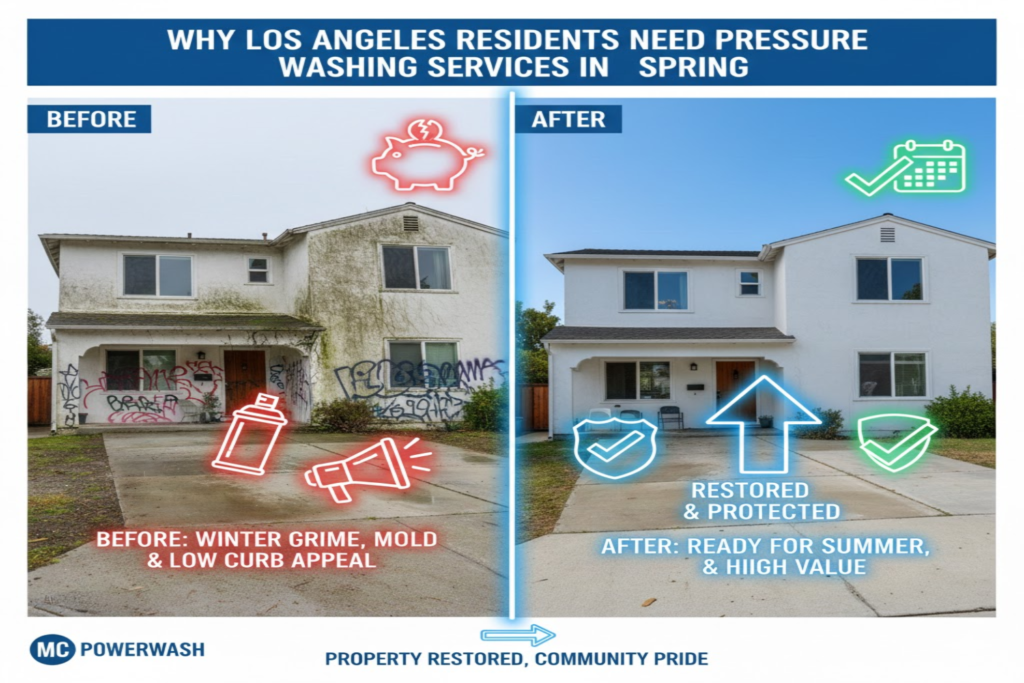
- Economic Consequences and “Visual Blight”: Real estate studies consistently show that “visual blight”—the presence of graffiti and litter—has a direct negative correlation with property values. For commercial zones, the impact is even more severe. High-density tagging reduces consumer “dwell time” and foot traffic. If a storefront is covered in graffiti, shoppers subconsciously perceive the area as unsafe, leading to a decline in local business revenue.
- Environmental Safety and Watershed Protection: In coastal urban centers like Los Angeles, the environmental cost of graffiti removal is a major concern. Standard spray paints contain heavy metals and VOCs (Volatile Organic Compounds). When these are washed off haphazardly, they enter the storm drain system. Because Los Angeles utilizes a separate sewer system, these toxins flow directly into the Pacific Ocean. Utilizing “eco-friendly” biodegradable soy-based cleaners is not just a preference; it is a necessity for protecting the local marine watershed.
- Community Resilience and Psychology: Rapid removal is a form of “non-verbal communication.” It tells vandals that the residents are vigilant and that the neighborhood is actively managed. This psychological barrier is often more effective than security cameras. A clean wall represents a community that is resilient and refuses to be intimidated by petty vandalism.
6. Comparison Table: Professional Removal vs. DIY “Buffing”
Many property owners choose to simply paint over graffiti—a process known in the industry as “buffing.” While inexpensive, this often creates a new set of problems.
| Feature | Professional Graffiti Removal | DIY “Painting Over” (Buffing) |
| Aesthetic Result | Restores the original texture and color of the masonry. | Creates a “patchwork quilt” look with mismatched paint. |
| Longevity | Permanently extracts the pigment from the pores. | Layers of paint can peel; dark tags often “bleed” through. |
| Surface Health | Preserves the natural “breathability” of brick/stone. | Traps moisture inside the wall, leading to structural rot. |
| Property Value | Maintains the “Like New” curb appeal of the building. | Decreases value by signaling a “quick-fix” mentality. |
| Proactive Protection | Allows for the application of anti-graffiti barriers. | No protection; the new paint is just a fresh canvas. |
7. Anti-Graffiti Coatings: The Proactive Approach
If your property is a frequent target for vandals, reactive cleaning isn’t enough. You need a proactive defense strategy.
Investing in “Sacrificial” and Permanent Barriers
- Sacrificial Coatings: These are typically wax-based clear coats. They are “sacrificial” because when the wall is tagged, you simply use a low-pressure hot water wash to melt the wax. The wax—and the graffiti—wash away together. The wall is then recoated. This is the preferred method for historic buildings because it is non-invasive.
- Permanent Silane-Based Coatings: This is the “high-tech” solution. These coatings use nanotechnology to create a cross-linked molecular bond that makes the surface virtually non-stick. Spray paint simply cannot bond to the surface; it “beads up” like water on a freshly waxed car. In the high-vandalism areas of Los Angeles, these coatings pay for themselves within the first year by drastically reducing cleaning labor costs.
- Strategic Landscaping (Defensive Greenery): Sometimes the best barrier is a biological one. Professional “Crime Prevention Through Environmental Design” (CPTED) specialists suggest planting thorny bushes (like Bougainvillea or Barberry) against walls. In Los Angeles, these plants thrive and create a physical “no-go zone” for vandals while simultaneously improving the property’s oxygen output and aesthetics.
9. Conclusion: The Power of Persistent Maintenance
The battle against vandalism is won through persistence. As we have explored, the “speed of restoration” is your greatest weapon. By reporting incidents through the proper channels—whether it’s the MyLA311 app in Los Angeles or a direct call to a professional team—you are doing more than just cleaning a wall; you are reclaiming your property’s dignity.
Final Call to Action: Don’t let a vandal have the last word. Empower yourself to be the eyes and ears of your community. Whether you choose to invest in permanent nanotechnology coatings or simply stay vigilant with your reporting, your actions prevent the “broken windows” cycle from taking hold. A clean city is a safe city, and it begins with a single report.
8. Frequently Asked Questions (FAQs)
Will the city remove graffiti on my private house for free?
In some jurisdictions, yes—but with caveats. In Los Angeles, the MyLA311 system allows you to request removal on private property, but you must sign a waiver. Furthermore, the city will likely “buff” (paint over) the tag with a generic gray or tan paint rather than professionally restoring the original brick or stone.
What is the best chemical for removing spray paint from brick?
For DIYers, a citrus-based gel is the safest starting point. However, professional “Graffiti Removers” usually contain N-Methyl-2-pyrrolidone (NMP), which requires specialized gloves and respirators. For brick, the secret isn’t just the chemical; it’s the “dwell time” and the use of hot water extraction.
How do I report graffiti on a freeway overpass?
In Los Angeles, freeway overpasses are the jurisdiction of Caltrans, not the LAPD or the local city council. You can report these directly through the Caltrans Maintenance Service Request portal. Because these areas involve high-speed traffic, never attempt to clean them yourself.
Can I get in trouble for “street art” if I didn’t have a permit?
Yes. Legally, the intent or artistic quality of the work does not matter; if it was done without the explicit written permission of the property owner and the necessary city permits, it is classified as vandalism. Unpermitted murals are often removed by the city just as quickly as tags.