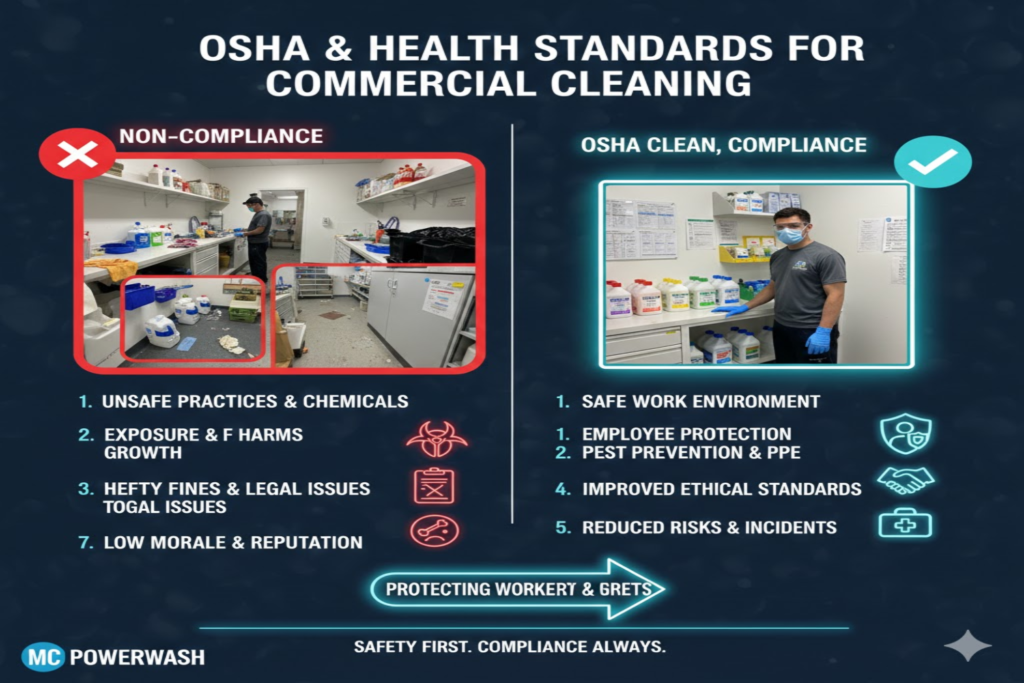
Commercial cleaning in high-rise buildings, offices, retail spaces, and multi-family properties must follow strict OSHA (Occupational Safety and Health Administration) and public health standards to protect workers, building occupants, and the environment. In Los Angeles, where high-density urban structures, coastal humidity, and strict local health codes apply, compliance is especially critical during tasks like garbage chute cleaning, pressure washing los angeles, floor care, and restroom sanitation. OSHA’s general industry standards (29 CFR 1910) cover hazard communication, personal protective equipment (PPE), respiratory protection, walking-working surfaces, and bloodborne pathogens. Health standards from Cal/OSHA, the Los Angeles County Department of Public Health, and building codes require proper ventilation, chemical handling, slip/fall prevention, and biohazard management. Non-compliance can result in heavy fines, work stoppages, increased insurance premiums, and liability for injuries or illnesses. Following these standards ensures worker safety, reduces liability, and maintains hygienic building conditions. Regular training, documented procedures, and proper equipment are essential for every commercial cleaning operation.
Understanding OSHA’s Role in Commercial Cleaning
OSHA, under the U.S. Department of Labor, sets and enforces workplace safety standards to prevent injuries, illnesses, and fatalities. For commercial cleaning, the most relevant standards fall under General Industry (29 CFR 1910) rather than Construction. Key rules cover chemical exposure, PPE requirements, fall protection, confined space entry, and hazard communication (HazCom). In Los Angeles, Cal/OSHA enforces federal standards plus stricter state-specific rules, including aerosol transmissible diseases and heat illness prevention. Violations are classified as serious, repeat, or willful, with penalties reaching tens of thousands of dollars per incident. OSHA also requires employers to provide a workplace free from recognized hazards. Proper training, safety data sheets (SDS), and incident reporting are mandatory. Compliance protects both workers and the business from legal and financial consequences.
Key OSHA Standards for Chemical Handling in Cleaning
Commercial cleaners frequently use degreasers, disinfectants, acids, and alkaline cleaners that can cause skin burns, respiratory irritation, or eye damage. OSHA’s Hazard Communication Standard (29 CFR 1910.1200) requires employers to maintain SDS for every chemical, label containers properly, and train workers on safe handling. The Personal Protective Equipment standard (1910.132) mandates gloves, goggles, respirators, and protective clothing based on chemical risk assessments. When using pressure washers or sprayers, employers must ensure workers are trained to prevent injection injuries. Proper storage, spill response plans, and ventilation are required. In Los Angeles, Cal/OSHA also enforces strict rules for indoor air quality when using volatile chemicals. Written chemical safety programs and regular refresher training are mandatory. Compliance prevents acute injuries and long-term health effects.
Respiratory Protection Requirements
Many commercial cleaning tasks—pressure washing chutes, using strong disinfectants, or cleaning moldy areas—generate mists, vapors, or dust that require respiratory protection. OSHA’s Respiratory Protection standard (1910.134) requires a written respiratory protection program, medical evaluations, fit testing, and proper selection of NIOSH-approved respirators. Half-face or full-face respirators with organic vapor cartridges are common for solvent-based cleaners. Powered air-purifying respirators (PAPRs) may be needed in poorly ventilated chutes. Employers must train workers on proper use, maintenance, and limitations. Fit testing must be repeated annually or when facial changes occur. In high-humidity environments, proper seal checks are critical. Respiratory protection prevents inhalation injuries and long-term lung damage.
Fall Protection & Walking-Working Surfaces
- Cleaning high walls, chutes, or elevated areas in commercial buildings exposes workers to fall risks.
- OSHA’s Walking-Working Surfaces standard (1910.22–1910.30) requires clean, dry, level floors free of slip hazards.
- When workers use ladders, scaffolds, or work near open sides, fall protection (guardrails, safety nets, or personal fall arrest systems) is mandatory at heights above 4 feet. Fixed ladders over 24 feet require cages or ladder safety devices.
- Portable ladders must be inspected before each use and set at the correct angle. In Los Angeles, Cal/OSHA adds requirements for heat illness prevention when working outdoors or in hot mechanical rooms.
- Proper fall protection training and equipment prevent one of the leading causes of serious injuries in cleaning operations.
Bloodborne Pathogens & Biohazard Exposure
Commercial cleaners may encounter blood, bodily fluids, used needles, or medical waste in restrooms, trash chutes, or common areas. OSHA’s Bloodborne Pathogens standard (1910.1030) requires an exposure control plan, universal precautions, engineering controls (sharps containers), and PPE. Hepatitis B vaccination must be offered to at-risk employees. Training on proper handling, spill cleanup, and post-exposure procedures is mandatory. In buildings with medical offices or clinics, additional precautions apply. Biohazard waste must be disposed of according to local health regulations. Compliance reduces risk of serious infections. Regular training and updated exposure plans are essential.
Confined Space Entry for Chute & Mechanical Cleaning
Some chute cleaning requires entry into the compactor room, basement access points, or mechanical areas classified as confined spaces. OSHA’s Permit-Required Confined Spaces standard (1910.146) mandates atmospheric testing, ventilation, rescue plans, and permits before entry. Workers need training on hazards, communication, and emergency procedures. Most professional cleaning companies avoid entry by using top/bottom access and extension tools. When entry is unavoidable, strict protocols apply. In Los Angeles, Cal/OSHA enforces additional confined space rules. Compliance prevents asphyxiation, engulfment, and other serious incidents. Entry should be the last resort in chute cleaning.
Slip, Trip & Fall Prevention in Commercial Cleaning
- Wet floors during mopping, pressure washing runoff, or spill cleanup create major slip hazards.
- OSHA requires immediate warning signs (wet floor cones, barricades) and prompt drying or diversion of water. Non-slip footwear is mandatory for workers.
- Electrical cords must be managed to prevent trip hazards. Cleaning during low-traffic hours reduces exposure.
- In Los Angeles, Cal/OSHA emphasizes heat illness prevention when working in hot mechanical rooms or outdoors.
- Proper housekeeping and signage prevent one of the most common workplace injuries.
- Regular safety audits identify and correct hazards. Preventing slips protects workers and reduces liability.
Hazard Communication & Training Requirements
Every commercial cleaning company must maintain a written HazCom program under OSHA 1910.1200. This includes an inventory of all chemicals, SDS access for workers, proper labeling, and documented training. Employees must understand chemical hazards, safe handling, PPE requirements, and emergency procedures. Training must occur upon hiring, when new chemicals are introduced, and annually. In multi-lingual workforces, training must be provided in languages workers understand. Records must be kept for at least one year. Effective communication prevents chemical exposures and ensures proper response to spills. It is a foundational OSHA requirement.
Recordkeeping & Incident Reporting
OSHA requires employers to maintain records of work-related injuries and illnesses (OSHA 300, 300A, 301 logs) if they have 10 or more employees. Serious incidents (hospitalization, amputation, eye loss) must be reported within 8–24 hours. Near-misses and minor incidents should be documented internally. Training records, SDS, exposure control plans, and confined space permits must be retained. In Los Angeles, Cal/OSHA may require additional reporting for certain exposures. Accurate recordkeeping demonstrates compliance during inspections. It also helps identify patterns and improve safety programs. Proper documentation protects the company legally and financially.
Cal/OSHA & Los Angeles-Specific Health Standards
California enforces stricter rules through Cal/OSHA, including aerosol transmissible diseases (ATD), heat illness prevention, and injury & illness prevention programs (IIPP). Los Angeles County Department of Public Health requires proper sanitization in multi-family housing and public accommodations. Local building codes mandate ventilation and fire safety in waste systems. Pressure washing runoff must be directed to sanitary sewers, not storm drains. Compliance with these overlapping standards is mandatory. Many professional cleaning companies carry Cal/OSHA certifications. Local enforcement ensures higher safety levels. Understanding both federal and state requirements is essential in Los Angeles.
Comparison Table: Key OSHA & Health Standards for Commercial Cleaning
| Standard / Requirement | OSHA Reference | Key Requirements | Applies To | Potential Penalty for Violation (2025 est.) | Importance Level |
| Hazard Communication (HazCom) | 1910.1200 | SDS access, labeling, training, written program | All chemical use | $15,625 per violation | Critical |
| Personal Protective Equipment (PPE) | 1910.132 | Hazard assessment, PPE provision, training, maintenance | All cleaning tasks | $16,131 per violation | Critical |
| Respiratory Protection | 1910.134 | Written program, fit testing, medical evaluation, training | Chemical mists, vapors | $16,131 per violation | High |
| Walking-Working Surfaces / Fall Protection | 1910.22–1910.30 | Clean floors, guardrails, fall arrest at 4+ ft, ladder safety | Elevated cleaning, wet floors | $16,131 per serious violation | Critical |
| Bloodborne Pathogens | 1910.1030 | Exposure control plan, universal precautions, vaccination offer, training | Restrooms, medical waste | $17,400 per violation | High |
| Confined Space Entry | 1910.146 | Permit system, atmospheric testing, rescue plan, training | Chute compactor rooms | $16,131 per violation | Critical |
| Heat Illness Prevention (Cal/OSHA) | Title 8, Section 3395 | Water, shade, rest, training, high-heat procedures | Outdoor or hot indoor work | $25,000+ per serious violation | High |
| Injury & Illness Prevention Program | Title 8, Section 3203 | Written IIPP, hazard assessment, training, recordkeeping | All California employers | $7,000–$25,000 per violation | Mandatory |
OSHA Inspection & Citation Trends in Commercial Cleaning
OSHA inspections often focus on PPE violations, missing SDS, inadequate training, and fall hazards. In recent years, repeat violations for respiratory protection and hazard communication have carried the highest penalties. Cal/OSHA frequently cites heat illness prevention failures in outdoor pressure washing operations. Proper documentation, visible safety programs, and employee interviews help during inspections. Many citations stem from lack of written programs or incomplete training records. Proactive compliance audits reduce risk. Correcting violations quickly and implementing corrective actions prevents escalation. Staying ahead of common citations protects the business.
Conclusion
OSHA and health standards for commercial cleaning exist to prevent injuries, illnesses, and fatalities while ensuring safe, hygienic building environments. In Los Angeles, Cal/OSHA and local health regulations add layers of requirements for chemical handling, respiratory protection, fall prevention, confined spaces, and heat illness. Key standards cover hazard communication, PPE, bloodborne pathogens, walking-working surfaces, and confined space entry. Compliance involves written programs, employee training, proper equipment, and accurate recordkeeping. Violations carry substantial fines and can result in work stoppages or increased insurance costs. Regular safety audits, employee involvement, and professional training keep operations compliant. Following these standards protects workers, reduces liability, and maintains high-quality service. In commercial cleaning, safety and health compliance are non-negotiable responsibilities.
Frequently Asked Questions (FAQs)
1. What is the most frequently cited OSHA violation in commercial cleaning?
Hazard Communication (HazCom) violations are among the most common. Missing or inaccessible SDS, improper labeling, and lack of employee training are frequent issues. Proper chemical inventory, SDS binders, and annual training prevent most citations. It is a foundational standard that applies to nearly every cleaning operation.
2. Do cleaners need respirators when pressure washing waste chutes?
Yes, in most cases. Pressure washing creates mists and aerosols that can contain bacteria, mold, or chemical vapors. OSHA requires a respiratory protection program, fit testing, and appropriate NIOSH-approved respirators (usually half-face with organic vapor cartridges). Medical evaluations are also required. Proper respiratory protection is mandatory for safe chute cleaning.
3. What PPE is required for commercial cleaners in Los Angeles?
Minimum PPE includes chemical-resistant gloves, safety goggles, non-slip footwear, and long sleeves/pants. Respirators are required for mists or vapors. Face shields or chemical suits are needed for high-exposure tasks. Cal/OSHA enforces strict PPE assessment and training rules. Employers must provide and maintain all PPE at no cost to workers.
4. How does Cal/OSHA differ from federal OSHA for cleaning companies?
Cal/OSHA enforces federal standards plus stricter state rules, including aerosol transmissible diseases, heat illness prevention, and injury & illness prevention programs (IIPP). Penalties are often higher, and some requirements (like written IIPP) are more detailed. California employers must comply with both federal and Cal/OSHA regulations. Local enforcement is rigorous in Los Angeles.
5. Are commercial cleaners required to have fall protection training?
Yes, OSHA requires training on fall hazards whenever workers are exposed to falls of 4 feet or more. This includes ladder safety, scaffold use, and personal fall arrest systems. Training must be documented and repeated when changes occur. Fall protection is one of the leading causes of serious injuries in cleaning operations.
6. What must be included in a bloodborne pathogens program?
The program must include an exposure control plan, universal precautions, engineering controls (sharps containers), PPE, Hepatitis B vaccination offer, training, and post-exposure procedures. It applies to any worker who may encounter blood or bodily fluids. Annual training and recordkeeping are mandatory. Compliance reduces infection risk significantly.
7. How often must respiratory fit testing be conducted?
Fit testing is required before initial use, whenever a different respirator is used, and at least annually thereafter. Additional testing is needed after facial changes (weight loss, dental work). Qualitative or quantitative fit testing must be documented. Proper fit ensures respiratory protection effectiveness.
8. What records must commercial cleaning companies keep for OSHA?
OSHA 300, 300A, and 301 logs for injuries/illnesses (if 10+ employees), training records, SDS, exposure control plans, respiratory protection program documents, and PPE assessments. Records must be retained for specific periods (1–5 years depending on type). Proper recordkeeping is required during inspections.
9. Can a cleaning company be fined for not having a written IIPP in California?
Yes, Cal/OSHA requires every employer to have a written Injury and Illness Prevention Program (IIPP). Violations are common and carry significant penalties. The IIPP must include hazard identification, training, communication, and corrective actions. It is one of the most cited standards in California.
10. What should be done if an OSHA inspector arrives at a cleaning site?
Remain calm, ask for identification and the reason for the visit. Designate a company representative to accompany the inspector. Provide requested documents promptly. Do not volunteer unnecessary information. Take notes and photos of the inspection process. Contact legal counsel if serious violations are alleged. Cooperation and preparation minimize impact.