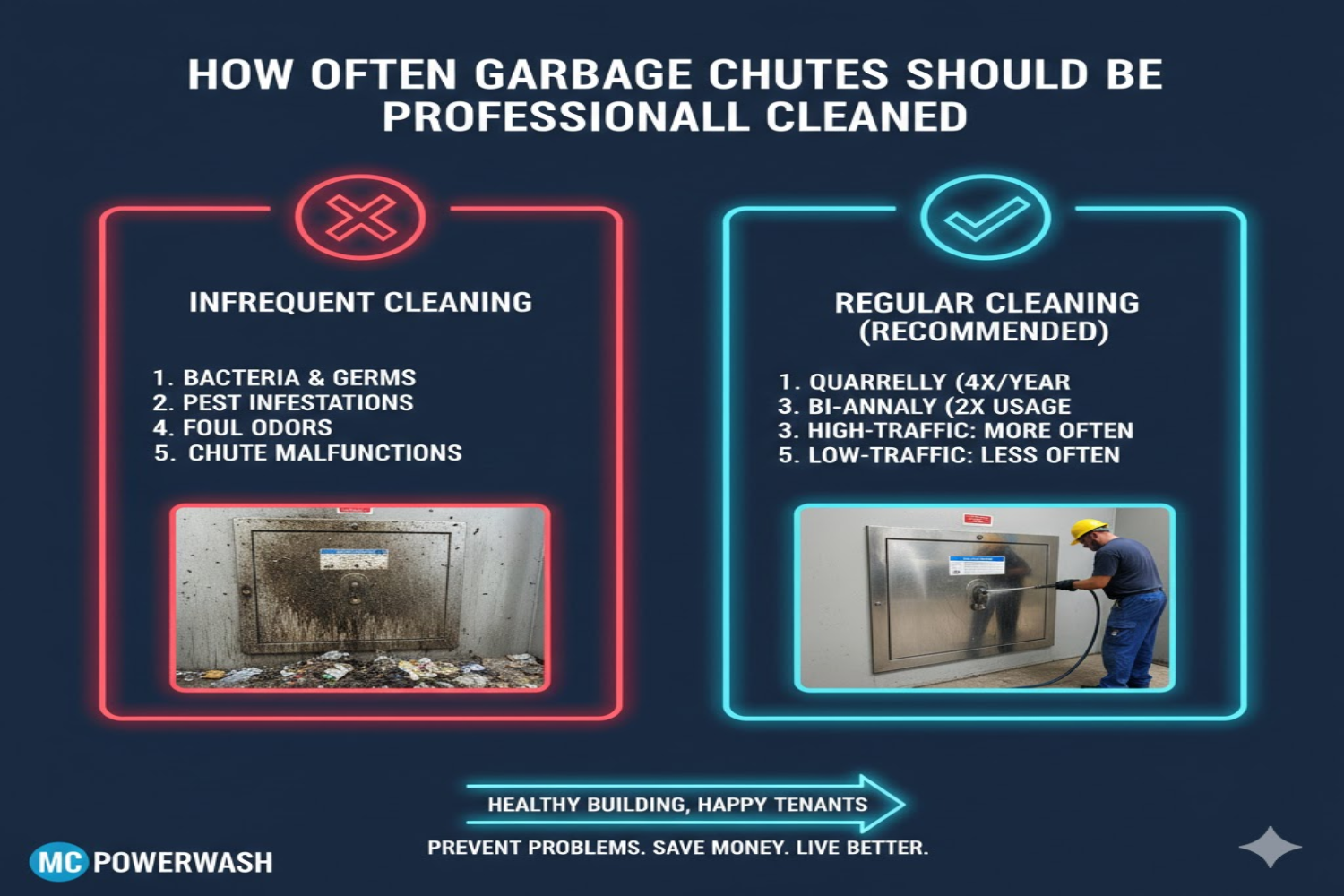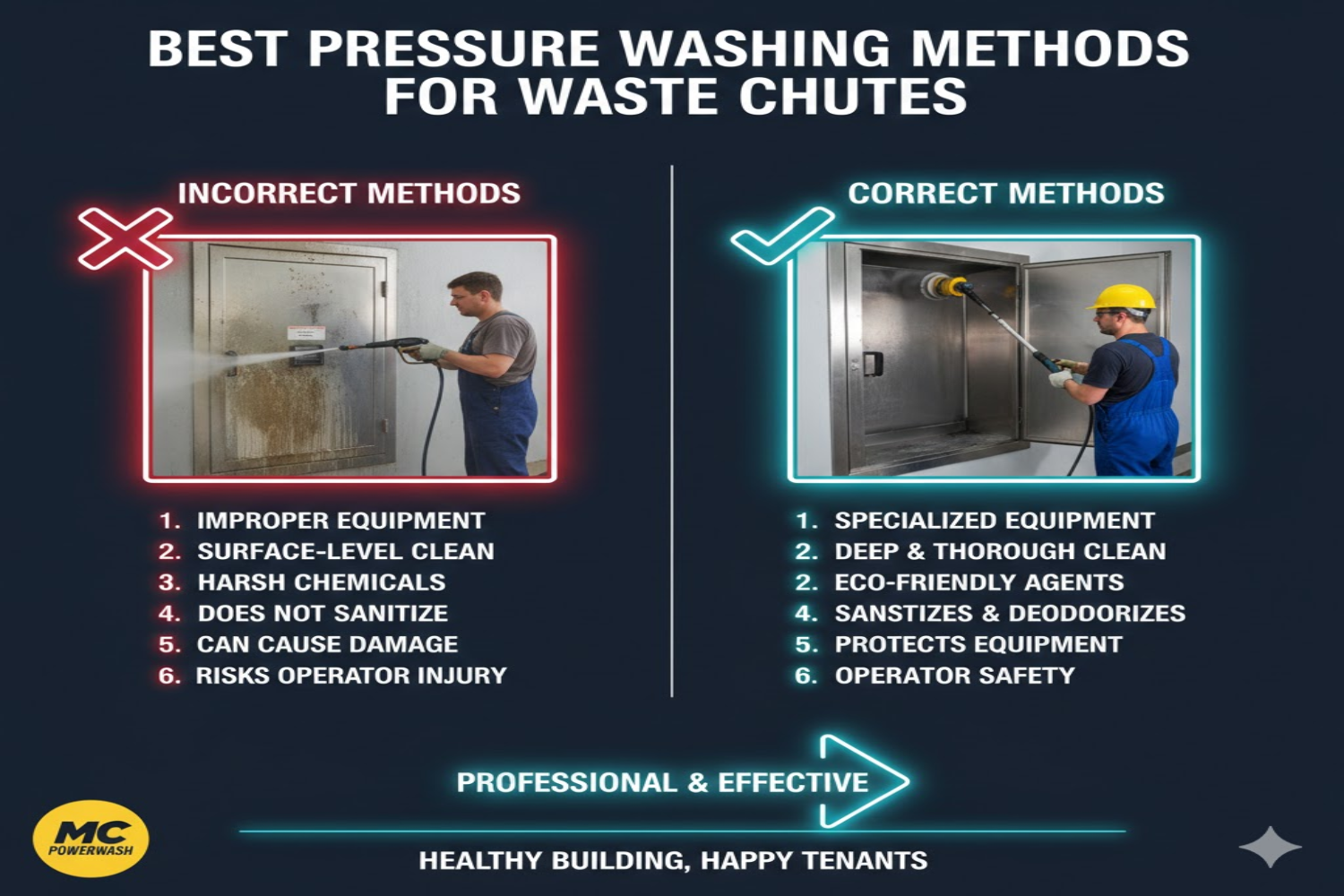
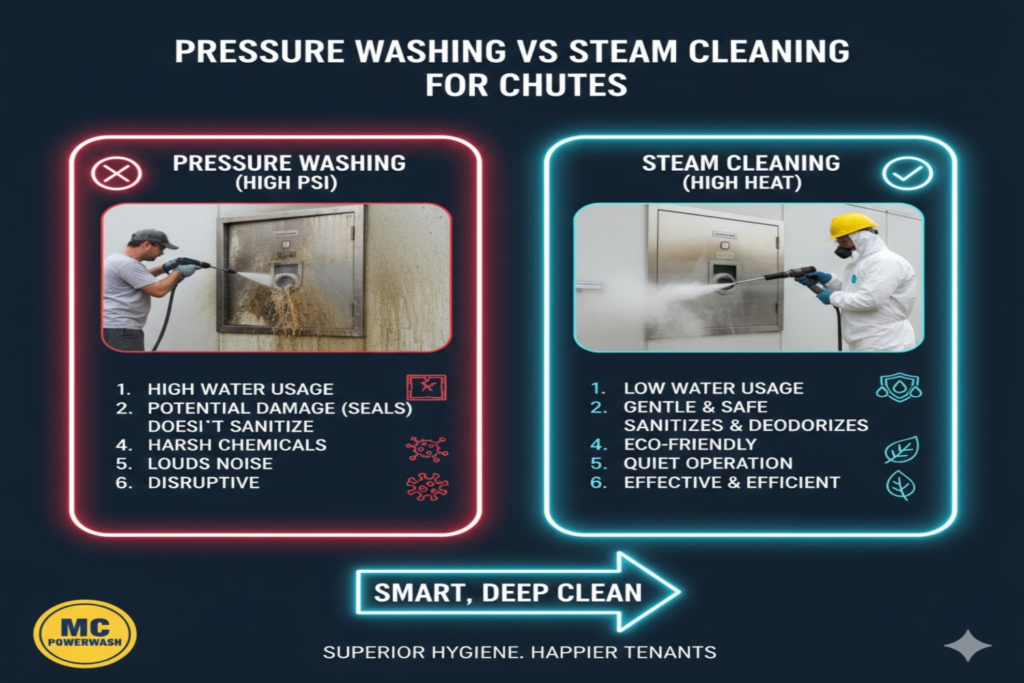
Pressure washing and steam cleaning are two of the most commonly compared methods for professional garbage chute (waste chute) cleaning in multi-story buildings. In Los Angeles, where high-rise apartments and condos face rapid grease and food residue buildup due to warm weather and dense occupancy, both techniques are widely used. Pressure washing uses high-pressure hot water (typically 180–220°F at 2,000–4,000 PSI) to blast away thick sludge, grease, and stuck debris from chute walls. Steam cleaning relies on high-temperature vapor (220–300°F) to melt grease, sanitize, and loosen residue with minimal water volume. Each method has unique strengths: pressure washing excels at heavy mechanical removal, while steam cleaning offers superior sanitization and chemical reduction. The right choice depends on chute condition, building height, environmental regulations, and budget. Many professionals combine both for maximum hygiene. Understanding the differences helps property managers select the most effective and compliant solution.
Understanding Pressure Washing for Garbage Chutes
Pressure washing uses a high-pressure pump to force hot water through specialized rotating nozzles or chain flails inside the chute. The combination of mechanical force and heat dislodges even thick, hardened grease layers that have built up over months. In Los Angeles, where food waste decomposes quickly, pressure washing Los angeles removes large volumes of sludge in one pass. Biodegradable degreasers are often injected into the water stream to emulsify fats and proteins. The method is fast, covers large surface areas, and flushes debris downward into containment. It is the industry standard for deep cleaning in high-rise buildings. Pressure washing also provides thermal sanitization by killing many bacteria and mold spores. When performed correctly, it leaves the chute clean, free-flowing, and significantly fresher.
How Steam Cleaning Works on Waste Chutes
Steam cleaning uses a boiler to generate high-temperature dry or wet vapor (220–300°F) that is directed through wands or specialized chute nozzles. The heat melts grease and oils, while steam penetrates pores to loosen residue and kill surface bacteria. Because steam contains very little liquid water, it produces minimal runoff compared to pressure washing. This makes it advantageous in buildings with strict wastewater restrictions. Steam also sanitizes more deeply than hot water alone due to higher temperature and vapor action. It is gentler on metal surfaces and leaves no chemical residue if used without additives. Steam cleaning excels at odor reduction and mold elimination. It is often preferred for maintenance or lighter soiling between major cleans.
Pressure Washing Advantages for Heavy Buildup
- Pressure washing is superior when chutes have thick, layered grease and food sludge that has hardened over months.
- The high mechanical force (2,000–4,000 PSI) physically removes compacted debris that steam alone cannot dislodge.
- Hot water melts fats quickly, allowing complete flushing of large volumes of waste.
- Rotating nozzles ensure 360-degree coverage, reaching seams, welds, and bends.
- It is faster for large high-rise chutes because it covers more surface area in less time.
- Pressure washing is the go-to method for heavily soiled chutes in food-heavy buildings.
- It provides immediate visible results and restores free flow effectively.
- The method is highly scalable for tall structures.
- Pressure washing handles the toughest commercial chute conditions.
Steam Cleaning Advantages for Sanitization & Low Water
Steam cleaning offers deeper thermal sanitization because vapor temperatures often exceed 250°F, killing a wider range of bacteria, mold spores, and pathogens more effectively than hot water. It uses significantly less water (often 90% less than pressure washing), producing minimal runoff. This is a major benefit in buildings with limited drainage or strict environmental rules. Steam penetrates microscopic pores and crevices better than liquid water, reaching hidden residue. It leaves no chemical residue when used alone, making it ideal for sensitive environments. Steam reduces odor more thoroughly by breaking down volatile compounds at high heat. It is gentler on chute metal and fire dampers. Steam cleaning is preferred for hygiene-focused maintenance.
Pressure Washing vs Steam Cleaning – Speed & Coverage
Pressure washing is generally faster for large or heavily soiled chutes because high pressure and volume allow quick removal of bulk waste. A 10–20 story building can often be cleaned in 6–12 hours. Steam cleaning is slower due to lower water volume and the need for longer dwell time to melt and sanitize. However, steam covers vertical surfaces more evenly without splashing. Pressure washing flushes debris downward efficiently, while steam requires more wiping or vacuuming. Speed favors pressure washing for deep cleans; steam is better for targeted or lighter jobs. Both methods can be combined—pressure for bulk removal, steam for final sanitization. The choice depends on time constraints and chute condition.
Water Usage & Environmental Impact Comparison
Pressure washing uses large volumes of hot water (often 3–8 gallons per minute), producing significant runoff that must be contained or directed to sanitary drains. In Los Angeles, runoff regulations require careful management to avoid fines. Steam cleaning uses far less water (typically 0.5–1.5 gallons per hour), generating minimal liquid waste. This makes steam more environmentally friendly and easier to comply with wastewater rules. Pressure washing often requires biodegradable degreasers, while steam can work with little to no chemicals. Steam produces less wastewater and fewer disposal issues. Environmental impact favors steam for eco-conscious buildings. Both can be green when proper detergents are used. Water usage is a key decision factor.
Cost Comparison – Equipment & Operational Expenses
Pressure washing requires truck-mounted or trailer-mounted hot-water units, which are expensive to own or rent. Operating costs include fuel, water, and degreaser. Labor time is shorter due to faster cleaning. Steam cleaning equipment (boilers and vapor units) has higher upfront costs and slower operation, increasing labor expenses. Pressure washing is generally cheaper per clean for large jobs because of speed. Steam may cost more due to longer time on site. Both methods offer discounts for regular contracts. Pressure washing is more cost-effective for routine deep cleans. Steam becomes economical when runoff disposal or chemical use is restricted. Total cost depends on building size and frequency.
Surface Safety & Chute Material Considerations
- Pressure washing at proper PSI (2,000–4,000) is safe for stainless steel and galvanized chutes when using rotating nozzles.
- Excessive pressure risks damaging welds or fire dampers.
- Steam cleaning is gentler on metal because it uses no mechanical force, reducing risk of pitting or seal damage.
- Both are safe when technicians are experienced.
- Concrete-lined older chutes tolerate pressure better but may absorb more water.
- Steam is preferred for delicate or historic chutes.
- Proper technique protects chute integrity.
- Surface safety should guide method selection.
- Both preserve chute lifespan when used correctly.
Odor Elimination Comparison
Pressure washing removes the bulk odor source (grease and sludge) very effectively, especially when combined with degreasers and deodorizers. Hot water flushes away odor molecules. Steam cleaning penetrates deeper and destroys odor compounds at higher temperatures, often providing slightly better immediate odor reduction. Both methods eliminate most smells when followed by enzymatic or residual treatments. Pressure washing is faster at bulk removal; steam excels at deep odor destruction. Many professionals combine both for maximum freshness. Odor results depend on post-cleaning treatments. Both achieve excellent long-term odor control.
Comparison Table: Pressure Washing vs Steam Cleaning for Garbage Chutes
| Aspect | Pressure Washing | Steam Cleaning | Winner / Best Use Case |
| Grease & Sludge Removal | Very High (mechanical force + heat) | High (thermal melting) | Pressure washing for heavy buildup |
| Bacteria / Mold Sanitization | High (hot water kills many pathogens) | Very High (higher vapor temperature) | Steam cleaning for maximum kill |
| Water Usage | High (3–8 GPM) | Very Low (0.5–1.5 GPH) | Steam for low runoff / eco-compliance |
| Runoff Volume & Disposal | High volume – requires containment | Minimal – easier to manage | Steam in strict wastewater areas |
| Cleaning Speed | Faster (covers large areas quickly) | Slower (lower volume, longer dwell) | Pressure washing for large high-rises |
| Chemical Requirement | Usually needs degreaser | Can be chemical-free or minimal | Steam for low-chemical preference |
| Surface Safety (Metal Chutes) | Safe at proper PSI | Very gentle – no mechanical force | Steam for older or delicate chutes |
| Odor Elimination | Excellent with degreasers | Excellent – deep vapor penetration | Steam slightly better for stubborn smells |
| Cost per Clean | Lower labor time – often cheaper | Higher labor time – usually more expensive | Pressure washing for routine deep cleans |
| Environmental Impact | Medium (higher water + chemicals) | Low (minimal water & chemical use) | Steam for eco-sensitive buildings |
When to Choose Pressure Washing Over Steam
Choose pressure washing when the chute has thick, layered grease and heavy sludge that requires mechanical removal. It is faster and more cost-effective for large high-rise buildings with routine deep-clean needs. Pressure washing excels at flushing large volumes of waste downward into containment. It is the preferred method for heavily soiled chutes. Use it when speed and bulk removal are priorities. Pressure washing is the go-to for most commercial chute cleaning jobs. It handles the toughest conditions efficiently. Choose it for standard maintenance schedules.
When to Choose Steam Cleaning Over Pressure Washing
Choose steam cleaning when runoff volume must be minimized or chemical use is restricted. It is ideal for buildings with strict wastewater rules or limited drainage. Steam provides superior sanitization and odor destruction without heavy mechanical force. It is gentler on older chutes or those with delicate seals. Steam excels at maintenance between deep cleans. Use it when hygiene and low environmental impact are top priorities. Steam is preferred for targeted or lighter soiling. It complements pressure washing in hybrid approaches.
Conclusion
Both pressure washing and steam cleaning are highly effective for garbage chute cleaning, but they serve slightly different purposes. Pressure washing is faster, more powerful for heavy grease and sludge removal, and cost-effective for routine deep cleans in high-rise buildings. Steam cleaning provides deeper sanitization, uses far less water, and is gentler on surfaces, making it ideal when runoff or chemical restrictions apply. In Los Angeles, where high-density properties face rapid buildup, many professionals combine both—pressure washing for bulk removal and steam for final sanitization and odor control. The best method depends on chute condition, building regulations, budget, and hygiene goals. Regular professional service using the right technique keeps chutes clean, safe, and odor-free. Choosing wisely ensures long-term hygiene, resident satisfaction, and compliance.
Frequently Asked Questions (FAQs)
1. Which is more effective for heavy grease buildup in chutes?
Pressure washing is generally more effective for heavy, layered grease and sludge. The high mechanical force (2,000–4,000 PSI) physically removes thick deposits that steam alone struggles to dislodge. Hot water melts grease, making it easier to flush away. Pressure washing handles tough commercial buildup faster and more completely.
2. Does steam cleaning use less water than pressure washing?
Yes, steam cleaning uses significantly less water (often 90% less) because it relies on high-temperature vapor rather than high-volume liquid. This produces minimal runoff, making it easier to comply with wastewater regulations. Pressure washing uses several gallons per minute. Steam is preferred when water volume is a concern.
3. Which method kills more bacteria and mold in the chute?
Steam cleaning typically kills more bacteria and mold because vapor temperatures often exceed 250°F, providing deeper thermal sanitization. Pressure washing with hot water (180–220°F) is also very effective but slightly less intense. Both methods sanitize well when combined with disinfectants. Steam has a small edge for maximum pathogen reduction.
4. Is pressure washing safe for stainless steel garbage chutes?
Yes, when done correctly at 2,000–4,000 PSI with rotating nozzles, pressure washing is safe for stainless steel. Professionals avoid excessive pressure near welds or seals. It is one of the most commonly used methods for metal chutes. Proper technique prevents damage while removing buildup effectively.
5. Can steam cleaning remove thick grease layers by itself?
Steam cleaning melts and loosens grease effectively but is slower and less powerful than pressure washing for very thick, hardened layers. It works best on moderate buildup or as a follow-up to pressure washing. For heavy sludge, steam alone may require multiple passes. Combining both methods gives the best results.
6. Which method produces less runoff and is more eco-friendly?
Steam cleaning is more eco-friendly because it uses minimal water and can often work without chemicals. Pressure washing produces higher runoff volumes that require containment and treatment. Steam is preferred in buildings with strict environmental or wastewater rules. Both can be green with biodegradable additives.
7. How much faster is pressure washing compared to steam?
Pressure washing is usually 30–50% faster for large or heavily soiled chutes because high pressure and volume remove bulk waste quickly. Steam cleaning is slower due to lower water flow and the need for longer contact time. Pressure washing is better for time-sensitive or large-scale jobs. Speed depends on chute condition.
8. Can I use both pressure washing and steam cleaning together?
Yes—many professional cleaners use pressure washing first to remove bulk grease and sludge, then follow with steam cleaning for deeper sanitization and odor reduction. This hybrid approach combines the strengths of both methods. It provides maximum hygiene and freshness. Combining is common in high-end or high-traffic buildings.
9. Which method is better for odor elimination after cleaning?
Steam cleaning often provides slightly better immediate odor reduction because higher vapor temperatures break down volatile compounds more thoroughly. Pressure washing removes the bulk odor source very effectively when combined with degreasers and deodorizers. Both achieve excellent results with proper post-treatment. Steam has a small edge for stubborn smells.
10. What is the most important factor when choosing between the two?
The most important factor is the chute condition: heavy grease and sludge favor pressure washing for mechanical removal. Strict runoff rules, chemical restrictions, or need for maximum sanitization favor steam cleaning. Budget, time, and building regulations also matter. Most professionals recommend pressure washing as the primary method with steam as a strong complement.