A luxury patio in Los Angeles is designed to be an oasis—a seamless transition from the comfort of the indoors to the beauty of the California sun. However, nothing shatters this aesthetic faster than the presence of flattened, blackened chewing gum or deep-set organic stains. Homeowners often treat these issues as mere “surface dirt,” but the reality is much more complex. Gum and organic debris are not just sitting on top of your patio; they are aggressive invaders that bond with the substrate on a molecular level.
The true danger of these contaminants lies in a phenomenon known as “Shadowing.” This occurs when a homeowner successfully removes the physical piece of gum or debris, but a permanent dark or light “ghost” remains in its place. This happens because the oils from the gum have migrated into the stone’s pores, or because aggressive scrubbing has “etched” the area, changing the stone’s texture forever. To achieve a pristine result, one must adopt a Zero-Tolerance Policy that balances raw mechanical force with sophisticated chemical finesse. This guide provides a professional-grade roadmap for eradicating these stubborn pollutants without compromising the integrity of your stone.
2. The Chewing Gum Challenge: Hardened vs. Fresh
Chewing gum is essentially a synthetic thermoplastic polymer. When first dropped, it is elastic and highly adhesive. However, under the relentless Southern California UV rays, it undergoes a chemical transformation known as The “Black Spot” Evolution.
- Carbonized Fossils: As gum sits on a hot patio, it loses its moisture and attracts dust, smog, and carbon particles. It eventually hardens into a black, rock-like fossil that is virtually inseparable from the stone. At this stage, it has effectively “fused” with the patio’s texture.
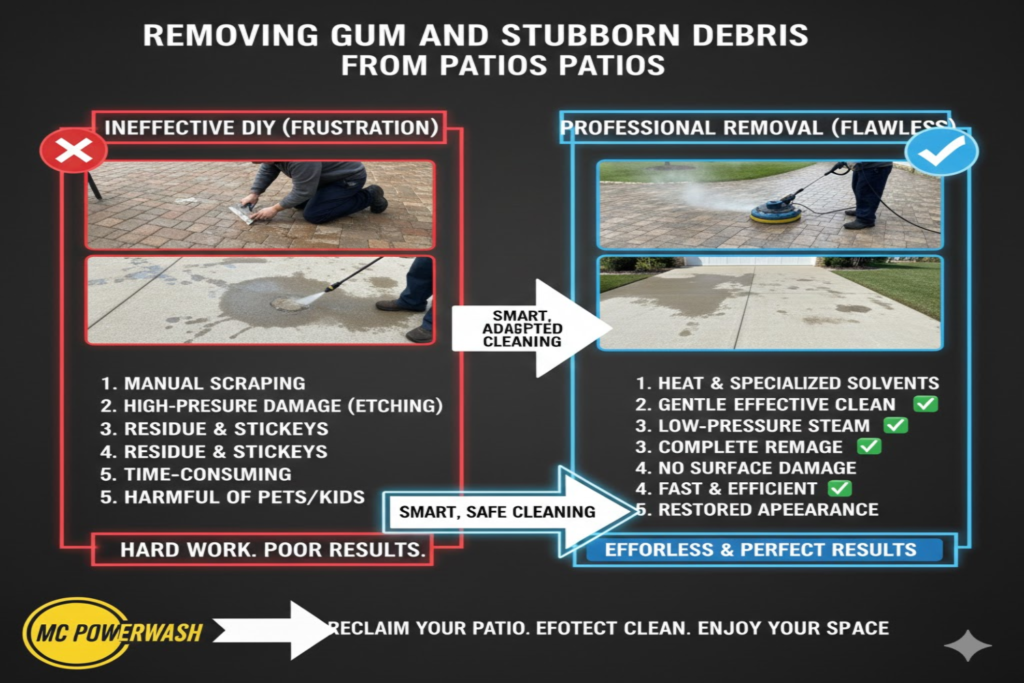
- The Failure of Standard Pressure Washing: Novices often try to “blast” gum off with a high-PSI cold water pressure washer. This is a mistake. The water pressure might shear the top of the gum off, but it often leaves behind “Gum Rings.” These rings are the remnants of the gum’s original adhesive base, now deeply embedded in the pores. Furthermore, the pressure required to “blast” carbonized gum is often high enough to pit the concrete or strip the finish off natural stone, creating a permanent scar.
3. Method 1: The Cold Treatment (Freezing)
For delicate natural stones such as Travertine, Slate, or Mexican Saltillo, the “Cold Treatment” is the gold standard for safety. This method relies on the science of Thermal Shock.
The Tools
To execute this, you need a way to rapidly drop the temperature of the gum. Professional “gum removers” in aerosol cans are the most common, but compressed air cans (held upside down) or even dry ice can be used for particularly stubborn spots.
The Technique
By applying intense cold to the gum, you force the polymers to contract rapidly. This causes the gum to become extremely brittle (glass-like) and lose its adhesive grip on the stone. Once the gum is “frozen,” a gentle tap with a plastic tool will cause it to snap off the surface in one solid piece, rather than smearing.
Pros & Cons
- Pros: It is the safest method for expensive, soft stones. There is zero risk of etching, pitting, or water intrusion.
- Cons: It is extremely labor-intensive. If you have a commercial-sized patio or a driveway “peppered” with dozens of gum spots, the freezing method becomes time-prohibitive.
4. Method 2: The Heat Treatment (Steam & Hot Water)
When dealing with large-scale debris removal, professionals turn to the power of thermodynamics. Heat is the natural enemy of adhesives.
The Magic of $200^\circ\text{F}$
At temperatures approaching $200^\circ\text{F}$ ($93^\circ\text{C}$), chewing gum reaches its melting point and liquifies. Professional steam machines or hot-water pressure washers (boilers) agitate the gum at a molecular level, turning a solid “black spot” into a soft slurry that can be easily vacuumed or wiped away.
The “Plastic Scraper” Rule
A crucial tip for homeowners: Never use metal tools. Whether you are using steam or cold, always use a plastic putty knife or scraper. Metal scrapers—especially on wet stone—can leave permanent grey “metal marks” or deep gouges in the patio surface. Plastic provides enough leverage to pop the debris without any risk to the substrate.
5. Debris Removal Matrix
Selecting the right methodology is the difference between a clean patio and a damaged one. Use the following matrix to guide your approach:
Professional Debris Removal Strategy
| Debris Type | Best Removal Method | Recommended Chemical | Risk Level |
| Chewing Gum | Steam or Freezing | Citrus-Based Solvent | Low |
| Tree Sap & Resin | Chemical Dissolving | Isopropyl Alcohol | Medium |
| Berries / Berries | Soft Washing | Sodium Percarbonate | Low |
| Hardened Mud | Low-Pressure Rinse | pH-Neutral Soap | Low |
| Mortar / Cement | Mechanical “Popping” | Diluted Muriatic Acid | High |
| Bird Droppings | Hot Water Flush | Enzyme-Based Cleaner | Low |
6. Dealing with Stubborn Organic Debris
Organic debris often leaves “tannin” stains—deep pigments that act like wood stain on your stone.
- Tree Sap and Resin: In neighborhoods like Pasadena or Encino, sap from Oak and Pine trees is a constant battle. Sap is a hydrocarbon, meaning water alone will not move it. The best technique is using Isopropyl Alcohol or specialized Citrus Solvents. Apply the solvent, let it sit (dwell) for five minutes, and the sap will dissolve into a liquid that can be blotted away.
- Berry and Bird Stains: These require an oxidative reaction. Sodium Percarbonate (Oxygen-based bleach) is the best tool here. It breaks down the color molecules of the berry or bird waste without the environmental toxicity of chlorine bleach. It is safe for your grass and extremely effective at lifting pigments out of white or light-colored stone.
- Construction Debris (Mortar & Paint): Dried mortar from a recent renovation is common on Los Angeles estates. Do not use a pressure washer on mortar. The pressure required to move the cement will likely destroy the brick or stone underneath. Instead, use a small hammer and a plastic chisel to “pop” the mortar off horizontally. Any remaining white haze can be treated with a mild acid wash specifically formulated for masonry.
The Professional Finish: Consistency is Key
Removing the debris is just the beginning. To ensure a uniform look, you must rinse the entire area thoroughly to remove any chemical residue. In the dry Southern California climate, chemicals can “flash dry” on the stone, creating new stains. Always keep the surface damp and work in small, manageable sections.
By following this zero-tolerance policy, you aren’t just cleaning your patio; you are performing a technical restoration. You are protecting the “Outdoor Heart” of your home from the long-term damage of neglect and improper cleaning.
7. Professional Tips for “Shadow” Removal
Often, the physical debris—the wad of gum or the clump of sap—is the easy part. The real challenge is the “shadow” or “ghost stain” left behind. This is a discoloration caused by oils or pigments that have seeped into the stone’s capillaries.
- Dwell Time (The “Let it Work” Rule): The most common mistake is scrubbing too soon. Chemistry takes time. When you apply a cleaner, you must allow for Dwell Time—typically 10 to 15 minutes. This allows the molecules of the cleaner to surround the stain molecules and “eat” the bond. If you don’t allow for dwell time, you are forced to use excessive pressure to compensate, which leads to surface etching.
- The Poultice Method (Deep Extraction): For porous stones like limestone or sandstone that have absorbed deep oil from a gum base or automotive fluid, a surface wash isn’t enough. You need a Poultice. This involves mixing an absorbent material (like baking soda, diatomaceous earth, or even unscented kitty litter) with a cleaning solvent to create a peanut-butter-like paste. Apply it to the stain, cover it with plastic wrap, and let it sit for 24 hours. As the paste dries, it creates a vacuum effect, drawing the stain out of the stone and into the absorbent material.
- The 45-Degree Angle (The Finishing Sweep): When performing your final rinse to remove debris, never aim the wand straight down ($90^\circ$). This can create “pitting” or drive the loosened dirt deeper. Keep the wand at a 45-degree angle. This creates a “shearing” force that lifts the debris and sweeps it away from the clean area, preventing surface scarring and ensuring a uniform finish.
8. Specialized Chemicals: What Works and What’s Safe
Not all cleaners are created equal, and using the wrong one on a Los Angeles patio can result in permanent chemical burns.
- Citrus-Based Solvents (D-Limonene): Derived from orange peels, these are the gold standard for gum and sap removal. They are biodegradable and incredibly effective at breaking down synthetic rubbers and resins. They are generally safe for all stone types, though they should always be rinsed thoroughly to prevent a sticky residue.
- pH-Neutral Degreasers: Most high-end patios are protected by a sealer. Acidic or highly alkaline cleaners will strip that sealer instantly. A pH-neutral degreaser is designed to attack the “grime” without upsetting the chemical balance of the sealer or the stone itself.
- WD-40 and Goo Gone (The Home Remedies): While effective at dissolving adhesives, use these with extreme caution. WD-40 is an oil-based lubricant; if you use it on unsealed stone and don’t wash it off immediately with soap, you will replace a gum stain with a permanent oil stain. Goo Gone is safer but can still leave a film that prevents future sealers from bonding. Always perform a “triple-rinse” after using these products.
9. Post-Removal Care: Re-Sealing the “Scars”
Gum removal is an abrasive process. Whether you use heat, chemicals, or freezing, you are likely stripping the protective sealer from that specific square inch of stone.
Why Gum Removal Strips Sealer
The same chemical bond that allows gum to stick to stone is what the sealer is designed to prevent. When the gum is ripped or melted away, it often takes the top layer of sealer with it. This leaves a “scar”—an unsealed patch that will absorb water and dirt much faster than the rest of the patio.
Spot-Sealing vs. Full Re-Application
If you only had one or two gum spots, you can Spot-Seal. Once the area is dry, apply a tiny amount of sealer with a sponge, “feathering” the edges so it blends. However, if your patio was covered in debris, the cleaning process has likely weakened the sealer across the entire surface. In this case, a full re-application is necessary to ensure the stone remains protected against the intense UV rays of the Southern California sun.
10. Local Factors: The Los Angeles Sun and “Flash Drying”
Cleaning in Los Angeles presents a unique challenge: the heat.
- The Danger of Midday Sunlight: If you apply a solvent or a detergent to a patio when the surface temperature is $110^\circ\text{F}$ or higher, the liquid will “Flash Dry.” When a chemical evaporates too quickly, it leaves behind a concentrated mineral crust that can be harder to remove than the original stain. Always treat gum and debris in the early morning (before 10:00 AM) or late afternoon.
- Environmental Runoff Compliance: Los Angeles has strict “Clean Water Act” protocols. You cannot allow dissolved gum, oils, or chemicals to enter the storm drains that lead to the Pacific. Use “Sandbagging” or “Snake Booms” at the edge of your property to capture the runoff. For large jobs, use a wet-vac to “reclaim” the water before it leaves your patio.
11. Conclusion
A pristine patio is the result of Finesse over Force. Whether you are dealing with a historic brick path in Pasadena or a modern slate pool deck in Malibu, the “Zero-Tolerance Policy” for gum and debris ensures your outdoor space remains a true asset to your property.
Final Maintenance Thoughts
Your best defense is the “Weekly Sweep.” By removing organic debris (leaves, berries, sap) before the sun has a chance to “bake” them into the surface, you prevent stains from forming in the first place. When you do encounter a stubborn spot, remember to choose the gentlest method first. Start with a plastic scraper and cold water; only move to steam and specialized chemicals if necessary.
By respecting the chemistry of your stone and the regulations of your environment, you can maintain a “Red Carpet” ready patio that is prepared for everything from high-end alfresco dining to quiet family retreats. Your home’s first impression starts at the floor—keep it spotless.
12. FAQs: Removing the Toughest Grime
Q: Will vinegar remove old chewing gum?
A: Vinegar is a mild acid. While it may soften very fresh gum, it is almost useless against “black spot” carbonized gum. Furthermore, vinegar can etch (dull) calcium-based stones like Marble, Travertine, and Limestone. It is best avoided for patio care.
Q: Can I use a blowtorch to melt gum off my concrete?
A:DANGER—NO. This is a common but disastrous DIY myth. Intense direct heat causes the moisture trapped inside the concrete to turn to steam instantly. This leads to “Spalling,” where the surface of the concrete literally explodes or “pops,” leaving a permanent crater in your driveway.
Q: How do I prevent gum from sticking to my patio in the future?
A: The best defense is a high-quality Topical Sealer. This creates a non-porous film over the stone. If gum is dropped on a sealed surface, it cannot “bite” into the pores, allowing it to be popped off with a simple plastic scraper and zero chemicals.