In the world of home maintenance, few things are as satisfying as watching a high-pressure stream of water peel away years of grime from a driveway. We have all seen the viral “oddly satisfying” videos where dark concrete turns bright white in seconds. However, these videos rarely show the inherent danger lurking behind the trigger. A pressure washer is not just a “stronger garden hose”—it is a sophisticated industrial tool that transforms water into a high-velocity cutting blade.
At pressures ranging from 2,500 to 4,000 PSI (pounds per square inch), water can easily slice through skin, muscle, and even bone. In fact, a pressure washer is statistically more dangerous than a lawnmower; while a mower has a localized blade, the “blade” of a pressure washer can be projected several feet and reflected off hard surfaces in unpredictable directions. To master this tool, you must protect the “Three Pillars of Safety”: Personal Safety (your body), Property Safety (your home), and Environmental Safety (the Southern California ecosystem).
2. Personal Protective Equipment (PPE): The Non-Negotiables
Operating a pressure washer without PPE is an invitation for an emergency room visit. In the hot Los Angeles sun, it is tempting to work in casual summer attire, but this is a critical mistake.
- Footwear: The Anti-Flip-Flop Rule: Flip-flops and sneakers are the leading cause of pressure washing injuries. If the stream accidentally crosses your foot, it will slice through thin rubber and fabric instantly. Professional-grade, waterproof steel-toe or composite-toe boots are the only acceptable footwear. They provide a barrier against the “Water Injection” risk and offer better traction on slippery, soapy surfaces.
- Eye Protection: When water hits concrete at high speeds, it doesn’t just stop; it kicks back. Sand, pebbles, and chips of old sealer become high-velocity projectiles. Always wear wraparound safety goggles or a full-face shield to prevent permanent eye injury.
- Hearing Protection: Gas-powered pressure washers typically operate at 85 to 105 decibels. Extended exposure to these levels can lead to permanent hearing loss. Use earplugs or noise-canceling earmuffs to manage the roar of the engine.
- Hand Protection: Specialized heavy-duty rubber gloves serve a dual purpose. They provide a better grip on the vibrating wand and protect your skin from the caustic chemicals (like Sodium Hypochlorite) often used in the “Soft Wash” process.
3. The “Silent Killer”: Injection Injuries
The most terrifying injury associated with this tool is the High-Pressure Injection Injury. This occurs when the water stream is so powerful that it punctures the skin and “injects” water, air, and bacteria deep into the underlying tissue.
- A Deceptive Wound: An injection injury often looks like a small, clean puncture—almost like a paper cut or a small needle prick. Because there is little blood, many homeowners simply put a bandage on it and continue working. This is a fatal error. Inside the body, the water has likely caused massive internal tissue damage and introduced contaminants that lead to rapid, severe infection and potential amputation.
+1 - The “Firearm” Mindset: You must treat the pressure washing wand like a loaded firearm. Never point it at another person or a pet, even as a joke. Never attempt to “clean” your hands or boots with the spray.
- Emergency First Aid: If you are struck by the high-pressure stream, seek emergency medical attention immediately. Explicitly tell the doctor: “I have suffered a high-pressure injection injury.” Most general practitioners may not realize the severity of a small puncture wound unless you specify the tool involved.
4. Equipment Safety: Inspect Before You Ignite
A pressure washer is a system under extreme tension. A failure in any component can turn a routine chore into a mechanical disaster.
- The Hose Check: Before starting the machine, run your hands along the length of the high-pressure hose. Look for “bubbles,” kinks, or exposed wire braiding. A frayed hose can burst at 3,000 PSI, creating a whip-like effect that can cause severe blunt-force trauma.
- O-Ring Maintenance: The small rubber O-rings at the trigger and pump connections prevent leaks. If an O-ring fails, a fine, high-pressure mist can spray out, which can cause skin burns if the water is hot or the chemicals are concentrated.
- Pump Safety & Thermal Relief: Never leave a pressure washer running for more than two minutes without pulling the trigger. When the trigger is closed, the water recirculates in the pump, heating up rapidly. Most machines have a “Thermal Relief Valve” that will dump boiling hot water on the ground to prevent the pump from exploding.
- Electrical Safety: If using an electric unit, ensure the GFCI (Ground Fault Circuit Interrupter) is functioning. Never use standard extension cords; they can overheat or create an electrocution risk in the wet environment of a driveway wash.
5.The Nozzle Safety Spectrum
The color-coded nozzle system is your primary safety guide. Choosing the wrong nozzle for the job is the #1 cause of property damage and personal injury.
Nozzle Risk & Distance Matrix
| Nozzle Color | Degree of Spray | Risk Level | Safe Distance | Common Use |
| Red | $0^\circ$ | EXTREME | Never Use on Home | Removing rust from metal only. |
| Yellow | $15^\circ$ | HIGH | 18 – 24 Inches | Stripping paint/heavy stains. |
| Green | $25^\circ$ | MODERATE | 12 – 18 Inches | Standard concrete cleaning. |
| White | $40^\circ$ | LOW | 6 – 12 Inches | Siding, windows, and wood. |
| Black | $65^\circ$ | LOWEST | 4 – 6 Inches | Applying soap/detergents. |
6. Chemical Safety: Avoiding Toxic Cocktails
In the Southern California heat, the chemicals you use can be just as dangerous as the water pressure.
- The “Bleach Rule” (DANGER): Most patio cleaners contain Sodium Hypochlorite (bleach). Never mix bleach with any ammonia-based soaps or acidic cleaners (like vinegar or rust removers). This chemical reaction creates Chlorine Gas, which is lethal if inhaled.
- Respiratory Safety: When you spray chemicals through a pressure washer, they become “atomized”—turned into a fine mist. In the still air of a courtyard or near a garage, you can easily inhale this mist. Wear a respiratory mask (N95 or better) when applying detergents to prevent chemical burns to your lungs.
- Skin Protection: Professional degreasers are “caustic,” meaning they are designed to eat through oil and grease. If they get on your skin, they will begin to dissolve your natural skin oils immediately. If a spill occurs, flush the area with fresh water for at least 15 minutes.
7. Property Protection: Avoiding “Permanent Mistakes”
Property damage during pressure washing often happens in a split second. A slip of the hand or an incorrect nozzle choice can result in thousands of dollars in repairs.
- Windows and Screens: Never aim a pressure washer directly at a window, especially with a $0^\circ$ or $15^\circ$ nozzle. The sheer force can shatter glass or blow out the seals on double-paned windows, leading to permanent fogging. Screens are even more delicate; high pressure will shred window mesh instantly. Always clean near windows using a wide $40^\circ$ fan and maintain a distance of at least three feet.
- Landscape Shielding: In Southern California, high-end landscaping is a major investment. Most pressure washing chemicals (especially Sodium Hypochlorite) are “salts” that dehydrate plants. To prevent chemical “burning,” follow the Pre-Soak Rule: saturate all surrounding grass, bushes, and flowers with fresh water before you start using soaps. This ensures the plant’s roots are full of clean water and cannot absorb the runoff.
- Vehicle Safety (The 10-Foot Rule): Overspray is a significant risk. Even if you aren’t spraying toward a car, the wind can carry chemical mist onto the paint, causing spotting or oxidation. Always move vehicles at least 10 feet away from the wash zone and keep them upwind.
8. Operational Best Practices
The way you physically handle the machine determines your level of control.
- The Two-Hand Grip: A pressure washer wand has significant “recoil”—the backward kick when you first pull the trigger. Always keep one hand on the trigger handle and the other on the wand’s grip. This prevents the wand from flying upward and hitting you in the face or striking a nearby window.
- The “Safety Stance”: Driveways become incredibly slick once soap and algae are mixed. Never stand on a slope while spraying downward. Maintain a wide, athletic stance with your weight centered. This prevents “slip-and-fall” injuries, which are the most common non-water-related accidents in the industry.
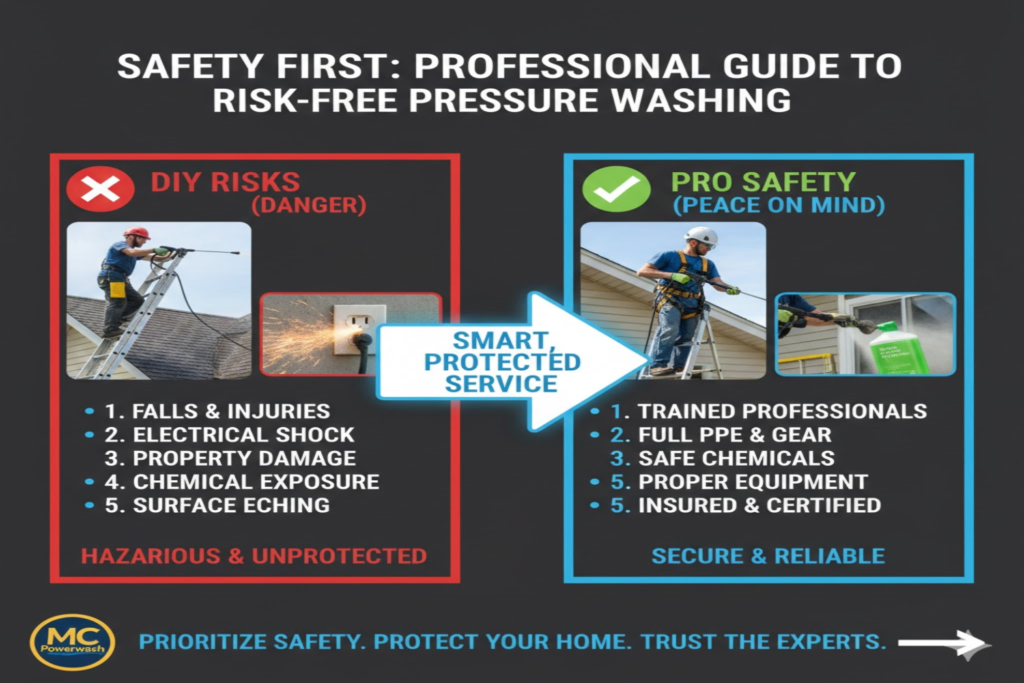
- The No-Ladder Law: NEVER use a pressure washer while standing on a ladder. The recoil of the spray can easily push you backward, causing a catastrophic fall. If you cannot reach a spot from the ground, use a telescoping extension wand. A fall from even six feet while holding a pressurized wand is almost always a trip to the hospital.
9. Environmental Safety (SoCal Specific)
In Los Angeles and Orange County, environmental safety isn’t just a suggestion—it’s the law. The storm drain system in Southern California leads directly to the ocean without treatment.
- Storm Drain Protection: It is illegal to allow detergents, oil, or heavy silt to enter the municipal storm drains. Use “drain covers” or “sand dikes” to redirect runoff to a grassy area where the soil can naturally filter the water. If you are cleaning a heavy oil spill, you must use a reclaim vacuum to capture the water.
- Wildlife and Pet Safety: If you are using professional-grade degreasers, ensure pets are kept indoors for at least 4 hours after the job is done. Even “Eco-Friendly” soaps can irritate a dog’s paws or be toxic if licked off the ground before they have fully dried and dissipated.
10. Post-Job Safety Checklist
The danger doesn’t end when you flip the “Off” switch. The system remains under high pressure even after the engine stops.
- Depressurizing the System: After turning off the machine and the water supply, you must pull the trigger on the wand. You will see a final burst of water. This releases the internal pressure. If you try to disconnect the hoses while they are still pressurized, the brass fittings can fly off with enough force to break a finger or cause a facial injury.
- Proper Storage: Gas engines stay hot for a long time. Never store a hot pressure washer in a garage near flammable materials (like gas cans or paint thinners). Let it cool down in an open, ventilated area for at least 30 minutes.
- Hose Management: High-pressure hoses have a “memory” and like to coil and tangle. Take the time to wrap them in large, loose loops. Tight kinks can weaken the internal wire braiding, leading to a burst the next time you use the machine.
11. Conclusion: The Responsible Homeowner’s Creed
Safety is the invisible foundation of a professional-looking home. There is no “satisfied” feeling in a clean driveway if it comes at the cost of a shattered window, a dead garden, or a trip to the emergency room. By respecting the physics of high-pressure water and the chemistry of your cleaning agents, you move from being a “guy with a sprayer” to a responsible property steward.
The secret to a successful project in Southern California is preparation. Wear your PPE, check your surroundings, and always prioritize finesse over force. When you follow these protocols, you don’t just get a clean driveway . A job done safely is a job done right.
12. FAQs: Safety and Emergencies
Q: What do I do if I spray my foot?
A: Even if it looks like a minor scratch, go to the ER. Explain that it was a high-pressure water injury. Internal infections can set in within hours, and early treatment is the only way to prevent serious complications.
Q: Is it safe to pressure wash in the rain?
A: For gas units, light rain is fine, but beware of lightning. For electric units, it is strictly unsafe. Water and electricity are a lethal combination; if the rain is heavy enough to puddle around your extension cords, stop immediately.
Q: Can the pressure washer tip over?A: Yes, especially when you pull on the hose. Always place the machine on a flat, stable surface. A tipping machine can leak hot oil or gasoline, creating a fire hazard and damaging the engine’s internal components.