For many homeowners in Southern California, driveway and patio maintenance is often treated as a reactive chore—something addressed only when the oil stains become an eyesore or the patio turns a slippery shade of green. However, the most successful property managers and homeowners know that the secret to long-lasting hardscaping is a preventative mindset. Concrete, pavers, and natural stone are porous “living” materials that react to the environmental shifts of each season.
By adopting a seasonal checklist, you move away from the high-stress “restoration” cleanings that often require aggressive chemicals and damaging high pressure. Instead, you focus on light, consistent maintenance that is 70% cheaper over the life of the property. Whether it’s preventing tannin stains from fallen autumn leaves or managing the high-traffic grease of summer road trips, a 365-day approach ensures your home’s “welcome mat” stays pristine while protecting your investment from the structural decay caused by neglect.
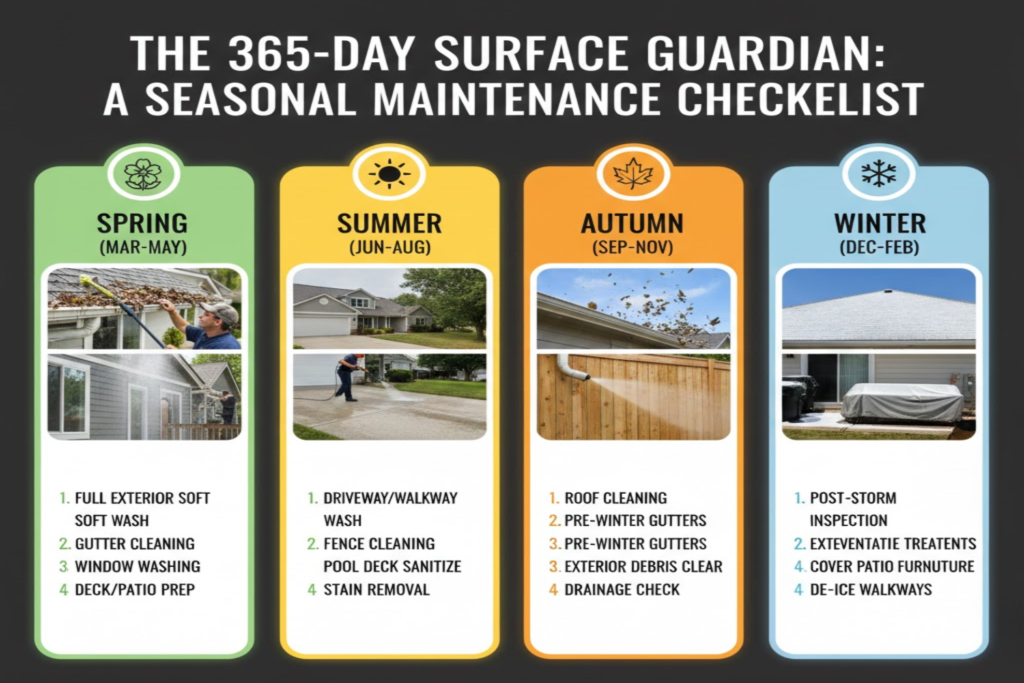
2. [Spring] The Great Restoration: Resetting the Clock
Spring is the “Anchor Season” for exterior maintenance. In SoCal, as the winter rains subside and the temperatures stabilize between $60^\circ\text{F}$ and $80^\circ\text{F}$, it is the perfect window to perform a deep-clean and “reset” your surfaces for the upcoming year of outdoor living.
The Post-Winter Structural Inspection
Winter moisture is the primary cause of structural failure in hardscaping. Your first task in Spring is a Visual Audit. Walk your driveway and patio looking for new cracks or the widening of old ones. Even in a mild climate, the “Hydraulic Pressure” from winter rain can shift the soil beneath your slabs. Use a screwdriver to poke into cracks; if the concrete feels “sandy” or loose, it’s time for a professional crack-fill before you begin your cleaning process.
The Spring Deep Wash: Removing the “Winter Film”
Winter often leaves a fine film of carbon soot, road salt (if you live near the mountains), and pulverized organic matter.
- The Technique: Start with a high-volume rinse to remove loose grit.
- The Chemistry: Use an alkaline-based “Spring Cleaner” (Sodium Metasilicate) to break down the winter grime.
- The Tool: This is the time to break out the Surface Cleaner. Because the air is still cool, you have longer “dwell times” for your detergents without the risk of them drying out too quickly on the concrete.
Weed Prevention and Joint-Sand Stabilization
Early Spring is when weeds begin their aggressive growth cycle. If you have a paver patio, check the joints. If the sand has washed away during the winter, weeds will take root. After your deep wash, once the patio is bone-dry, “top off” your joints with Polymeric Sand. This sand contains a binder that, when misted with water, hardens like mortar, creating a “weed-proof” barrier that protects your patio for the rest of the year.
3. [Summer] Protection and High-Traffic Management
Summer in California is synonymous with high heat and high traffic. While the driveway faces the heat-baked grease of vehicles, the patio becomes the social hub for “chilling and grilling.”
UV Defense and Sealer Integrity
The intense UV radiation of a Southern California July can “bleach” the color out of stamped concrete and decorative pavers. If you haven’t sealed your surfaces in the last 2-3 years, Summer is the season to check your sealer’s integrity.
- The Water Bead Test: Pour a cup of water on several spots. If the water beads up like a freshly waxed car, your protection is solid. If the water soaks in and turns the stone dark, your sealer has failed.
- Maintenance: Applying a UV-resistant clear coat in early Summer prevents “color-washout” and makes future spill cleanups significantly easier.
Managing “Summer Algae” and Irrigation Slick
Surprisingly, algae can thrive in the Summer due to over-irrigation. When sprinklers hit a shaded patio every night, the combination of heat and standing water creates a slippery “green slick.”
- The Fix: Adjust your irrigation timers to ensure the patio has time to dry out during the day.
- The Detergent: A light misting of a pH-neutral biocide once a month will kill the microscopic spores before they turn into a visible slip hazard.
Handling “Heat-Baked” Stains
Summer is prime time for oil leaks and BBQ grease. On a $100^\circ\text{F}$ day, an oil spot can be “baked” deep into the concrete in just a few hours.
- The Pro Tip: Never apply degreasers to a sun-baked driveway. The chemicals will flash-dry and leave a permanent “chemical scar.” Instead, clean in the early morning while the stone is still cool, or pre-wet the concrete with cold water to drop the surface temperature before applying your detergent.
4. [Fall] Tannin Control and Preparation for Rain
As the heat of summer fades, the primary threat to your driveway and patio shifts from UV rays to organic chemistry. Fall is arguably the most critical season for “preventative” maintenance, as the debris dropped by trees can leave permanent “tattoos” on your stone surfaces.
The Battle Against Tannin Staining
In Southern California, trees like the California Sycamore, Oak, and various Eucalyptus species shed their leaves and pods during the fall. When these leaves become wet—either from early rains or morning dew—they release tannins. Tannins are organic dyes that act like tea, seeping deep into the pores of unsealed concrete.
- The Maintenance Routine: The most effective “cleaner” in the fall is a leaf blower. Blowing leaves off the patio daily prevents them from decomposing and staining.
- The Chemical Fix: If you already have brown leaf-shaped stains, do not use high pressure; it won’t work. Instead, use a detergent containing Oxalic Acid, which chemically breaks down the tannin bond and “lifts” the color out of the stone.
Gutter, Drainage, and Runoff Audit
Before the first major “Pineapple Express” storm hits, you must ensure your drainage system is clear. If your gutters are clogged with autumn debris, water will overflow directly onto your driveway or patio.
- Foundation Risks: Overflowing water can lead to “point-loading,” where a high volume of water saturates the soil in one spot, leading to cracks in your concrete slab.
- Drainage Test: Pour a bucket of water at the high point of your driveway. Watch the flow. If it pools or “dams” up against your garage or house, you need to clear the silt and organic matter from your area drains before the rainy season begins.
5. [Winter] Safety, Slip Prevention, and Hibernation
While Southern California winters are mild compared to the East Coast, the combination of shorter days and increased moisture creates a specific set of hazards for hardscape owners.
Managing the Winter “Biofilm”
The reduced sunlight in winter means shaded walkways rarely dry out completely. This leads to a thin, invisible biofilm of algae. While it might not look green yet, it is incredibly slippery when wet.
- Safety First: Periodically sweep your walkways with a stiff-bristle broom to break up the biofilm.
- The “Winter Mist”: A very light application of a diluted “No-Rinse” biocide (like Wet & Forget or a weak bleach solution) once in December and once in February will keep your paths safe for guests and delivery drivers.
De-Icing Etiquette for Mountain and Inland Areas
If you live in the Inland Empire or the Canyons where frost occurs, avoid using standard rock salt (Sodium Chloride).
- The Damage: Salt lowers the freezing point of water, but when the brine soaks into the concrete and re-freezes, it creates internal pressure that causes “spalling” (the top layer of concrete flaking off).
- The Solution: Use Calcium Magnesium Acetate (CMA) or simply use sand for traction. Sand provides grip without the chemical erosion that destroys your concrete’s “cream coat.”
6. [Table Section] The Seasonal Chemical Rotation
| Season | Primary Contaminant | Best Active Ingredient | Priority Goal |
| Spring | Winter Soot & Grime | Sodium Metasilicate | Deep Restoration |
| Summer | Oil, Grease, & BBQ | Alkaline Degreasers | UV Protection & Sealing |
| Fall | Leaf & Wood Tannins | Oxalic / Citric Acid | Stain Prevention |
| Winter | Algae & Biofilm | Sodium Hypochlorite | Slip & Fall Safety |
7. The “Monthly 15-Minute” Maintenance Ritual
Consistency is the enemy of decay. You don’t need to spend hours every weekend if you follow this “15-Minute Ritual” once a month.
The Quick Sweep and Clear
Remove any localized dirt piles or leaf accumulation in the corners of the patio. Piles of dirt hold moisture, which invites moss. A quick sweep prevents these “micro-ecosystems” from forming.
The Spot-Check for “Shadows”
Inspect your driveway for new oil leaks. If caught within 30 days, an oil spot can usually be removed with simple dish soap and a brush. If left for 6 months, it becomes a “shadow” that requires professional-grade heated extraction.
The Joint Integrity Test
If you have pavers, kick a few of the sand joints. If the sand is loose or missing, add a handful of sand immediately. This prevents the pavers from shifting and reduces the chance of ants or weeds colonizing the gaps.
11. Conclusion: A Legacy of Curb Appeal
A driveway and patio are not static objects; they are an evolving part of your home’s ecosystem. By following this seasonal checklist, you are effectively “future-proofing” your property. You aren’t just cleaning; you are managing the chemistry of your environment to prevent the slow creep of erosion, staining, and biological growth.
The reward for this consistency is a home that always looks “ready for a guest,” a safer environment for your family, and a significant boost to your property value. In the competitive Southern California market, a well-maintained exterior can increase a home’s perceived value by up to 5%. Invest in the cycle, and your surfaces will serve you for decades to have.
12. FAQs: Timing Your Maintenance
Is it better to seal in the Spring or the Fall?
Spring is generally better. The moderate temperatures allow the sealer to cure slowly and evenly. If you seal in the Fall, you risk trapped moisture from the upcoming rainy season causing the sealer to turn “milky.”
How often should I “top off” my joint sand?
Usually, once a year in the Spring. In high-wind areas like Palmdale or Rancho Cucamonga, you may need to check it every six months.
Can I pressure wash in the rain?
Technically, yes, but your detergents will be diluted and less effective. It’s better to wait for a dry day so your chemicals can “dwell” on the surface and do the work for you.