1. Introduction: The Concept of “Slow Decay”
Property ownership is often viewed as a static investment, but in reality, a home is a dynamic structure constantly under siege by environmental forces. One of the most dangerous misconceptions held by homeowners is that exterior degradation happens in sudden, visible bursts. In truth, the decline of a property is a process of “slow decay.” It begins with microscopic layers of dust and pollutants that settle into the pores of your siding, brick, and concrete. Over time, these layers accumulate moisture and become a breeding ground for biological organisms.
Many people view pressure washing as a purely aesthetic service—a “bath” for the house intended to improve curb appeal for a weekend party. However, professional exterior cleaning is more akin to a medical checkup for your home’s skin. When you skip routine pressure washing, you aren’t just letting your house get “a little dirty”; you are allowing a chemical and biological chain reaction to occur that can compromise the structural integrity of the building. The thesis of this guide is simple but urgent: skipping routine pressure washing leads to irreversible structural damage, significant health hazards, and a massive decline in property valuation that far exceeds the cost of the service itself.
2. Accelerated Material Degradation: The Chemical Breakdown
Every building material—whether it is vinyl siding, traditional stucco, or industrial-grade concrete—is porous to some degree. When you skip regular cleaning, you allow environmental contaminants to move from the surface into the substrate of the material.
The Chemical Breakdown of Building Materials
One of the primary catalysts for material failure is the interaction between dirt and UV radiation. On surfaces like vinyl or painted wood, a layer of grime acts as an abrasive. As the wind moves this grit across the surface, it creates microscopic scratches that strip away the UV-protective coatings. Once these coatings are compromised, the sun’s rays cause the material to become brittle, leading to cracking and fading. In the intense sun of Los Angeles, this process is accelerated, and a house that hasn’t been washed in three years can look a decade older than a well-maintained neighbor.
Concrete Spalling and Pitting
Concrete is often viewed as indestructible, but it is actually a giant “sponge.” When oil, salt, and grime sit on a driveway for years, they seep into the concrete’s pores. During the rare but heavy rain cycles in Los Angeles, these contaminants expand and contract, causing a process known as “spalling.” This is where the top layer of the concrete begins to flake off, eventually leading to deep pits and structural cracks. Routine pressure washing removes these corrosive chemicals before they can migrate deep enough to cause permanent mechanical failure of the slab.
The Hard Water Factor
The water supply in many urban areas, including Los Angeles, is notoriously “hard,” meaning it is packed with minerals like calcium and magnesium. When garden sprinklers hit your home’s stone or brickwork and are allowed to dry in the sun, they leave behind mineral deposits. If these deposits are not pressure washed away annually, they undergo a chemical bonding process with the stone. Eventually, this leads to white, chalky stains (efflorescence) that can etch the stone permanently, requiring expensive acid-washing or sandblasting to correct.
3. The Biological Threat: Algae, Mold, and Mildew
While chemical degradation is a silent killer, biological growth is a visible predator. Your home’s exterior is an ecosystem, and without routine pressure washing, it becomes a sanctuary for organisms that literally consume your home.
Living Organisms That Eat Your Home
The most common culprit is Gloeocapsa Magma, a type of black algae that appears as dark streaks on roofs and siding. This isn’t just an eyesore; this algae feeds on the limestone filler used in modern shingles. As it eats the limestone, the shingles become lighter, lose their UV-reflectivity, and eventually crumble. By skipping a pressure wash (or a soft wash for roofs), you are effectively shortening the lifespan of your roof by 10 to 15 years.
The “Root” Problem: Moss and Lichen
Unlike algae, which sits on the surface, moss and lichen actually “root” into the material. They find their way into the mortar joints of brickwork and the grain of wooden decks. Once rooted, they hold onto water like a sponge. When the temperature fluctuates, this trapped water expands, physically prying the mortar away from the brick or splitting the wood fibers. This creates entry points for even more water, leading to “rot cycles” that can compromise the very “bones” of your porch or siding.
Mold Migration to the Interior
It is a mistake to think that what stays outside, stays outside. Mold and mildew colonies that begin on your north-facing walls or under your eaves eventually produce spores. These spores are drawn into your home through soffit vents and HVAC intakes. If you have a thick layer of green mildew on your exterior, you are likely breathing in those spores every time your air conditioner cycles. Routine pressure washing acts as a biological “reset,” ensuring that these colonies never grow large enough to migrate into your interior living spaces.
4. Health and Safety Liability: Risks Beyond the Surface
Beyond the structural and biological damage, skipping pressure washing creates significant legal and physical risks for property owners.
The “Slip and Fall” Risk Factor
In a city like Los Angeles, where people are used to dry pavement, a sudden rainstorm can turn a dirty walkway into a legal nightmare. Algae and mold create a “slime layer” that is invisible when dry but becomes as slippery as ice when wet. If a delivery driver or a guest slips on your algae-covered driveway, you as the homeowner are liable for their injuries. Routine pressure washing restores the friction of the surface, ensuring a safe walking path regardless of the weather.
Allergen Accumulation
Your driveway and sidewalks are the largest “filters” on your property. They collect massive amounts of ragweed, oak pollen, and other seasonal allergens. Every time you walk from your car to your front door, you are kicking up these allergens and tracking them into your home on your shoes. By skipping the pressure wash, you are allowing a “pollen reservoir” to sit right at your doorstep, which can significantly worsen the symptoms of allergy and asthma sufferers in your household.
Pest Attraction
Pests like spiders, cockroaches, and even rodents are attracted to the “bio-film” that grows on dirty houses. Spiders, in particular, love to build webs over the grime because it attracts the smaller insects they feed on. A house that is routinely pressure washed is far less attractive to these pests because it lacks the “food chain” that starts with organic grime. If you want to reduce your pest control bills, the best place to start is with a clean exterior.
5. Financial Consequences and Property Value
When homeowners look at their monthly budget, they often categorize pressure washing as a “discretionary” expense—something that can be pushed to next year. However, real estate experts and financial advisors view it differently. Neglecting your exterior is a form of “financial leakage” where you lose more in home equity than you save in service costs.
The “Deferred Maintenance” Tax
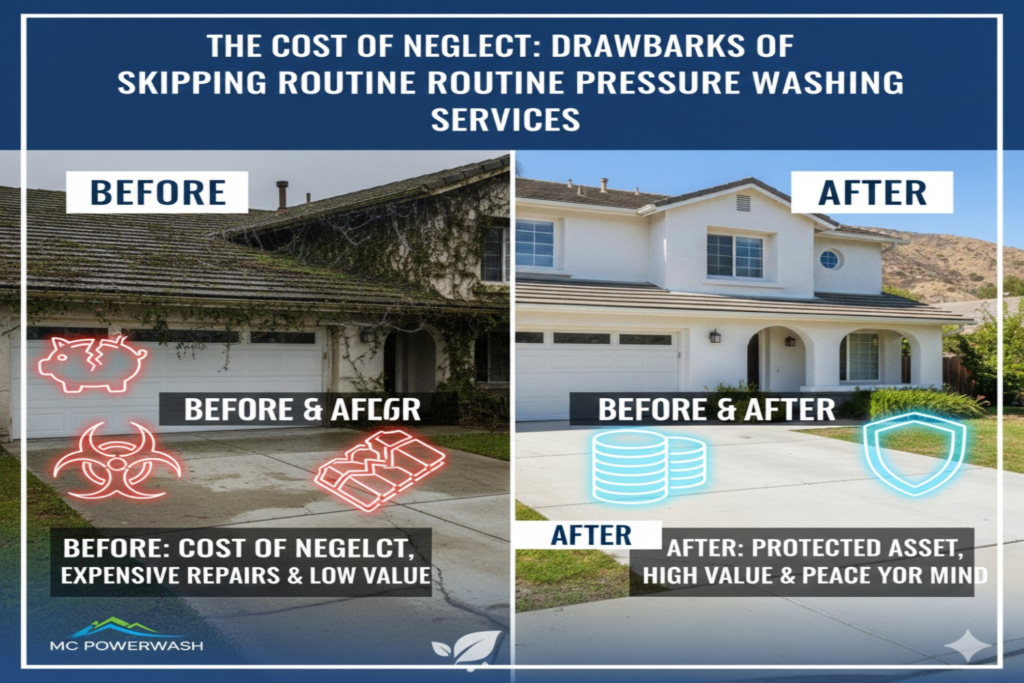
In the world of professional appraisals, there is a concept known as the “deferred maintenance tax.” This isn’t a government tax, but a market penalty. A property that shows signs of neglect—stained driveways, green mildew on the siding, or “tiger-striped” gutters—is immediately devalued by potential buyers. On average, a dirty exterior can subtract 5% to 10% from a home’s total sale price. In the premium real estate market of Los Angeles, where home values are in the millions, skipping a $500 pressure wash could literally cost you $50,000 to $100,000 in lost negotiating power during a sale.
Premature Replacement vs. Routine Cleaning
The math of home maintenance is startling. The average lifespan of vinyl siding is 25 years, but that assumes it is kept free of the acidic pollutants and algae that cause it to become brittle. If you skip routine washing, that lifespan can drop to 12 or 15 years. Replacing the siding on a standard home can easily cost $20,000 to $30,000. By spending a few hundred dollars a year on routine pressure washing, you are effectively “buying” another decade of life for your home’s exterior. It is the highest Return on Investment (ROI) of any home improvement task.
Commercial Impact and “Unconscious Bias”
For business owners, the stakes are even higher. Customers make a split-second judgment about the quality of a business based on its storefront. This is called “unconscious bias.” If a customer sees gum stains, oil spots, and a layer of city grime on your entryway, they subconsciously associate that filth with your products or services. In the competitive retail landscape of Los Angeles, a dirty storefront is a silent “closed” sign that drives customers directly to your cleaner competitors.
6. Comparison Table: Routine Maintenance vs. Total Neglect
| Factor | Routine Pressure Washing (Annual) | Skipping Services (3+ Years) |
| Siding Lifespan | Reaches full 25+ year potential. | Brittleness/Cracking by year 12. |
| Driveway Safety | High-friction, algae-free surface. | Slippery “slime layer” when wet. |
| Health Impact | Minimal allergens/spores near vents. | High concentration of respiratory irritants. |
| Repair Costs | $300 – $600 (Preventative Cleaning). | $5,000 – $15,000 (Repairs & Paint). |
| Curb Appeal | Consistent “Like New” appearance. | Permanent staining; “tired” look. |
| Pest Control | Low attraction for spiders/insects. | High biological biofilm attracts pests. |
7. The Environmental Toll of Neglect
Interestingly, many people skip pressure washing because they want to “save water” or avoid chemicals. However, from an environmental perspective, waiting longer is actually far worse for the planet.
Chemical Intensity and Restoration
When you clean a property annually, the bond between the dirt and the surface is weak. Most routine cleans can be accomplished using mild, biodegradable surfactants or even just “soft washing” techniques. However, when you wait three to five years, the grime undergoes a chemical bonding process with the substrate. To remove these “fossilized” stains, professionals are forced to use much harsher, more toxic chemicals like heavy degreasers or concentrated sodium hypochlorite. By cleaning regularly, you keep the chemical footprint of your home maintenance at a minimum.
The Paradox of Water Waste
A common myth in Los Angeles is that pressure washing is a waste of water during dry spells. In reality, a routine annual wash is incredibly fast and efficient. Contrast this with a “restoration” wash on a neglected property: the technician must spend four times as long on each square foot to break through the layers of built-up grime. This results in nearly 50% more water usage overall. Staying ahead of the dirt is actually the most water-conscious way to maintain your property’s exterior.
9. Conclusion: The “Ounce of Prevention” Philosophy
The drawbacks of skipping routine pressure washing are not just aesthetic; they are structural, legal, and financial. We have explored how the “slow decay” of building materials is accelerated by neglect, and how the biological threats of algae and mold can lead to thousands of dollars in premature replacement costs. Pressure washing should be viewed as the cheapest insurance policy you can buy for your home.
As the old adage goes, “An ounce of prevention is worth a pound of cure.” By investing in an annual cleaning, you are protecting your home’s foundation, your family’s respiratory health, and your property’s overall market value. Don’t wait for the stains to become permanent or for the driveway to become a liability. Stay ahead of the decay, preserve your investment, and ensure that your home remains a source of pride rather than a source of stress. Start your maintenance routine today, and see the difference that professional clarity and cleanliness can make.
8. Frequently Asked Questions (FAQs)
Will pressure washing damage my paint? If done correctly, no. However, if you use high-pressure on “oxidized” paint (paint that has already started to turn chalky from sun damage), it will strip the color away. This is why professionals use a “soft wash” technique on painted surfaces. It uses low pressure combined with specialized soaps to kill mold and lift dirt without harming the paint bond.
How often should I pressure wash my driveway? For the best results and safety, a driveway should be pressure washed once a year. This prevents the accumulation of oil (which eats into the concrete) and the growth of slippery algae. If you have heavy overhanging trees, you might require a touch-up every six months to manage sap and tannin stains from falling leaves.
H3: Can I just wait for the rain to clean my house? Absolutely not. Rain is actually part of the problem. Rainwater carries pollutants from the air and deposits them on your walls. Furthermore, the dampness after a rain provides the perfect moisture for algae and mold to grow. Rain moves dirt around, but it does not remove it; only pressurized water and surfactants can physically lift the grime from the pores of the material.
Is “Soft Washing” different from Pressure Washing? Yes. Pressure washing uses high-force water (PSI) to physically “blast” dirt away. It is best for hard surfaces like concrete. Soft washing uses low pressure (similar to a garden hose) and relies on chemistry to kill organic growth and lift dirt. Soft washing is the industry standard for roofs, siding, and delicate stone.
Can pressure washing help get rid of a flea or tick infestation? Surprisingly, yes. Many pests, including fleas, ticks, and spiders, thrive in the moist, organic debris that accumulates around the perimeter of your home and in the cracks of your patio. By pressure washing these areas, you physically remove the larvae and the nesting environments. While it isn’t a replacement for professional pest control, it is a vital first step in “mechanical pest management” that makes your property much less hospitable to insects.
Is it safe to pressure wash my wood deck or fence? Wood is a delicate, fibrous material. Using high-pressure water on wood is very risky; it can “fuzz” the grain, splinter the surface, and leave permanent lap marks. For wood, professionals almost always use a “soft wash” approach with specialized wood cleaners that brighten the timber and kill deep-seated mold without destroying the wood fibers. Never use high PSI on cedar or redwood, as these are softwoods that can be carved into by a pressure stream.
Does pressure washing kill my plants and landscaping? A common drawback of hiring an amateur is “plant shock.” Many cleaning solutions, if left to dry on leaves, can burn them. However, a professional company will use a “pre-wetting” and “post-rinsing” technique. By saturating your plants with fresh water before and after the service, the cleaning chemicals are diluted to harmless levels. In a sensitive landscape like those often found in 180°C or even 10% of the garden, this step is crucial for safety.
Why do my gutters have dark streaks after the house is washed? Those dark vertical lines are known as “tiger stripes.” They are the result of an electrostatic bond between the metal of the gutter and the pollutants in the air. Standard pressure washing or soft washing often won’t remove them. They require a specialized “gutter brightening” service that involves a specific chemical reaction to break that electrostatic bond. If you see these streaks, ask your technician about a targeted treatment.
Can I use a pressure washer to clean my roof shingles? Never. You should never use high pressure on asphalt shingles. The force will strip away the ceramic granules that protect your roof from UV rays. This will lead to premature roof failure and will likely void your roof’s warranty. Roofs should only be cleaned using a “Non-Pressure” soft wash system approved by the Asphalt Roofing Manufacturers Association (ARMA).
How long does a professional pressure washing service take? For a standard 2,000-square-foot home, a full exterior wash typically takes between 2 and 4 hours. This includes setup, pre-treating the surfaces, the actual cleaning, and a final thorough rinse of the windows and landscaping. If a company claims they can do the whole house in 45 minutes, they are likely skipping the vital “dwell time” that chemicals need to actually kill the mold and algae.