
Street art and graffiti are often confused because both appear on public surfaces without permission, but they differ significantly in intent, style, execution, and cultural perception. While the line can sometimes blur (especially in modern urban art scenes), there are clear ways to distinguish between the two. Understanding these differences helps appreciate the creativity behind street art and the social commentary often embedded in graffiti. Here are the main ways to tell them apart.
Urban landscapes are filled with visual expressions ranging from colorful murals to quick spray-painted tags. While many people use the terms interchangeably, street art and graffiti are distinctly different forms of artistic expression. Understanding the differences helps homeowners, city officials, art enthusiasts, and tourists appreciate public art while recognizing when a property may be at risk of vandalism.
In cities like Los Angeles, New York, and San Francisco, street art often contributes to neighborhood beauty and cultural identity, while graffiti—especially unauthorized tagging—can negatively affect property values and safety perceptions. Here’s how you can tell the difference between the two.
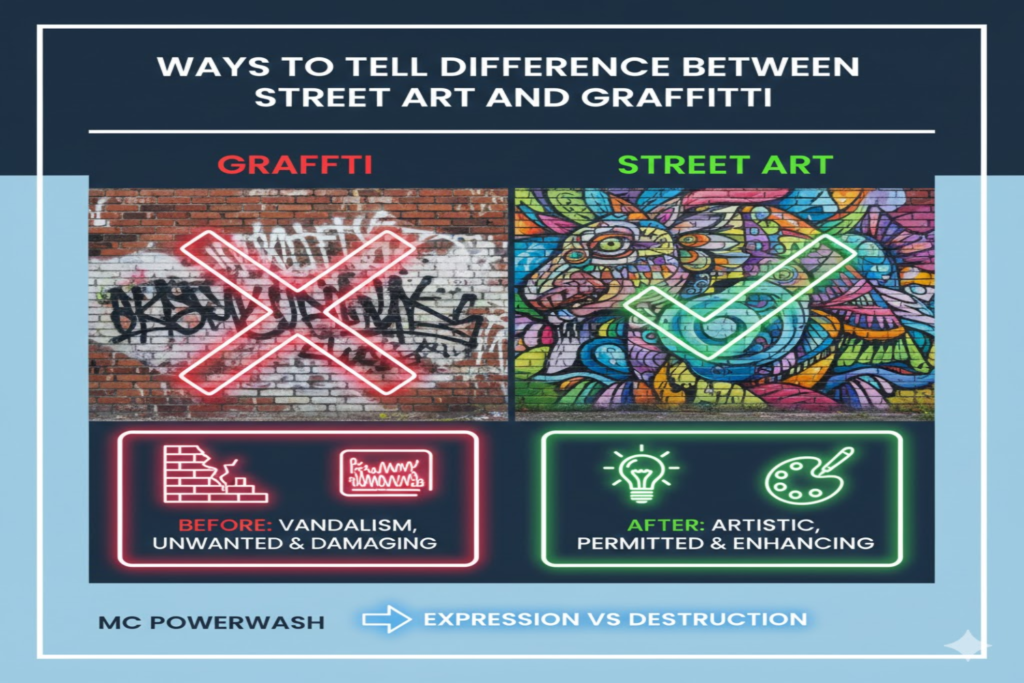
Artistic Intent and Message
Street art is usually created with a deliberate artistic purpose—often to beautify, provoke thought, convey a social or political message, or tell a story. Artists like Banksy, Shepard Fairey, or local muralists aim to engage viewers and add value to the urban environment.los angeles
Graffiti, by contrast, is primarily about personal expression, tagging, or marking territory. Classic graffiti focuses on the writer’s name (tag), crew affiliation, or stylistic flair, with less emphasis on broader meaning or public benefit.
Quick check: Does the work seem designed to communicate something beyond “I was here”? If yes → more likely street art. Street art and graffiti are often confused because both appear on public surfaces without permission, but they differ significantly in intent, style, execution, and cultural perception. While the line can sometimes blur (especially in modern urban art scenes), there are clear ways to distinguish between the two. Understanding these differences helps appreciate the creativity behind street art and the social commentary often embedded in graffiti. Here are the main ways to tell them apart.
Complexity, Skill Level, and Time Investment
Street art typically involves detailed planning, multiple colors, stencils, wheat-paste posters, large-scale murals, or intricate freehand pieces. It often takes hours or days to complete and requires advanced artistic skills.
Traditional graffiti (especially tags and throw-ups) is quick—done in seconds to minutes using spray cans to avoid detection. Even more elaborate “pieces” (masterpieces) prioritize speed and style over photorealism. Street art and graffiti are often confused because both appear on public surfaces without permission, but they differ significantly in intent, style, execution, and cultural perception.
While the line can sometimes blur (especially in modern urban art scenes), there are clear ways to distinguish between the two. Understanding these differences helps appreciate the creativity behind street art and the social commentary often embedded in graffiti. Here are the los angeles main ways to tell them apart.
Quick check: Does the work look time-consuming and highly detailed? Street art usually does; basic tags or simple throw-ups are classic graffiti.
Placement and Respect for Surfaces
Street artists often choose locations thoughtfully—blank walls, legal walls, abandoned buildings, or areas where the work can be seen and appreciated without excessive destruction. Many street artists now work with permission or on designated mural programs.
Graffiti writers traditionally place tags, throw-ups, and pieces wherever they can—trains, highway signs, private property, public bathrooms—prioritizing visibility and risk over permission.
Quick check: Is the work on a curated mural wall, gallery-like setting, or clearly commissioned? Almost certainly street art. Random tags on private homes or shop fronts? Classic graffiti.
Style and Technique
Street Art
- Mediums and methods: Includes stencils, wheatpasting, murals, mosaics, chalk art, and 3D installations.
- Complexity: Often detailed with vibrant colors, depth, and professional design elements.
- Time and effort: Can take days or weeks to complete, sometimes with collaborative teams.
Graffiti
- Mediums and methods: Primarily spray paint, markers, and paint pens.
- Lettering focus: Bubble letters, wildstyle text, and tagging dominate.
- Speed: Often done quickly to avoid detection.
Tip: Detailed murals with shading, realism, or thematic storytelling are likely street art, whereas repetitive lettering or small tags are graffiti.
Location and Permission
Street Art
- Found in visible public spaces, c
Use of Mediums and Techniques
Street art frequently uses stencils, wheat-pasting, murals with brushes/rollers, installations, projections, yarn bombing, or mixed media. It often incorporates typography, imagery, satire, or pop culture references.
Graffiti relies heavily on spray paint for tags, throw-ups (bigger bubble letters), and full-color pieces. The focus is on flow, style, and letter structure within graffiti subculture (wildstyle, 3D, etc.).
Quick check: Stencils, posters, detailed murals, or non-spray media → street art. Predominantly spray-painted letters and signatures → graffiti.
Community Perception and Legal Status
Street art is increasingly viewed as legitimate public art—many cities commission murals, offer legal walls, and celebrate famous street artists. Pieces are often protected or left untouched for years.
Graffiti (especially tagging) is still widely seen as vandalism. Most cities actively remove tags quickly and prosecute writers. Permission changes everything—legal graffiti walls exist, but unauthorized tagging remains illegal.
Quick check: Is the work celebrated, photographed by tourists, or los angeles featured in media? Likely street art. Quickly buffed or painted over? Classic unauthorized graffiti.
Signature and Anonymity
Graffiti writers almost always include a tag or signature—personal identity is central to the culture. The name or crew mark is the main focus.
Street artists may sign subtly (or not at all), use pseudonyms (like Banksy), or let the artwork speak for itself. The message or image often matters more than the artist’s identity.
Quick check: Dominated by a bold name or tag? Graffiti. Image-focused with minimal or hidden signature? Street art.Urban landscapes are filled with visual expressions ranging from colorful murals to quick spray-painted tags. While many people use the terms interchangeably, street art and graffiti are distinctly different forms of artistic expression. Understanding the differences helps homeowners, city officials, art enthusiasts, and tourists appreciate public art while recognizing when a property may be at risk of vandalism.
In cities like Los Angeles, New York, and San Francisco, street art often contributes to neighborhood beauty and cultural identity, while graffiti—especially unauthorized tagging—can negatively affect property values and safety perceptions. Here’s how you can tell the difference between the two.
Large Overview Table: Street Art vs. Graffiti Comparison
| Aspect | Street Art | Graffiti |
| Primary Intent | Artistic expression, social message, beautification | Personal identity, tagging, territorial marking |
| Time & Complexity | High—detailed, planned, time-intensive | Low to medium—quick tags, throw-ups common |
| Mediums Used | Stencils, murals, posters, installations | Mostly spray paint (tags, throw-ups, pieces) |
| Placement | Chosen thoughtfully, often legal or semi-legal | Wherever possible, rarely with permission |
| Community View | Increasingly accepted as public art | Often seen as vandalism (except legal walls) |
| Signature Focus | Subtle or absent—artwork is the focus | Central—tag/name is the main element |
Tips to Identify Street Art vs Graffiti
- Check for artist credits: Street art often includes the artist’s name, plaque, or signature.
- Look at complexity: Large, detailed, colorful murals are street art; small tags are usually graffiti.
- Observe placement: Legal street art is often in visible, public areas; graffiti tends to be hidden or hard-to-reach.
- Frequency: Graffiti is repeated across multiple walls; murals are unique.
- Local resources: Cities sometimes provide street art maps or festival guides for reference.
Environmental and Social Considerations
Urban landscapes are filled with visual expressions ranging from colorful murals to quick spray-painted tags. While many people use the terms interchangeably, street art and graffiti are distinctly different forms of artistic expression. Understanding the differences helps homeowners, city officials, art enthusiasts, and tourists appreciate public art while recognizing when a property may be at risk of vandalism.
In cities like Los Angeles, New York, and San Francisco, street art often contributes to neighborhood beauty and cultural identity, while graffiti—especially unauthorized tagging—can negatively affect property values and safety perceptions. Here’s how you can tell the difference between the two.
- Street art: Encourages cultural tourism, preserves local heritage, reduces illegal tagging by providing legal outlets.
- Graffiti: Can lead to property damage, community complaints, and increased municipal cleaning costs.
- Urban management: Cities that support street art while providing designated graffiti walls often see a reduction in vandalism.
Conclusion
While street art and graffiti share urban roots and sometimes overlap (especially in evolving scenes), the differences in purpose, execution, placement, and reception are clear. Street art aims to add value, provoke thought, or beautify—often with permission or community support. Graffiti is about personal expression, style, and subculture—frequently unauthorized. Recognizing these distinctions helps appreciate both art forms without conflating them. Next time you see a mural or a tag, ask: Is this trying to say something bigger, or is it mainly about the artist’s name? That question usually reveals the answer.
Understanding the difference between street art and graffiti is essential for homeowners, city planners, tourists, and art enthusiasts. While both forms bring creativity to urban spaces, their intent, legality, and impact on communities are very different. Street art is usually commissioned or sanctioned, visually complex, and designed to enhance neighborhoods, promote culture, or deliver social messages. Graffiti, on the other hand, is often unauthorized, focused on tagging or personal expression, and can lead to property damage or community complaints.
Recognizing these differences allows cities to support public art while controlling vandalism, and helps residents appreciate creativity without mistaking graffiti for authorized works. By promoting legal street art programs and maintaining awareness of graffiti trends, communities can preserve cultural identity, boost tourism, and protect property values.
Frequently Asked Questions (FAQs):
- Is all unauthorized public art considered graffiti?
Not necessarily—many street art pieces are created without permission but are valued for their artistry and message. Graffiti is more narrowly associated with tagging and letter-based styles rooted in hip-hop culture. Intent and style matter more than permission alone.
- Can something be both street art and graffiti?
Yes—there’s overlap. Some graffiti artists evolve into street artists (e.g., creating large murals), and some street art includes tagging elements. The line is blurry in modern urban art scenes, especially on legal walls or commissioned projects.
- Why do cities remove graffiti but keep some street art?
Cities often distinguish based on artistic merit, community impact, and complaints. Detailed murals are frequently preserved or celebrated, while simple tags are removed quickly because they’re seen as vandalism. Permission and local attitudes play a big role.
- Are stencils always street art and spray tags always graffiti?
Generally yes—stencils are a hallmark of street art (Banksy, Shepard Fairey), while hand-drawn spray tags are the foundation of traditional graffiti. However, some artists cross techniques, so medium alone isn’t definitive.
- Do graffiti writers ever get commissions?
Yes—many graffiti artists transition into commercial work, murals, gallery shows, or brand collaborations. Once they gain recognition, their style is valued as art. Permission changes the perception from vandalism to legitimate work.
- Is graffiti always illegal?
No—legal graffiti walls, commissioned pieces, and designated art zones exist worldwide. When done with permission, it’s celebrated as public art. Unauthorized tagging remains illegal in most places.
- Why is street art more accepted today than graffiti?
Street art often carries social commentary, beauty, or humor that resonates with the public. Graffiti’s roots in tagging and territorial marking are seen by some as destructive. Media coverage of famous street artists has also helped legitimize the broader movement.
- Can I tell the difference just by looking at a photo?
Usually yes—if it’s a detailed mural with imagery, stencils, or a clear message → street art. If it’s mostly letters, a bold tag, or quick throw-up → graffiti. Context (location, permission, community reaction) also helps.
- Is graffiti only about names and letters?
Traditional graffiti centers on tags, throw-ups, and pieces (letter-based art), but modern graffiti writers also create characters, scenes, and abstract works. The focus on personal style and name remains core to the culture.
- How should I respond if I see graffiti or street art in my neighborhood?
For simple tags or vandalism → report it to local authorities or property owners for removal. For impressive murals or street art → appreciate it, photograph it, and support legal walls or public art programs. Many cities now encourage positive urban art while cracking down on tagging.