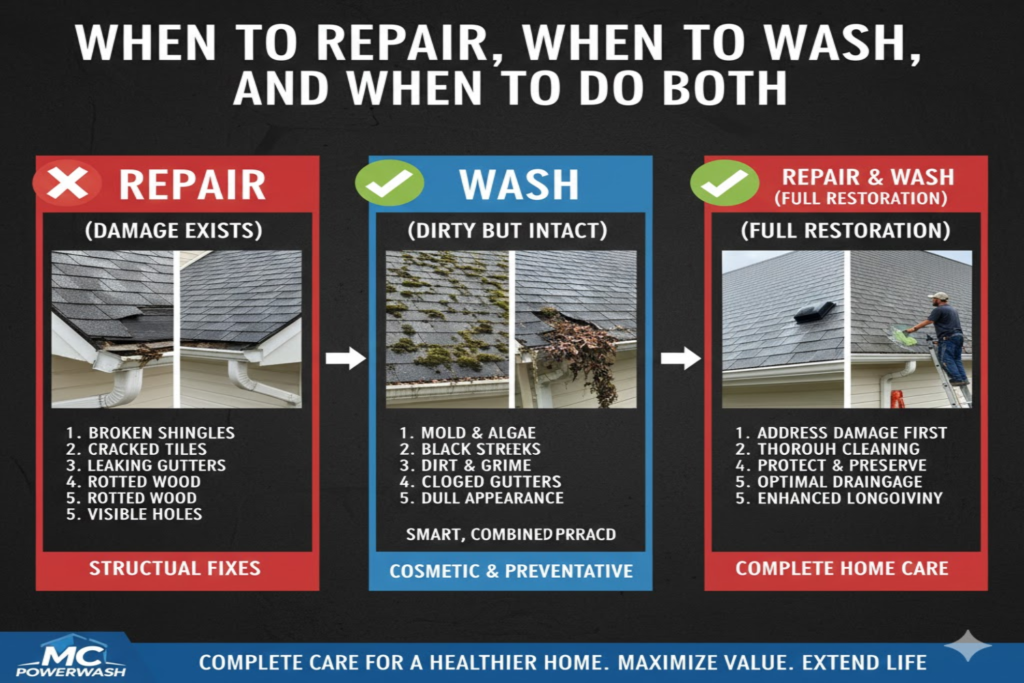
In the world of property management and home ownership, there is a common misconception that pressure washing and structural repair are two separate silos of maintenance. Homeowners often treat pressure washing as a “cosmetic” task and repairs as a “functional” necessity. However, in reality, these two disciplines are deeply intertwined. Attempting to “clean” a surface that is structurally failing is like trying to paint a house while the foundation is sinking—it is a waste of resources that can actually accelerate the damage.
The “Restoration Roadmap” is about understanding the synergy between water pressure and structural integrity. Sometimes, you must wash a surface to reveal the hidden damage buried under layers of grime. Other times, you must repair a crack to prevent the pressure washer from turning a small fracture into a massive sinkhole. Navigating this intersection correctly is the difference between a driveway that lasts thirty years and one that needs to be torn out and replaced in ten. This guide explores the “Why,” the “When,” and the “How” of combining these two vital tasks.
2. The “Pre-Wash” Inspection: Identifying Red Flags
Before you ever connect a hose to a pump, you must perform a “Surface Audit.” High-pressure water is a powerful tool, but on a compromised surface, it acts as a destructive force. Identifying “Red Flags” during a dry inspection is the first step in deciding whether to pick up the wand or the trowel first.
Concrete Spalling: The Flaking Surface
Spalling occurs when the top layer of the concrete (the “cream coat”) begins to flake, pit, or peel away. This is often caused by poor mixing during the original pour or damage from salt and freeze-thaw cycles.
- The Risk: If you hit spalled concrete with 3,000 PSI, you will “strip” the surface, exposing the rough aggregate underneath.
- The Diagnosis: If you can peel away bits of the surface with a screwdriver or a stiff brush, you have a repair situation that must be addressed before or immediately after a very low-pressure wash.
Structural vs. Hairline Cracks
Not all cracks are created equal.
- Hairline Fractures: These are often “settlement” or “shrinkage” cracks. They are usually less than 1/8-inch wide and are largely cosmetic. These can generally be washed and then filled with a liquid crack-filler.
- Structural Cracks: If a crack is wide enough to fit a coin into, or if one side of the crack is higher than the other (heaving), you are dealing with a structural issue. Blasting water into these cracks will erode the sub-base, making the “heave” even worse.
Finding “Hollow Spots”
Sometimes the surface looks perfect, but the support underneath has washed away. Professionals use a “Chain Drag” or a “Tap Test.” By dragging a heavy chain across the concrete or tapping it with a hammer, you can listen for a “hollow” thud. A hollow sound indicates a void. If you pressure wash over a void, the weight of the water and the machine (or even your body) can cause the “bridge” of concrete to collapse.
3. Scenario A: Pressure Washing Before Repair
There are many instances where “Cleaning First” is the mandatory first step of the repair process. You cannot build a lasting repair on a foundation of filth.
The Decontamination Phase
Repair mortars, epoxy injections, and concrete caulks all rely on “Adhesion.” They need to bond to the molecules of the concrete. If the crack is filled with moss, algae, motor oil, or fine dust, the repair material will bond to the dirt instead of the stone. Within a few months, the patch will simply pop out.
- The Pro Tip: Use a “Detailed Wash” technique. Use a narrow nozzle to specifically target the interior of cracks and the edges of holes to ensure the “bonding surface” is surgically clean.
Exposing the “Truth”
Often, a driveway looks like it just has a few stains, but once the layers of grime are stripped away, a “spiderweb” of fractures is revealed. Washing first allows you to see the full extent of the damage. This prevents you from “patch-working” the surface ten different times; instead, you can identify all problem areas at once and perform a comprehensive, uniform repair.
Etching for Adhesion (Mechanical Profiling)
In the world of professional resurfacing, we talk about “Surface Profile.” A perfectly smooth, “glassy” concrete surface is actually bad for repairs because there is no “tooth” for the new material to grab onto. Pressure washing at a slightly higher PSI can “etch” the surface, creating a microscopic sandpaper-like texture. This “mechanical profile” increases the surface area for the bonding agent, ensuring that your repair becomes a permanent part of the slab rather than a temporary “sticker.”
4. Scenario B: Repairing Before Pressure Washing
Conversely, there are times when the pressure washer must stay in the garage until the “structural bandages” are applied.
The Erosion Risk (Sub-Base Washout)
The most common mistake in DIY maintenance is blasting water into an open, deep crack. Concrete driveways are supported by a compacted layer of gravel and sand. If high-pressure water enters a crack, it acts like a “hydraulic drill,” liquefying that sub-base and flushing it out from under the slab.
- The Result: You end up with a clean driveway that is now “hollow” underneath, leading to massive cracking the next time you park your car on it. In this case, you should “Dry-Clean” the crack (using a wire brush and vacuum) and seal it before performing a full-surface wash.
Protecting the Foundation and Rebar
If you have a patio that is attached to your home’s foundation, open cracks are “expressways” for water to reach your home’s footer or basement walls. Furthermore, many concrete slabs contain “Rebar” (steel reinforcement). If water reaches the steel, the metal will rust and expand. The expansion of rusting steel creates “Internal Pressure” that will blow the concrete apart from the inside out. Filling these entry points with a waterproof sealant before a heavy wash is a vital protective measure.
5. The Repair vs. Wash Decision Matrix
| Problem Identified | Risk of Pressure | Recommended Workflow | Key Material Needed |
| Active Oil Leak | Spreads the stain | Wash First (Degrease) | Industrial Degreaser |
| Wide Cracks (>1/4″) | Sub-base washout | Repair First (Seal) | Backer Rod + Caulk |
| Surface Spalling | Deep pitting | Repair First (Patch) | Polymer Mortar |
| Heavy Moss/Algae | Spoils the bond | Wash First (Sterilize) | Sodium Hypochlorite |
| Hollow Voids | Structural collapse | Repair First | Mud-jacking / Poly-foam |
6. The “Golden Window”: The Ideal 48-Hour Workflow
To get the best of both worlds, professionals follow a specific “Multi-Day” sequence. This ensures that the surface is clean enough for repairs to stick, but dry enough for sealants to cure.
Day 1: The Chemical Decontamination
On the first day, perform a “Soft Wash” or a low-pressure deep clean. The goal here is Chemical Sterilization. You want to kill the mold and dissolve the oils. Use high-volume rinsing to ensure all soap residue is gone.
- The Goal: A surgically clean, “open-pored” surface.
The “Dry-Out” Period
You cannot perform repairs on wet concrete. Most repair mortars require a “Saturated Surface Dry” (SSD) condition or a completely dry surface. After washing, you must wait at least 24 hours (in a climate like Los Angeles) or longer in humid areas. If you trap moisture inside a crack by sealing it too soon, the water will turn to vapor in the sun and “push” the repair material out.
Day 2: The Structural Fix
Once the surface is dry, you can now see every crack and pit with perfect clarity. Apply your patches, inject your epoxies, and fill your joints. Because the surface was cleaned on Day 1, your materials will achieve a “Primary Bond” that can last for a decade.
7. The “Golden Window” Continued: Finalizing the Restoration
While the first 24 to 48 hours focus on cleaning and structural bonding, the tail end of the workflow is where the “aesthetic” and “longevity” of the project are secured. After your Day 2 repairs have had adequate time to cure—typically according to the manufacturer’s “traffic-ready” specs—you move into the final stabilization phase.
The Importance of the Cure Time
One of the most frequent errors is rushing to seal or “re-wash” a repaired area. If you apply a waterproof sealer over a concrete patch that is still “off-gassing” or releasing moisture during its chemical hardening phase, the sealer will turn a milky, opaque white. Patience is the ultimate tool here. For most polymer-modified mortars used in Southern California, a 24-hour cure is sufficient before the final protective steps.
8. [Bullet Points Section] Critical Mistakes in the Repair/Wash Cycle
Navigating the line between cleaning and fixing requires avoiding these three “Project Killers”:
- The Moisture Trap: Sealing a crack or applying a patch while the interior of the concrete is still saturated from the pressure wash. This leads to “Efflorescence” (white salt stains) and eventually causes the patch to delaminate as the trapped water tries to evaporate.
- The ” impatience Blast”: Using a high-pressure Turbo Nozzle on a patch that is only a few days old. Even if a repair feels hard to the touch, its internal bond strength takes up to 28 days to reach full capacity. Treat new repairs with a gentle fan spray only.
- Chemical Conflict: Using acidic “rust removers” or strong degreasers after you have applied a repair caulk. Some chemicals can melt the binders in concrete caulks or weaken the bond of epoxy injections. Always do your heavy chemical cleaning before applying repair compounds.
9. Equipment & Materials for the “Dual-Task” Homeowner
To bridge the gap between washing and repairing, you need a hybrid toolkit. These are the bridge products that make “Cleaning + Fixing” a seamless process.
Polymeric Sand: The Paver’s Best Friend
For those with paver patios, Polymeric Sand is the ultimate “Repair and Clean” hybrid. When you pressure wash pavers, you inevitably blow out some of the old, mossy sand. By sweeping in new polymeric sand once the joints are dry, you aren’t just “filling a hole”—the polymers in the sand harden to create a water-resistant, weed-proof joint that reinforces the structural stability of the entire patio.
Self-Leveling Concrete Sealant
For horizontal driveway cracks, a “Self-Leveling” polyurethane sealant is far superior to standard mortar. It remains flexible, allowing the concrete to expand and contract in the SoCal sun without cracking again. Because it flows like thick syrup, it “grips” the surgically cleaned walls of the crack (cleaned during your Day 1 wash) for a watertight seal.
The “Crack Chaser” Blade
If a crack is too narrow for repair material to enter, professionals use a “Crack Chaser” (a V-shaped diamond blade on a small grinder). This creates a wider “channel” for the sealant. Safety Note: Always perform this grinding before the final wash to ensure the dust slurry is rinsed away.
10. When to Call a Specialist: Beyond the DIY Scope
Not every driveway can be saved with a pressure washer and a tub of Goo-Gone. Recognizing when a surface has moved from “Maintenance” to “Engineering” will save you thousands in failed DIY attempts.
Sunken Slabs and “Mud-Jacking”
If a section of your driveway has “settled” more than an inch lower than the adjacent slab, no amount of pressure washing will fix it. This indicates a “Sub-grade failure.” You need a specialist who performs Mud-jacking or Poly-foam Injection. They drill small holes and pump a grout or foam under the slab to “lift” it back to level. Only after the slab is lifted should you perform your deep clean and crack sealing.
Rebar “Bloom” (Spalling from Within)
If you see orange, rusty stains combined with concrete “popping” off in chunks, your internal steel reinforcement is rusting. This is a “Cancer” of concrete. Simply patching the surface will fail, as the rusting steel will continue to expand. A structural specialist must treat the rebar with a zinc-rich primer before the repair can be considered permanent.
11. Conclusion: The Total Surface Restoration
The secret to a “Magazine-Ready” driveway isn’t found in the power of the machine, but in the logic of the sequence. By treating Pressure Washing as the “Discovery and Preparation” phase and Repair as the “Fortification” phase, you create a surface that is both beautiful and resilient.
Integrating these two tasks ensures that you aren’t just “hiding” problems under a clean surface, but actually solving the underlying issues. A weekend spent following the Restoration Roadmap—washing on Saturday and repairing on Sunday—will do more for your property value than five years of “pressure-only” cleaning. Take the time to do both, and your hardscaping will remain the pride of the neighborhood for decades to come.
12. FAQs: Expert Advice on Timing
How long should a concrete patch dry before I can pressure wash it again?
Ideally, wait 7 to 14 days before hitting a new patch with a pressure washer. If you must rinse the area sooner, use a garden hose with a low-pressure nozzle only.
Should I clean my gutters before or after repairing my patio?
Before. Gutter debris and “gutter-muck” are highly acidic and contain organic spores. If you repair the patio first and then dump gutter filth onto it, you risk staining your new repairs and re-introducing mold into the pores of the stone.
Can I pressure wash a driveway after it’s been resurfaced?Wait at least 30 days for a new resurfacing “overlay” to fully cure. Even then, avoid high-pressure Turbo Nozzles, as the bond between the new thin-set and the old concrete is the most vulnerable point.